-->
#1 Trusted Cybersecurity News Platform
Followed by 5.20+ million
The Hacker News Logo
Subscribe – Get Latest News
Security Service Edge

Search results for hash# | Breaking Cybersecurity News | The Hacker News

Cryptography Hacks - Hash Encryption using DuckDuckGo Search Engine

Cryptography Hacks - Hash Encryption using DuckDuckGo Search Engine

Jan 30, 2014
Over the past several months, it has become clear that the Internet and our Privacy have been fundamentally compromised. A Private search engine DuckDuckGo claims that when you click on one of their search results, they do not send personally identifiable information along with your request to the third party. Like Google dorks (advance search patterns), there are thousands of similar, but technically more useful search hacks are also available in DuckDuckGo called DuckDuckGoodies . Today I am going to share about Handy " Cryptography " using DuckDuckGo search engine . Whether you are a Hacker, Cracker or a Researcher, you need to face a number of hash strings in your day to day life. Hashing is a one way encryption of a plain text or a file, generally used to secure passwords or to check the integrity of the file. There is a certain set of hashing algorithms, e.g.md5, sha1, sha-512 etc. A hash function generates the exact output if executed n numbe...
Securing Passwords with Bcrypt Hashing Function

Securing Passwords with Bcrypt Hashing Function

Apr 10, 2014
Passwords are the first line of defense against cyber criminals. It is the most vital secret of every activity we do over the internet and also a final check to get into any of your user account, whether it is your bank account, email account, shopping cart account or any other account you have. We all know storing passwords in clear text in your database is ridiculous. Many desktop applications and almost every web service including, blogs, forums eventually need to store a collection of user data and the passwords, that has to be stored using a hashing algorithm. Cryptographic hash algorithms MD5, SHA1, SHA256, SHA512, SHA-3 are general purpose hash functions, designed to calculate a digest of huge amounts of data in as short a time as possible. Hashing is the greatest way for protecting passwords and considered to be pretty safe for ensuring the integrity of data or password. The benefit of hashing is that if someone steals the database with hashed passwords, they o...
98% of SSL enabled websites still using SHA-1 based weak Digital Certificates

98% of SSL enabled websites still using SHA-1 based weak Digital Certificates

Feb 06, 2014
The National Institute of Standards and Technology (NIST) had published a document on Jan 2011 that the SHA-1 algorithm will be risky and should be disallowed after year 2013, but it was recently noticed by Netcraft experts that NIST.gov website itself were using 2014 dated SSL certificate with SHA-1 hashes. " From January 1, 2011 through December 31, 2013, the use of SHA-1 is deprecated for digital signature generation. The user must accept risk when SHA-1 is used, particularly when approaching the December 31, 2013 upper limit. SHA-1 shall not be used for digital signature generation after December 31, 2013. " NIST in the document. Digital signatures facilitate the safe exchange of electronic documents by providing a way to test both the authenticity and the integrity of information exchanged digitally. Authenticity means when you sign data with a digital signature, someone else can verify the signature, and can confirm that the data originated from you and was not...
cyber security

5 Cloud Security Risks You Can’t Afford to Ignore

websiteSentinelOneEnterprise Security / Cloud Security
Get expert analysis, attacker insights, and case studies in our 2025 risk report.
cyber security

Accelerate your AI Initiatives

websiteZsclaerZero Trust / AI Security
See how Zscaler’s new innovations are delivering a unified approach to secure your AI journey.
New Report: Child Sexual Abuse Content and Online Risks to Children on the Rise

New Report: Child Sexual Abuse Content and Online Risks to Children on the Rise

Oct 10, 2023 Cybersecurity / Online Security
Certain online risks to children are on the rise, according to a recent report from Thorn , a technology nonprofit whose mission is to build technology to defend children from sexual abuse. Research shared in the  Emerging Online Trends in Child Sexual Abuse 2023 report , indicates that minors are increasingly taking and sharing sexual images of themselves. This activity may occur consensually or coercively, as youth also report an increase in risky online interactions with adults. "In our digitally connected world, child sexual abuse material is easily and increasingly shared on the platforms we use in our daily lives," said John Starr, VP of Strategic Impact at Thorn. "Harmful interactions between youth and adults are not isolated to the dark corners of the web. As fast as the digital community builds innovative platforms, predators are co-opting these spaces to exploit children and share this egregious content." These trends and others shared in the Emerging O...
Dropbox potential security flaw revealed, could be exploited by hackers !

Dropbox potential security flaw revealed, could be exploited by hackers !

May 18, 2011
It seems that information which Dropbox, the popular web-based file-sharing site/service, issued in response to a US Federal Trade Commission complaint, has revealed a potential security flaw that, according to Ray Bryant, CEO of Idappcom, could be exploited by hackers. According to Bryant, after becoming upset with Dropbox's claims over encryption, a security researcher filed an FTC complaint against the network and, as part of its response, the firm revealed that users' files are hash-tagged each time they are uploaded. This means that, if user A uploads, for example, pictures with a given hash-tag and then user B uploads the same name/sized file - with the same hash-tag - their version is not actually uploaded. Put simply, he claims, users A and B share access to user A's first file, without user A's permission. Bryant says it may also be possible to upload an infected version of a popular file on other services and, when other users `upload' the legitima...
Google Introduces Enhanced Real-Time URL Protection for Chrome Users

Google Introduces Enhanced Real-Time URL Protection for Chrome Users

Mar 15, 2024 Browser Security / Phishing Attack
Google on Thursday announced an enhanced version of Safe Browsing to provide real-time, privacy-preserving URL protection and safeguard users from visiting potentially malicious sites. “The  Standard protection mode for Chrome  on desktop and iOS will check sites against Google’s server-side list of known bad sites in real-time,” Google’s Jonathan Li and Jasika Bawa  said . “If we suspect a site poses a risk to you or your device, you’ll see a warning with more information. By checking sites in real time, we expect to block 25% more phishing attempts.” Up until now, the Chrome browser used a locally-stored list of known unsafe sites that’s updated every 30 to 60 minutes, and then leveraging a  hash-based approach  to compare every site visited against the database. Google  first revealed  its plans to switch to real-time server-side checks without sharing users’ browsing history with the company in September 2023. The reason for the change, the...
Apache OpenMeetings Web Conferencing Tool Exposed to Critical Vulnerabilities

Apache OpenMeetings Web Conferencing Tool Exposed to Critical Vulnerabilities

Jul 20, 2023 Vulnerability / Software Security
Multiple security flaws have been disclosed in Apache OpenMeetings, a web conferencing solution, that could be potentially exploited by malicious actors to seize control of admin accounts and run malicious code on susceptible servers. "Attackers can bring the application into an unexpected state, which allows them to take over any user account, including the admin account," Sonar vulnerability researcher Stefan Schiller  said  in a report shared with The Hacker News. "The acquired admin privileges can further be leveraged to exploit another vulnerability allowing attackers to execute arbitrary code on the Apache OpenMeetings server." Following responsible disclosure on March 20, 2023, the vulnerabilities were addressed with the release of  Openmeetings version 7.1.0  that was released on May 9, 2023. The list of three flaws is as follows - CVE-2023-28936  (CVSS score: 5.3) - Insufficient check of invitation hash CVE-2023-29032  (CVSS score: 8.1) - An...
John the Ripper 1.7.7 new version Released !

John the Ripper 1.7.7 new version Released !

Apr 28, 2011
John the Ripper 1.7.7 new version Released ! “John the Ripper is a fast password cracker, currently available for many flavors of Unix, Windows, DOS, BeOS, and OpenVMS. Its primary purpose is to detect weak Unix passwords. It supports several crypt(3) password hash types commonly found on Unix systems, as well as Windows LM hashes.” This is the change log for JtR version 1.7.7: Added Intel AVX and AMD XOP instruction sets support for bitslice DES (with C compiler intrinsics). New make targets: linux-x86-64-avx, linux-x86-64-xop, linux-x86-avx, and linux-x86-xop (these require recent versions of GCC and GNU binutils). A “dummy” “format” is now supported (plaintext passwords encoded in hexadecimal and prefixed with “$dummy$”) – for faster testing and tuning of custom wordlists, rule sets, .chr files, and external modes on already known or artificial passwords, as well as for testing of future and modified versions of John itself. Apache “$apr1$” MD5-based password hashes are now ...
Google Achieves First-Ever Successful SHA-1 Collision Attack

Google Achieves First-Ever Successful SHA-1 Collision Attack

Feb 23, 2017
SHA-1, Secure Hash Algorithm 1, a very popular cryptographic hashing function designed in 1995 by the NSA, is officially dead after a team of researchers from Google and the CWI Institute in Amsterdam announced today submitted the first ever successful SHA-1 collision attack. SHA-1 was designed in 1995 by the National Security Agency (NSA) as a part of the Digital Signature Algorithm. Like other hashes, SHA-1 also converts any input message to a long string of numbers and letters that serve as a cryptographic fingerprint for that particular message. Collision attacks appear when the same hash value (fingerprint) is produced for two different messages, which then can be exploited to forge digital signatures, allowing attackers to break communications encoded with SHA-1. The explanation is technologically tricky, but you can think of it as attackers who surgically alters their fingerprints in order to match yours, and then uses that to unlock your smartphone. The researchers h...
Collision Attack: Widely Used SHA-1 Hash Algorithm Needs to Die Immediately

Collision Attack: Widely Used SHA-1 Hash Algorithm Needs to Die Immediately

Oct 08, 2015
SHA-1 – one of the Internet's widely adopted cryptographic hash function – is Just about to Die. Yes, the cost and time required to break the SHA1 algorithm have fallen much faster than previously expected. According to a team of researchers, SHA-1 is so weak that it may be broken and compromised by hackers in the next three months. The SHA-1 algorithm was designed in 1995 by the National Security Agency (NSA) as a part of the Digital Signature Algorithm. Like other hash functions, SHA-1 converts any input message to a long string of numbers and letters that serve as a cryptographic fingerprint for that message. Like fingerprints, the resulting hashes are useful as long as they are unique. If two different message inputs generate the same hash (also known as a collision ), it can open doors for real-world hackers to break into the security of banking transactions, software downloads, or any website communication. Collision Attacks on SHA-1 Researchers ...
Russian Hackers Exploit New NTLM Flaw to Deploy RAT Malware via Phishing Emails

Russian Hackers Exploit New NTLM Flaw to Deploy RAT Malware via Phishing Emails

Nov 14, 2024 Malware / Vulnerability
A newly patched security flaw impacting Windows NT LAN Manager (NTLM) was exploited as a zero-day by a suspected Russia-linked actor as part of cyber attacks targeting Ukraine. The vulnerability in question, CVE-2024-43451 (CVSS score: 6.5), refers to an NTLM hash disclosure spoofing vulnerability that could be exploited to steal a user's NTLMv2 hash. It was patched by Microsoft earlier this week. "Minimal interaction with a malicious file by a user such as selecting (single-click), inspecting (right-click), or performing an action other than opening or executing could trigger this vulnerability," Microsoft revealed in its advisory. Israeli cybersecurity company ClearSky, which discovered the zero-day exploitation of the flaw in June 2024, said it's been abused as part of an attack chain that delivers the open-source Spark RAT malware. "The vulnerability activates URL files, leading to malicious activity," the company said, adding the malicious file...
Critical OpenWrt Vulnerability Exposes Devices to Malicious Firmware Injection

Critical OpenWrt Vulnerability Exposes Devices to Malicious Firmware Injection

Dec 13, 2024 Linux / Vulnerability
A security flaw has been disclosed in OpenWrt 's Attended Sysupgrade ( ASU ) feature that, if successfully exploited, could have been abused to distribute malicious firmware packages. The vulnerability, tracked as CVE-2024-54143 , carries a CVSS score of 9.3 out of a maximum of 10, indicating critical severity. Flatt Security researcher RyotaK has been credited with discovering and reporting the flaw on December 4, 2024. The issue has been patched in ASU version 920c8a1 . "Due to the combination of the command injection in the imagebuilder image and the truncated SHA-256 hash included in the build request hash, an attacker can pollute the legitimate image by providing a package list that causes the hash collision," the project maintainers said in an alert. OpenWrt is a popular open-source Linux-based operating system for routers, residential gateways, and other embedded devices that route network traffic. Successful exploitation of the shortcoming could essentiall...
HashCodeCracker v1.2 Video Tutorials Available

HashCodeCracker v1.2 Video Tutorials Available

Oct 07, 2011
HashCodeCracker v1.2 Video Tutorials Available Hash Code Cracker V 1.2 was Released last week by BreakTheSecurity. This software will crack the MD5, SHA1,NTLM(Windows Password) hash codes. No need to install. Supports All platforms(windows XP/7,Linux,..). How to Run Hash Code Cracker Jar using Command Prompt~Password Cracking How to start Hash Code Cracker Jar with double Click~Password Cracking How to Crack the Password using Online Cracker Hash Code Cracker v1.2? Download  here  or from  here
Critical Flaw in WordPress LiteSpeed Cache Plugin Allows Hackers Admin Access

Critical Flaw in WordPress LiteSpeed Cache Plugin Allows Hackers Admin Access

Aug 22, 2024 Website Security / Vulnerability
Cybersecurity researchers have disclosed a critical security flaw in the LiteSpeed Cache plugin for WordPress that could permit unauthenticated users to gain administrator privileges. "The plugin suffers from an unauthenticated privilege escalation vulnerability which allows any unauthenticated visitor to gain Administrator level access after which malicious plugins could be uploaded and installed," Patchstack's Rafie Muhammad said in a Wednesday report. The vulnerability, tracked as CVE-2024-28000 (CVSS score: 9.8), has been patched in version 6.4 of the plugin released on August 13, 2024. It impacts all versions of the plugin, including and prior to 6.3.0.1. LiteSpeed Cache is one of the most widely used caching plugins in WordPress with over five million active installations. In a nutshell, CVE-2024-28000 makes it possible for an unauthenticated attacker to spoof their user ID and register as an administrative-level user, effectively granting them privileges to...
Seagate NAS Zero-Day Vulnerability allows Unauthorized Root Access Remotely

Seagate NAS Zero-Day Vulnerability allows Unauthorized Root Access Remotely

Mar 01, 2015
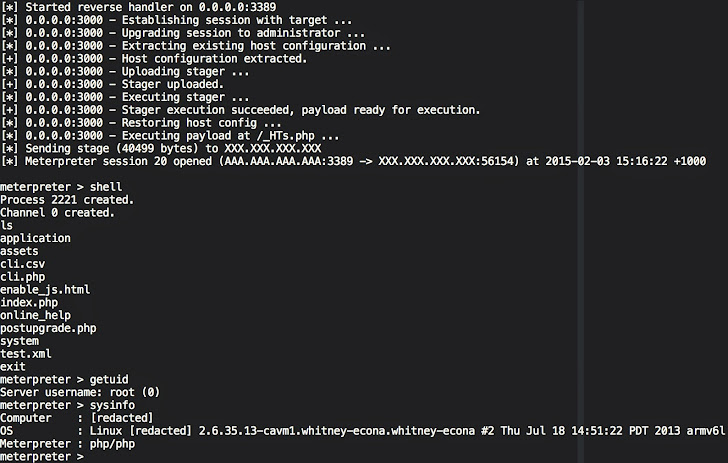
Seagate , a popular vendor of hardware solutions, has a critical zero-day vulnerability in its Network Attached Storage (NAS) device software that possibly left thousands of its users vulnerable to hackers. Seagate's Business Storage 2-Bay NAS product , found in home and business networks, is vulnerable to a zero-day Remote Code Execution vulnerability, currently affecting more than 2,500 publicly exposed devices on the Internet. Seagate is one of the world’s largest vendor of hardware solutions, with products available worldwide. After Western Digital, Seagate ranked second and holds 41% of the market worldwide in supplying storage hardware products. A security researcher, named OJ Reeves , discovered the zero-day remote code execution vulnerability on 7th October last year and, reported to the company totally in the white hat style. But even after 130 days of responsible disclosure, the zero-day bug remains unpatched till now. In order to exploit the vulnerability, an atta...
Experts Uncover Severe AWS Flaws Leading to RCE, Data Theft, and Full-Service Takeovers

Experts Uncover Severe AWS Flaws Leading to RCE, Data Theft, and Full-Service Takeovers

Aug 09, 2024 Cloud Security / Data Protection
Cybersecurity researchers have discovered multiple critical flaws in Amazon Web Services (AWS) offerings that, if successfully exploited, could result in serious consequences. "The impact of these vulnerabilities range between remote code execution (RCE), full-service user takeover (which might provide powerful administrative access), manipulation of AI modules, exposing sensitive data, data exfiltration, and denial-of-service," cloud security firm Aqua said in a detailed report shared with The Hacker News. Following responsible disclosure in February 2024, Amazon addressed the shortcomings over several months from March to June. The findings were presented at Black Hat USA 2024. Central to the issue, dubbed Bucket Monopoly, is an attack vector referred to as Shadow Resource, which, in this case, refers to the automatic creation of an AWS S3 bucket when using services like CloudFormation, Glue, EMR, SageMaker, ServiceCatalog, and CodeStar. The S3 bucket name created in...
Expert Insights Articles Videos
Cybersecurity Resources