#1 Trusted Cybersecurity News Platform
Followed by 5.20+ million
The Hacker News Logo
Subscribe – Get Latest News

Search results for malware scanner | Breaking Cybersecurity News | The Hacker News

Detecting Windows-based Malware Through Better Visibility

Detecting Windows-based Malware Through Better Visibility

Apr 01, 2024 Malware Detection / Endpoint Security
Despite a plethora of available security solutions, more and more organizations fall victim to Ransomware and other threats. These continued threats aren't just an inconvenience that hurt businesses and end users - they damage the economy, endanger lives, destroy businesses and put national security at risk. But if that wasn't enough – North Korea appears to be  using revenue from cyber attacks to funds its nuclear weapons program . Small and mid-size businesses are increasingly caught in the dragnet of ongoing malware attacks - often due to underfunded IT departments. Exacerbating the problem are complex enterprise security solutions that are often out of reach for many companies - especially when multiple products are seemingly needed to establish a solid defense. Volume-based products that incentivize users to collect less data in order to conserve funds work backward, dampening the anticipated benefits. But what if you could detect many malware attacks holistically with ...
Dynamic Analysis tools for Android Fail to Detect Malware with Heuristic Evasion Techniques

Dynamic Analysis tools for Android Fail to Detect Malware with Heuristic Evasion Techniques

May 14, 2014
We are quite aware of the Android malware scanner Google's Bouncer that tests the apps by running them in a virtualized environment i.e. a simulated phone created in software which automatically scans the apps to watch its real behaviour on users' devices, before approving them to the Play Store market. To protect its users and their devices from harm, Google launched this apps scanning software tool, two year ago. Bouncer is a security feature for the Android Play store Market that is designed to protect the Android users to not to be a victim of any malicious Android malware app. But does the security tool go far enough? Despite having protective shield factor, we have seen Google play store market is surrounded by many malicious apps which easily by-passes the Bouncer scan test and targets Android users. Security Research from Columbia University have exploited weaknesses in Google's Bouncer service to sneak malicious apps on to the Android market. They publish...
Over a Dozen Android Apps on Google Play Store Caught Dropping Banking Malware

Over a Dozen Android Apps on Google Play Store Caught Dropping Banking Malware

Jul 29, 2022
A malicious campaign leveraged seemingly innocuous Android dropper apps on the Google Play Store to compromise users' devices with  banking   malware . These 17 dropper apps, collectively dubbed  DawDropper  by Trend Micro, masqueraded as productivity and utility apps such as document scanners, QR code readers, VPN services, and call recorders, among others. All these apps in question have been removed from the app marketplace. "DawDropper uses Firebase Realtime Database, a third-party cloud service, to evade detection and dynamically obtain a payload download address," the researchers  said . "It also hosts malicious payloads on GitHub." Droppers are apps designed to sneak past Google's Play Store security checks, following which they are used to download more potent and intrusive malware on a device, in this case,  Octo  (Coper),  Hydra ,  Ermac , and  TeaBot . Attack chains involved the DawDropper malware establishing connectio...
cyber security

Compliance-Ready Tabletop Exercises to Elevate Incident Response

websiteFiligranIncident Response / Exposure Validation
Standardize tabletop drills at scale. improving real-world team response and decision-making.
cyber security

The Cyber Event of the Year Returns: SANS 2026

websiteSANS InstituteCybersecurity Training / Certification
50+ courses, NetWars, AI Keynote, and a full week of action. Join SANS in Orlando.
StoneDrill Disk Wiping Malware Found Targeting European Industries

StoneDrill Disk Wiping Malware Found Targeting European Industries

Mar 07, 2017
A new disk wiping malware has been uncovered targeting a petroleum company in Europe, which is quite similar to the mysterious disk wiper malware Shamoon that wiped data from 35,000 computers at Saudi Arabia's national oil company in 2012. Disk wiping malware has the ability to cripple any organization by permanently wiping out data from all hard drive and external storage on a targeted machine, causing great financial and reputational damage. Security researchers from Moscow-based antivirus provider Kaspersky Lab discovered the new wiper StoneDrill while researching last November's re-emergence of Shamoon malware (Shamoon 2.0) attacks – two attacks occurred in November and one in late January. Shamoon 2.0 is the more advanced version of Shamoon malware that reportedly hit 15 government agencies and organizations across the world, wipes data and takes control of the computer's boot record, preventing the computers from being turned back on. Meanwhile, Kaspersky resea...
Trojan & Botnet Activities Increased in February-March !

Trojan & Botnet Activities Increased in February-March !

Mar 05, 2011
Trojans were the most prolific malware threat in February-March, and collaboration seems to be the name of the game in malware development and distribution. Trojan-based attacks continue to be the biggest malware threat in February, but PDF exploits aren't far behind, according to several security reports. About 1 in 290 e-mails in February were malicious, making the month one of the most prolific periods for the threats, according to Symantec's February 2011 MessageLabs Intelligence Report. The global ratio of spam in e-mail traffic was 81.3 percent, an increase of 2.7 percent since January, the report found. The recent decline in spam appears to have reversed for the time being, according to the report. There was a lot of botnet activity in February, and the perpetrators appeared to be working together to some extent to distribute Trojans, according to Symantec. There were signs of integration across Zeus, Bredolab and SpyEye, as techniques associated with one malware family w...
New IoT Botnet Malware Discovered; Infecting More Devices Worldwide

New IoT Botnet Malware Discovered; Infecting More Devices Worldwide

Nov 01, 2016
The whole world is still dealing with the Mirai IoT Botnet that caused vast internet outage last Friday by launching massive distributed denial of service (DDoS) attacks against the DNS provider Dyn, and researchers have found another nasty IoT botnet. Security researchers at MalwareMustDie have discovered a new malware family designed to turn Linux-based insecure Internet of Things (IoT) devices into a botnet to carry out massive DDoS attacks. Dubbed Linux/IRCTelnet , the nasty malware is written in C++ and, just like Mirai malware , relies on default hard-coded passwords in an effort to infect vulnerable Linux-based IoT devices. The IRCTelnet malware works by brute-forcing a device's Telnet ports, infecting the device's operating system, and then adding it to a botnet network which is controlled through IRC (Internet Relay Chat) – an application layer protocol that enables communication in the form of text. So, every infected bot (IoT device) connects to a mali...
New BotenaGo Malware Variant Targeting Lilin Security Camera DVR Devices

New BotenaGo Malware Variant Targeting Lilin Security Camera DVR Devices

Apr 25, 2022
A new variant of an IoT botnet called BotenaGo has emerged in the wild, specifically singling out Lilin security camera DVR devices to infect them with Mirai malware. Dubbed " Lilin Scanner " by Nozomi Networks, the  latest version  is designed to exploit a two-year-old critical  command injection vulnerability  in the DVR firmware that was patched by the Taiwanese company in February 2020. BotenaGo , first documented in November 2021 by AT&T Alien Labs, is written in Golang and features over 30 exploits for known vulnerabilities in web servers, routers and other kinds of IoT devices. The botnet's source code has since been uploaded to GitHub, making it ripe for abuse by other criminal actors. "With only 2,891 lines of code, BotenaGo has the potential to be the starting point for many new variants and new malware families using its source code," the researchers  said  this year. The new BotenaGo malware is the  latest  to exploit vulnera...
WordPress Admins Urged to Remove miniOrange Plugins Due to Critical Flaw

WordPress Admins Urged to Remove miniOrange Plugins Due to Critical Flaw

Mar 18, 2024 Website Security / Vulnerability
WordPress users of miniOrange's Malware Scanner and Web Application Firewall plugins are being urged to delete them from their websites following the discovery of a critical security flaw. The flaw, tracked as  CVE-2024-2172 , is rated 9.8 out of a maximum of 10 on the CVSS scoring system and discovered by Stiofan . It impacts the following versions of the two plugins - Malware Scanner  (versions <= 4.7.2) Web Application Firewall  (versions <= 2.1.1) It's worth noting that the plugins have been permanently closed by the maintainers as of March 7, 2024. While Malware Scanner has over 10,000 active installs, Web Application Firewall has more than 300 active installations. "This vulnerability makes it possible for an unauthenticated attacker to grant themselves administrative privileges by updating the user password," Wordfence  reported  last week.  The issue is the result of a missing capability check in the function mo_wpns_init() that enab...
Undetectable Linux Malware Targeting Docker Servers With Exposed APIs

Undetectable Linux Malware Targeting Docker Servers With Exposed APIs

Jul 28, 2020
Cybersecurity researchers today uncovered a completely undetectable Linux malware that exploits undocumented techniques to stay under the radar and targets publicly accessible Docker servers hosted with popular cloud platforms, including AWS, Azure, and Alibaba Cloud. Docker is a popular platform-as-a-service (PaaS) solution for Linux and Windows designed to make it easier for developers to create, test, and run their applications in a loosely isolated environment called a container. According to the latest research Intezer shared with The Hacker News, an ongoing Ngrok mining botnet campaign scanning the Internet for misconfigured Docker API endpoints and has already infected many vulnerable servers with new malware. While the Ngrok mining botnet is active for the past two years, the new campaign is primarily focused on taking control over misconfigured Docker servers and exploiting them to set up malicious containers with cryptominers running on the victims' infrastructu...
Warning: New Undetectable DNS Hijacking Malware Targeting Apple macOS Users

Warning: New Undetectable DNS Hijacking Malware Targeting Apple macOS Users

Jan 12, 2018
A security researcher has revealed details of a new piece of undetectable malware targeting Apple's Mac computers—reportedly first macOS malware of 2018. Dubbed OSX/MaMi , an unsigned Mach-O 64-bit executable, the malware is somewhat similar to DNSChanger malware that infected millions of computers across the world in 2012. DNSChanger malware typically changes DNS server settings on infected computers, allowing attackers to route internet traffic through malicious servers and intercept sensitive information. First appeared on the Malwarebytes forum, a user posted a query regarding unknown malware that infected his friend's computer that silently changed DNS settings on infected macOS to 82.163.143.135 and 82.163.142.137 addresses. After looking at the post, ex-NSA hacker Patrick Wardle analysed the malware and found that it is indeed a ' DNS Hijacker, ' which also invokes security tools to install a new root certificate in an attempt to intercept encrypte...
VPNFilter Router Malware Adds 7 New Network Exploitation Modules

VPNFilter Router Malware Adds 7 New Network Exploitation Modules

Sep 27, 2018
Security researchers have discovered even more dangerous capabilities in VPNFilter —the highly sophisticated multi-stage malware that infected 500,000 routers worldwide in May this year, making it much more widespread and sophisticated than earlier. Attributed to Russia's APT 28, also known as 'Fancy Bear,' VPNFilter is a malware platform designed to infect routers and network-attached storage devices from 75 brands including Linksys, MikroTik, Netgear, TP-Link, QNAP, ASUS, D-Link, Huawei, ZTE, Ubiquiti, and UPVEL. In May, when VPNFilter infected half a million routers and NAS devices in 54 countries, the FBI seized a key command-and-control domain used by the malware and asked people to reboot their routers. Initially, it was found that VPNFilter had been built with multiple attack modules that could be deployed to the infected routers to steal website credentials and monitor industrial controls or SCADA systems, such as those used in electric grids, other infr...
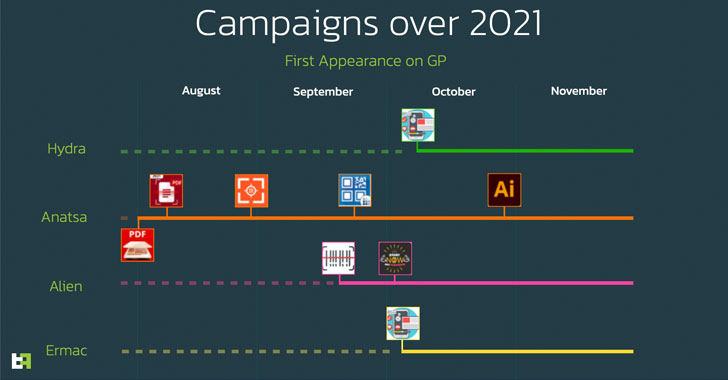
4 Android Banking Trojan Campaigns Targeted Over 300,000 Devices in 2021

4 Android Banking Trojan Campaigns Targeted Over 300,000 Devices in 2021

Nov 29, 2021
Four different Android banking trojans were spread via the official Google Play Store between August and November 2021, resulting in more than 300,000 infections through various dropper apps that posed as seemingly harmless utility apps to take full control of the infected devices. Designed to deliver Anatsa (aka TeaBot), Alien, ERMAC, and Hydra, cybersecurity firm ThreatFabric  said  the malware campaigns are not only more refined, but also engineered to have a small malicious footprint, effectively ensuring that the payloads are installed only on smartphones devices from specific regions and preventing the malware from being downloaded during the publishing process . Once installed, these banking trojans can surreptitiously siphon user passwords and SMS-based two-factor authentication codes, keystrokes, screenshots, and even deplete users' bank accounts without their knowledge by using a tool called Automatic Transfer System ( ATSs ). The apps have since been removed fro...
New AdLoad Variant Bypasses Apple's Security Defenses to Target macOS Systems

New AdLoad Variant Bypasses Apple's Security Defenses to Target macOS Systems

Aug 16, 2021
A new wave of attacks involving a notorious macOS adware family has evolved to leverage around 150 unique samples in the wild in 2021 alone, some of which have slipped past Apple's on-device malware scanner and even signed by its own notarization service, highlighting the malicious software ongoing attempts to adapt and evade detection. "AdLoad," as the malware is known, is one of several widespread adware and bundleware loaders targeting macOS since at least 2017. It's capable of backdooring an affected system to download and install adware or potentially unwanted programs (PUPs), as well as amass and transmit information about victim machines. The new iteration "continues to impact Mac users who rely solely on Apple's built-in security control XProtect for malware detection," SentinelOne threat researcher Phil Stokes  said  in an analysis published last week. "As of today, however, XProtect arguably has around 11 different signatures for AdLoa...
New Condi Malware Hijacking TP-Link Wi-Fi Routers for DDoS Botnet Attacks

New Condi Malware Hijacking TP-Link Wi-Fi Routers for DDoS Botnet Attacks

Jun 21, 2023 Network Security / Botnet
A new malware called  Condi  has been observed exploiting a security vulnerability in TP-Link Archer AX21 (AX1800) Wi-Fi routers to rope the devices into a distributed denial-of-service (DDoS) botnet. Fortinet FortiGuard Labs  said  the campaign has ramped up since the end of May 2023. Condi is the work of a threat actor who goes by the online alias zxcr9999 on Telegram and runs a Telegram channel called Condi Network to advertise their warez. "The Telegram channel was started in May 2022, and the threat actor has been monetizing its botnet by providing DDoS-as-a-service and selling the malware source code," security researchers Joie Salvio and Roy Tay said. An analysis of the malware artifact reveals its ability to terminate other competing botnets on the same host. It, however, lacks a persistence mechanism, meaning the program cannot survive a system reboot. To get around this limitation, the malware deletes multiple binaries that are used to shut down or re...
Expert Insights Articles Videos
Cybersecurity Resources