-->
#1 Trusted Cybersecurity News Platform
Followed by 5.20+ million
The Hacker News Logo
Subscribe – Get Latest News
Security Service Edge

Search results for GNU | Breaking Cybersecurity News | The Hacker News

OpenSSH 3.5p1 Remote Root Exploit for FreeBSD

OpenSSH 3.5p1 Remote Root Exploit for FreeBSD

Jun 30, 2011
OpenSSH 3.5p1 Remote Root Exploit for FreeBSD OpenSSH 3.5p1 Remote Root Exploit for FreeBSD has been shared by kcope on twitter . The Released note is as given below : OpenSSH 3.5p1 Remote Root Exploit for FreeBSD Discovered and Exploited By Kingcope Year 2011 -- The last two days I have been investigating a vulnerability in OpenSSH affecting at least FreeBSD 4.9 and 4.11. These FreeBSD versions run OpenSSH 3.5p1 in the default install. The sshd banner for 4.11-RELEASE is "SSH-1.99-OpenSSH_3.5p1 FreeBSD-20060930". A working Remote Exploit which spawns a root shell remotely and previous to authentication was developed. The bug can be triggered both through ssh version 1 and ssh version 2 using a modified ssh client. During the investigation of the vulnerability it was found that the bug resides in the source code file "auth2-pam-freebsd.c". http://www.freebsd.org/cgi/cvsweb.cgi/src/crypto/openssh/Attic/auth2-pam-freebsd.c This file does not exist in Fre...
GCC 4.6.3 Released with 70 bug-fixes

GCC 4.6.3 Released with 70 bug-fixes

Mar 05, 2012
GCC 4.6.3 Released with 70 bug-fixes The GNU Compiler Collection version 4.6.3 has been released. Jakub Jelinek of Red Hat announced the release this morning of GCC 4.6.3. Over GCC 4.6.2 there's over 70 bug-fixes and other work. However, all of the exciting work meanwhile is going into what will become GCC 4.7. The GNU Compiler Collection (GCC) is a compiler system produced by the GNU Project supporting various programming languages. GCC is a key component of the GNU toolchain. As well as being the official compiler of the unfinished GNU operating system, GCC has been adopted as the standard compiler by most other modern Unix-like computer operating systems, including Linux, the BSD family and Mac OS X. GCC 4.7 will offer some performance improvements, new CPU support, language enhancements, mature Intel Sandy/Ivy Bridge support, and initial Intel Haswell support. GCC 4.7 should be officially released in March or April. Read More here
Critical GNU InetUtils telnetd Flaw Lets Attackers Bypass Login and Gain Root Access

Critical GNU InetUtils telnetd Flaw Lets Attackers Bypass Login and Gain Root Access

Jan 22, 2026 Vulnerability / Linux
A critical security flaw has been disclosed in the GNU InetUtils telnet daemon ( telnetd ) that went unnoticed for nearly 11 years. The vulnerability, tracked as CVE-2026-24061 , is rated 9.8 out of 10.0 on the CVSS scoring system. It affects all versions of GNU InetUtils from version 1.9.3 up to and including version 2.7. "Telnetd in GNU Inetutils through 2.7 allows remote authentication bypass via a '-f root' value for the USER environment variable," according to a description of the flaw in the NIST National Vulnerability Database (NVD). In a post on the oss-security mailing list, GNU contributor Simon Josefsson said the vulnerability can be exploited to gain root access to a target system - The telnetd server invokes /usr/bin/login (normally running as root) passing the value of the USER environment variable received from the client as the last parameter. If the client supply [sic] a carefully crafted USER environment value being the string "-f root...
cyber security

AI Security Board Report Template

websiteWizAI Security / Compliance
This template helps security and technology leaders clearly communicate AI risk, impact, and priorities in language boards understand.
cyber security

AI Security Isn’t Optional—Join the Conversation at SANS Security West

websiteSANSCybersecurity Training
SANS Fellow, Eric Johnson addresses emerging risks and tactical responses.
Malware Exploits SHELLSHOCK Vulnerability to Hack NAS Devices

Malware Exploits SHELLSHOCK Vulnerability to Hack NAS Devices

Dec 16, 2014
The year is about to end, but serious threats like  Shellshock is " far from over ". Cyber criminals are actively exploiting this critical GNU Bash vulnerability to target those network attached storage devices that are still not patched and ready for exploitation. Security researchers have unearthed a malicious worm that is designed to plant backdoors on network-attached storage (NAS) systems made by Taiwan-based QNAP and gain full access to the contents of those devices. The worm is spread among QNAP devices, which run an embedded Linux operating system, by the exploitation of the GNU Bash vulnerability known as ShellShock or Bash, according to security researchers at the Sans Institute. QNAP vendor released a patch in early October to address the flaw in its Turbo NAS product, but because the patches are not automatic or easy to apply for many users, so a statistically significant portion of systems remain vulnerable and exposed to the Bash bug . Sh...
⚡ Weekly Recap: Firewall Flaws, AI-Built Malware, Browser Traps, Critical CVEs & More

⚡ Weekly Recap: Firewall Flaws, AI-Built Malware, Browser Traps, Critical CVEs & More

Jan 26, 2026 Hacking News / Cybersecurity
Security failures rarely arrive loudly. They slip in through trusted tools, half-fixed problems, and habits people stop questioning. This week’s recap shows that pattern clearly. Attackers are moving faster than defenses, mixing old tricks with new paths. “Patched” no longer means safe, and every day, software keeps becoming the entry point. What follows is a set of small but telling signals. Short updates that, together, show how quickly risk is shifting and why details can’t be ignored. ⚡ Threat of the Week Improperly Patched Flaw Exploited Again in Fortinet Firewalls — Fortinet confirmed that it's working to completely plug a FortiCloud SSO authentication bypass vulnerability following reports of fresh exploitation activity on fully-patched firewalls. "We have identified a number of cases where the exploit was to a device that had been fully upgraded to the latest release at the time of the attack, which suggested a new attack path," the company said. The activi...
GnuPG Email Encryption Project Relies on 'Werner Koch', and He is Running Out of Funds

GnuPG Email Encryption Project Relies on 'Werner Koch', and He is Running Out of Funds

Feb 06, 2015
Werner Koch , the man who authored the free email encryption software , is running out of funding to continue the development of his crucial open-source GNU Privacy Guard (GnuPG) encryption tools.The code works on plenty of operating systems from Linux and FreeBSD to Windows and OS X. The popular Gnu Privacy Guard (GnuPG or GPG) email encryption software is the same used by the former United States National Security Agency (NSA) contractor and whistleblower Edward Snowden to keep his communication secure from law enforcement authorities. GPG uses the OpenPGP standard to safeguard the communications of millions of people, including journalists, dissidents and security-minded people, around the world from eavesdroppers and other miscreants. GPG EMAIL ENCRYPTION RELIES ON THIS GUY ONLY Werner Koch has been maintaining and improving the code of his own secure email software since its initial development in 1997, and since then he has worked at very low wages, but is now...
Critical glibc Flaw Puts Linux Machines and Apps at Risk (Patch Immediately)

Critical glibc Flaw Puts Linux Machines and Apps at Risk (Patch Immediately)

Feb 17, 2016
A highly critical vulnerability has been uncovered in the GNU C Library (glibc) , a key component of most Linux distributions, that leaves nearly all Linux machines, thousands of apps and electronic devices vulnerable to hackers that can take full control over them. Just clicking on a link or connecting to a server can result in remote code execution (RCE), allowing hackers to steal credentials, spy on users, seize control of computers, and many more. The vulnerability is similar to the last year's  GHOST vulnerability (CVE-2015-0235) that left countless machines vulnerable to remote code execution (RCE) attacks , representing a major Internet threat. GNU C Library (glibc) is a collection of open source code that powers thousands of standalone apps and most Linux distributions, including those distributed to routers and other types of hardware. The recent flaw, which is indexed as CVE-2015-7547 , is a stack-based buffer overflow vulnerability in glibc's D...
Critical GHOST vulnerability affects most Linux Systems

Critical GHOST vulnerability affects most Linux Systems

Jan 28, 2015
A highly critical vulnerability has been unearthed in the GNU C Library (glibc) , a widely used component of most Linux distributions, that could allow attackers to execute malicious code on servers and remotely gain control of Linux machines. The vulnerability, dubbed " GHOST " and assigned CVE-2015-0235 , was discovered and disclosed by the security researchers from Redwood Shores, California-based security firm Qualys on Tuesday. CRITICAL AS HEARTBLEED AND SHELLSHOCK GHOST is considered to be critical because hackers could exploit it to silently gain complete control of a targeted Linux system without having any prior knowledge of system credentials (i.e. administrative passwords). Also Read:  Top Best Password Managers . The flaw represents an immense Internet threat, in some ways similar to the Heartbleed ,   Shellshock   and Poodle   bugs that came to light last year. WHY GHOST ? The vulnerability in the GNU C Library (glibc) is dubbe...
Remotely Exploitable 'Bash Shell' Vulnerability Affects Linux, Unix and Apple Mac OS X

Remotely Exploitable 'Bash Shell' Vulnerability Affects Linux, Unix and Apple Mac OS X

Sep 25, 2014
A Critical remotely exploitable vulnerability has been discovered in the widely used Linux and Unix command-line shell, known as Bash , aka the GNU Bourne Again Shell , leaving countless websites, servers, PCs, OS X Macs, various home routers, and many more open to the cyber criminals. Earlier today, Stephane Chazelas publicly disclosed the technical details of the remote code execution vulnerability in Bash which affects most of the Linux distributions and servers worldwide. REMOTELY EXPLOITABLE SHELLSHOCK The vulnerability (CVE-2014-6271) affects versions 1.14 through 4.3 of GNU Bash and being named as Bash Bug , and Shellshock by the Security researchers on the Internet discussions. According to the technical details, a hacker could exploit this bash bug to execute shell commands remotely on a target machine using specifically crafted variables. “ In many common configurations, this vulnerability is exploitable over the network, ” Stephane said. This 22-ye...
Cross-VM Side-channel attacks against cryptography keys

Cross-VM Side-channel attacks against cryptography keys

Nov 05, 2012
A group of researchers has developed a side-channel attack targeting virtual machines that could pose a threat to cloud computing environments. Side-channel attacks against cryptography keys have, until now, been limited to physical machines, this attack is the first such attack demonstrated on a symmetric multiprocessing system virtualized using a modern VMM (Xen). A side channel is a form of information leakage that arises as a byproduct of resource exposure, such as the sharing of memory caches. A side-channel attack exploits such leakage to steal secrets, such as cryptographic keys. " In this attack, the researchers were able to extract a private ElGamal decryption key from the target VM’s libgcrypt library; the target was running Gnu Privacy Guard. Over the course of a few hours of observations, they were able to reconstruct a 457-bit exponent accompanying a 4096-bit modulus with high accuracy. So high that the attacker was then left to search fewer than 10,000 possible...
Looney Tunables: New Linux Flaw Enables Privilege Escalation on Major Distributions

Looney Tunables: New Linux Flaw Enables Privilege Escalation on Major Distributions

Oct 04, 2023 Endpoint Security / Vulnerability
A new Linux security vulnerability dubbed Looney Tunables has been discovered in the GNU C library's ld.so dynamic loader that, if successfully exploited, could lead to a local privilege escalation and allow a threat actor to gain root privileges. Tracked as  CVE-2023-4911  (CVSS score: 7.8), the issue is a buffer overflow that resides in the dynamic loader's processing of the  GLIBC_TUNABLES environment variable . Cybersecurity firm Qualys, which  disclosed  details of the bug, said it was introduced as part of a code commit made in April 2021. The GNU C library, also called  glibc , is a core library in Linux-based systems that offers foundational features such as open, read, write, malloc, printf, getaddrinfo, dlopen, pthread_create, crypt, login, and exit. glibc's  dynamic loader  is a crucial component that's responsible for preparing and running programs, including finding the necessarily shared object dependencies required as well as l...
Glances v1.3.7 released - System monitoring tool for Linux

Glances v1.3.7 released - System monitoring tool for Linux

Feb 02, 2012
Glances v1.3.7 released - System monitoring tool for Linux Glances is a system monitoring tool for GNU/Linux distributions. It grabs information from your system and display its in a CLI curses screen.Glances can monitor CPU, average load, memory, network interface, disk IO, file system space and processes. When a alert is detected, stat is automatically colored and the processes list sorted by CPU or memory.The latest version (1.3.7) displays a log history in the bottom of the screen with the latests alerts. Glances use a standard GNU style installer: $ tar zxvf glances-1.3.7.tar.gz $ cd glances-1.3.7 $ ./configure $ make $ sudo make install Get More info from  Documentation  and  Official site . Download Glances v1.3.7 from Here .
New Facebook feature Encourages users to use PGP for Encrypted Communications

New Facebook feature Encourages users to use PGP for Encrypted Communications

Jun 01, 2015
In this era of Global surveillance, we all are worried about the privacy of our communication and sensitive data. There is no guarantee that our data is not being snooped on, but there is a solution — PGP (Pretty Good Privacy). PGP (Pretty Good Privacy) is more than 20 years old technology but is yet not widely adopted. PGP is an open source end-to-end encryption standard to encrypt e-mails, protecting you against companies, governments, or criminals spying on your Internet connection. But... ...the tool is too complicated for most of the people to implement and use. However, Facebook is now encouraging its users to use PGP and communicate by sending encrypted emails, adding the popular OpenPGP email encryption standard as an extra layer of security for the cautious. According to the latest announcement , you can now upload your Public PGP key to your Facebook profile so that anyone with your public key can send you encrypted emails. By giving such option to...
PenTBox 1.4 – Penetration Testing Security Suite Download

PenTBox 1.4 – Penetration Testing Security Suite Download

Apr 10, 2011
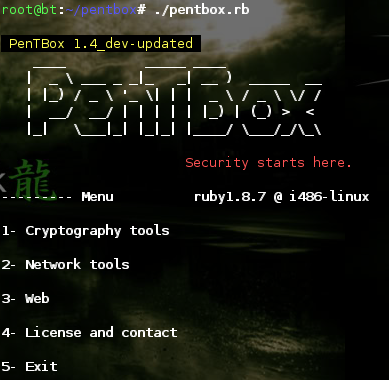
PenTBox 1.4 – Penetration Testing Security Suite Download PenTBox, a security framework written in Ruby and multiplatform (actually working even on iOS and Android!). Tools & Features (Updated) Technical features - GNU/GPLv3 License. Free in freedom and in price. - Multi-platform (Ruby: GNU/Linux, Windows, Mac OS, *BSD, iOS, Android, …). - Compatible with Ruby and JRuby. - Multithreading (native threads in Ruby >= 1.9 and JRuby). - Doesn’t require additional libraries (non standard are included). - Modular (easy to expand and customize). Tools (SVN Version) - Cryptography tools Base64 Encoder & Decoder Multi-Digest (MD5, SHA1, SHA256, SHA384, SHA512, RIPEMD-160) Hash Password Cracker (MD5, SHA1, SHA256, SHA384, SHA512, RIPEMD-160) Secure Password Generator - Network tools Net DoS Tester TCP port scanner Honeypot Fuzzer DNS and host gathering - Web HTTP directory bruteforce HTTP common files bruteforce A moderate number of people are using it...
Ubuntu Linux is a spyware ?

Ubuntu Linux is a spyware ?

Dec 08, 2012
Creator of the GNU Project & Free Software Foundation's Leader Richard Stallman has called out Ubuntu as being "spyware". Why ?  Because the operating system sends data to Ubuntu maker Canonical when a user searches the desktop. How ? Due to the Amazon search capabilities that have been integrated into Ubuntu's  Unity desktop environment with the Dash. First introduced in Ubuntu 12.10. Surveillance Program ?  Stallman equates the Amazon search integration into the Ubuntu desktop as having installed surveillance code. He said, " Ubuntu, a widely used and influential GNU/Linux distribution, has installed surveillance code. When the user searches her own local files for a string using the Ubuntu desktop, Ubuntu sends that string to one of Canonical’s servers. (Canonical is the company that develops Ubuntu.) " Stallman’s post , " The ads are not the core of the problem ," " The main issue is the spying. Canonical says it doe...
Apple — Most Mac OS X Users Not Vulnerable to 'Shellshock' Bash Bug

Apple — Most Mac OS X Users Not Vulnerable to 'Shellshock' Bash Bug

Sep 27, 2014
On one hand where more than half of the Internet is considering the Bash vulnerability to be severe, Apple says the vast majority of Mac computer users are not at risk from the recently discovered vulnerability in the Bash command-line interpreter – aka the " Shellshock " bug that could allow hackers to take over an operating system completely. Apple has issued a public statement in response to this issue, assuring its OS X users that most of them are safe from any potential attacks through the ShellShock Vulnerability , which security experts have warned affect operating systems, including Mac's OS X. " The vast majority of OS X users are not at risk to recently reported bash vulnerabilities ," Apple said. " Bash, a UNIX command shell and language included in OS X, has a weakness that could allow unauthorized users to remotely gain control of vulnerable systems. With OS X, systems are safe by default and not exposed to remote exploits of bash unl...
Hackers Using 'Shellshock' Bash Vulnerability to Launch Botnet Attacks

Hackers Using 'Shellshock' Bash Vulnerability to Launch Botnet Attacks

Sep 27, 2014
Researchers on Thursday discovered a critical remotely exploitable vulnerability in the widely used command-line shell GNU Bourne Again Shell ( Bash ), dubbed " Shellshock " which affects most of the Linux distributions and servers worldwide, and may already have been exploited in the wild to take over Web servers as part of a botnet that is currently trying to infect other servers as well. BOTNET ATTACK IN THE WILD The bot was discovered by the security researcher with the Twitter handle @yinettesys , who reported it on Github and said it appeared to be remotely controlled by miscreants, which indicates that the vulnerability is already being used maliciously by the hackers. The vulnerability (CVE-2014-6271) , which came to light on Wednesday, affects versions 1.14 through 4.3 of GNU Bash and could become a dangerous threat to Linux/Unix and Apple users if the patches to BASH are not applied to the operating systems. However, the patches for the vulnerabil...
Durandal - Distributed CPU/GPU Hash Cracker v 0.5 released

Durandal - Distributed CPU/GPU Hash Cracker v 0.5 released

Jul 07, 2011
Durandal - Distributed CPU/GPU Hash Cracker v 0.5 released Durandal is a distributed GPU/CPU computing software that aims to crack passwords. Mostly written in C++ with the Boost library, it works on many systems, however it is only built for Windows and GNU/Linux for the moment, on the x86 and x64 platforms. Durandal is freely available under the GPLv3 license. Features Windows (XP, Vista, 7) and GNU/Linux support 32bits and 64bits support Usual hash functions : MD5, SHA1, SHA256, SHA512, NTLMv1, MySQL (all versions) SSE2 optimized, Nvidia CUDA support Server, agent and administration console Network communications with XML over HTTP (proxy support) Download Here
Two New Linux Vulnerabilities Discovered, Allowing Root Privileges for Attackers

Two New Linux Vulnerabilities Discovered, Allowing Root Privileges for Attackers

Oct 30, 2010 Cybersecurity / System Administration
Two new vulnerabilities affecting Linux were uncovered this week. These vulnerabilities could potentially allow malicious hackers to gain root privileges. CVE-2010-3904: Reliable Datagram Sockets (RDS) Protocol Vulnerability The first vulnerability, reported on Tuesday by security firm VSR, arises from a flaw in the implementation of the Reliable Datagram Sockets (RDS) protocol in versions 2.6.30 through 2.6.36-rc8 of the Linux kernel. Known as CVE-2010-3904 , this bug could allow a local attacker to issue specially crafted socket function calls. This would enable the attacker to write arbitrary values into kernel memory, thereby escalating their privileges to root and gaining "superuser" status. The problem exists only in Linux installations where the CONFIG_RDS kernel configuration option is set and there are no restrictions preventing unprivileged users from loading packet family modules. This is the case for most stock distributions, as VSR notes. A proof-of-concept e...
John the Ripper 1.7.7 new version Released !

John the Ripper 1.7.7 new version Released !

Apr 28, 2011
John the Ripper 1.7.7 new version Released ! “John the Ripper is a fast password cracker, currently available for many flavors of Unix, Windows, DOS, BeOS, and OpenVMS. Its primary purpose is to detect weak Unix passwords. It supports several crypt(3) password hash types commonly found on Unix systems, as well as Windows LM hashes.” This is the change log for JtR version 1.7.7: Added Intel AVX and AMD XOP instruction sets support for bitslice DES (with C compiler intrinsics). New make targets: linux-x86-64-avx, linux-x86-64-xop, linux-x86-avx, and linux-x86-xop (these require recent versions of GCC and GNU binutils). A “dummy” “format” is now supported (plaintext passwords encoded in hexadecimal and prefixed with “$dummy$”) – for faster testing and tuning of custom wordlists, rule sets, .chr files, and external modes on already known or artificial passwords, as well as for testing of future and modified versions of John itself. Apache “$apr1$” MD5-based password hashes are now ...
Expert Insights Articles Videos
Cybersecurity Resources