#1 Trusted Cybersecurity News Platform
Followed by 5.20+ million
The Hacker News Logo
Subscribe – Get Latest News

Search results for vscode] | Breaking Cybersecurity News | The Hacker News

GlassWorm Returns with 24 Malicious Extensions Impersonating Popular Developer Tools

GlassWorm Returns with 24 Malicious Extensions Impersonating Popular Developer Tools

Dec 02, 2025 Malware / Blockchain
The supply chain campaign known as GlassWorm has once again reared its head, infiltrating both Microsoft Visual Studio Marketplace and Open VSX with 24 extensions impersonating popular developer tools and frameworks like Flutter, React, Tailwind, Vim, and Vue. GlassWorm was first documented in October 2025, detailing its use of the Solana blockchain for command-and-control (C2) and harvest npm, Open VSX, GitHub, and Git credentials, drain cryptocurrency assets from dozens of wallets, and turn developer machines into attacker-controlled nodes for other criminal activities. The most crucial aspect of the campaign is the abuse of the stolen credentials to compromise additional packages and extensions, thereby spreading the malware like a worm. Despite continued efforts of Microsoft and Open VSX, the malware resurfaced a second time last month, and the attackers were observed targeting GitHub repositories. The latest wave of the GlassWorm campaign, spotted by Secure Annex's Jo...
Malicious npm Package Targets Atomic Wallet, Exodus Users by Swapping Crypto Addresses

Malicious npm Package Targets Atomic Wallet, Exodus Users by Swapping Crypto Addresses

Apr 10, 2025 Malware / Cryptocurrency
Threat actors are continuing to upload malicious packages to the npm registry so as to tamper with already-installed local versions of legitimate libraries and execute malicious code in what's seen as a sneakier attempt to stage a software supply chain attack. The newly discovered package, named pdf-to-office , masquerades as a utility for converting PDF files to Microsoft Word documents. But, in reality, it harbors features to inject malicious code into cryptocurrency wallet software associated with Atomic Wallet and Exodus. "Effectively, a victim who tried to send crypto funds to another crypto wallet would have the intended wallet destination address swapped out for one belonging to the malicious actor," ReversingLabs researcher Lucija Valentić said in a report shared with The Hacker News. The npm package in question was first published on March 24, 2025, and has received three updates since then but not before the previous versions were likely removed by the a...
VS Code Forks Recommend Missing Extensions, Creating Supply Chain Risk in Open VSX

VS Code Forks Recommend Missing Extensions, Creating Supply Chain Risk in Open VSX

Jan 06, 2026 Threat Intelligence / Cloud Security
Popular artificial intelligence (AI)-powered Microsoft Visual Studio Code (VS Code) forks such as Cursor, Windsurf, Google Antigravity, and Trae have been found to recommend extensions that are non-existent in the Open VSX registry, potentially opening the door to supply chain risks when bad actors publish malicious packages under those names. The problem, according to Koi , is that these integrated development environments (IDEs) inherit the list of officially recommended extensions from Microsoft's extensions marketplace. These extensions don't exist in Open VSX. The VS Code extension recommendations can take two different forms: file-based, which are displayed as toast notifications when users open a file in specific formats, or software-based, which are suggested when certain programs are already installed on the host. "The problem: these recommended extensions didn't exist on Open VSX," Koi security researcher Oren Yomtov said. "The namespaces were u...
cyber security

2025 Cloud Security Risk Report

websiteSentinelOneCloud Security / Artificial Intelligence
Learn 5 key risks to cloud security such as cloud credential theft, lateral movements, AI services, and more.
cyber security

Most AI Risk Isn't in Models, It's in Your SaaS Stack

websiteRecoAI Security / (SaaS Security
Your models aren't the problem. The sprawl of your SaaS apps, AI and agents are. Here's where to start.
VSCode Marketplace Removes Two Extensions Deploying Early-Stage Ransomware

VSCode Marketplace Removes Two Extensions Deploying Early-Stage Ransomware

Mar 24, 2025 Malware / Encryption
Cybersecurity researchers have uncovered two malicious extensions in the Visual Studio Code (VSCode) Marketplace that are designed to deploy ransomware that's under development to its users. The extensions, named "ahban.shiba" and "ahban.cychelloworld," have since been taken down by the marketplace maintainers. Both the extensions, per ReversingLabs , incorporate code that's designed to invoke a PowerShell command, which then grabs a PowerShell-script payload from a command-and-control (C2) server and executes it. The payload is suspected to be ransomware in early-stage development, only encrypting files in a folder called "testShiba" on the victim's Windows desktop. Once the files are encrypted, the PowerShell payload displays a message, stating "Your files have been encrypted. Pay 1 ShibaCoin to ShibaWallet to recover them." However, no other instructions or cryptocurrency wallet addresses are provided to the victims, anothe...
Thousands Download Malicious npm Libraries Impersonating Legitimate Tools

Thousands Download Malicious npm Libraries Impersonating Legitimate Tools

Dec 19, 2024 Supply Chain / Software Security
Threat actors have been observed uploading malicious typosquats of legitimate npm packages such as typescript-eslint and @types/node that have racked up thousands of downloads on the package registry. The counterfeit versions, named @typescript_eslinter/eslint and types-node , are engineered to download a trojan and retrieve second-stage payloads, respectively. "While typosquatting attacks are hardly new, the effort spent by nefarious actors on these two libraries to pass them off as legitimate is noteworthy," Sonatype's Ax Sharma said in an analysis published Wednesday. "Furthermore, the high download counts for packages like "types-node" are signs that point to both some developers possibly falling for these typosquats, and threat actors artificially inflating these counts to boost the trustworthiness of their malicious components." The npm listing for @typescript_eslinter/eslint, Sonatype's analysis revealed, points to a phony GitHub repo...
Russian Hackers Exploit Microsoft OAuth to Target Ukraine Allies via Signal and WhatsApp

Russian Hackers Exploit Microsoft OAuth to Target Ukraine Allies via Signal and WhatsApp

Apr 23, 2025 Device Security / Threat Intelligence
Multiple suspected Russia-linked threat actors are "aggressively" targeting individuals and organizations with ties to Ukraine and human rights with an aim to gain unauthorized access to Microsoft 365 accounts since early March 2025. The highly targeted social engineering operations, per Volexity, are a shift from previously documented attacks that leveraged a technique known as device code phishing to achieve the same goals, indicating that indicating that the Russian adversaries behind these campaigns are actively refining their tradecraft to fly under the radar. "These recently observed attacks rely heavily on one-on-one interaction with a target, as the threat actor must both convince them to click a link and send back a Microsoft-generated code," security researchers Charlie Gardner, Josh Duke, Matthew Meltzer, Sean Koessel, Steven Adair, and Tom Lancaster said in an exhaustive analysis. At least two different threat clusters tracked as UTA0352 and UTA03...
Self-Spreading 'GlassWorm' Infects VS Code Extensions in Widespread Supply Chain Attack

Self-Spreading 'GlassWorm' Infects VS Code Extensions in Widespread Supply Chain Attack

Oct 24, 2025 DevOps / Malware
Cybersecurity researchers have discovered a self-propagating worm that spreads via Visual Studio Code (VS Code) extensions on the Open VSX Registry and the Microsoft Extension Marketplace, underscoring how developers have become a prime target for attacks. The sophisticated threat, codenamed GlassWorm by Koi Security, is the second such supply chain attack to hit the DevOps space within a span of a month after the Shai-Hulud worm that targeted the npm ecosystem in mid-September 2025. What makes the attack stand out is the use of the Solana blockchain for command-and-control (C2), making the infrastructure resilient to takedown efforts. It also uses Google Calendar as a C2 fallback mechanism. Another novel aspect is that the GlassWorm campaign relies on "invisible Unicode characters that make malicious code literally disappear from code editors," Idan Dardikman said in a technical report. "The attacker used Unicode variation selectors – special characters that are...
North Korea-linked Actors Exploit React2Shell to Deploy New EtherRAT Malware

North Korea-linked Actors Exploit React2Shell to Deploy New EtherRAT Malware

Dec 09, 2025 Vulnerability / Malware
Threat actors with ties to North Korea have likely become the latest to exploit the recently disclosed critical React2Shell security flaw in React Server Components (RSC) to deliver a previously undocumented remote access trojan dubbed EtherRAT . "EtherRAT leverages Ethereum smart contracts for command-and-control (C2) resolution, deploys five independent Linux persistence mechanisms, and downloads its own Node.js runtime from nodejs.org," Sysdig said in a report published Monday. The cloud security firm said the activity exhibits significant overlap with a long-running campaign codenamed Contagious Interview , which has been observed leveraging the EtherHiding technique to distribute malware since February 2025. Contagious Interview is the name given to a series of attacks in which blockchain and Web3 developers, among others, are targeted through fake job interviews, coding assignments, and video assessments, leading to the deployment of malware. These efforts typi...
⚡ THN Weekly Recap: Alerts on Zero-Day Exploits, AI Breaches, and Crypto Heists

⚡ THN Weekly Recap: Alerts on Zero-Day Exploits, AI Breaches, and Crypto Heists

Mar 03, 2025
This week, a 23-year-old Serbian activist found themselves at the crossroads of digital danger when a sneaky zero-day exploit turned their Android device into a target. Meanwhile, Microsoft pulled back the curtain on a scheme where cybercriminals used AI tools for harmful pranks, and a massive trove of live secrets was discovered, reminding us that even the tools we rely on can hide risky surprises. We've sifted through a storm of cyber threats—from phishing scams to malware attacks—and broken down what it means for you in clear, everyday language. Get ready to dive into the details, understand the risks, and learn how to protect yourself in an increasingly unpredictable online world. ⚡ Threat of the Week Serbian Youth Activist Targeted by Android 0-Day Exploit Chain — A 23-year-old Serbian youth activist had their Android phone targeted by a zero-day exploit chain developed by Cellebrite to unlock the device and likely deploy an Android spyware called NoviSpy. The flaws combined ...
Hackers Weaponize Visual Studio Code Remote Tunnels for Cyber Espionage

Hackers Weaponize Visual Studio Code Remote Tunnels for Cyber Espionage

Dec 10, 2024 Cyber Espionage / Hacking News
A suspected China-nexus cyber espionage group has been attributed to an attacks targeting large business-to-business IT service providers in Southern Europe as part of a campaign codenamed Operation Digital Eye . The intrusions took place from late June to mid-July 2024, cybersecurity companies SentinelOne SentinelLabs and Tinexta Cyber said in a joint report shared with The Hacker News, adding the activities were detected and neutralized before they could progress to the data exfiltration phase. "The intrusions could have enabled the adversaries to establish strategic footholds and compromise downstream entities," security researchers Aleksandar Milenkoski and Luigi Martire said . "The threat actors abused Visual Studio Code and Microsoft Azure infrastructure for C2 [command-and-control] purposes, attempting to evade detection by making malicious activities appear legitimate." It's currently not known which China-linked hacking group is behind the attacks,...
⚡ Weekly Recap: Chrome 0-Day, Ivanti Exploits, MacOS Stealers, Crypto Heists and More

⚡ Weekly Recap: Chrome 0-Day, Ivanti Exploits, MacOS Stealers, Crypto Heists and More

Jul 07, 2025 Cybersecurity / Hacking
Everything feels secure—until one small thing slips through. Even strong systems can break if a simple check is missed or a trusted tool is misused. Most threats don't start with alarms—they sneak in through the little things we overlook. A tiny bug, a reused password, a quiet connection—that's all it takes. Staying safe isn't just about reacting fast. It's about catching these early signs before they blow up into real problems. That's why this week's updates matter. From stealthy tactics to unexpected entry points, the stories ahead reveal how quickly risk can spread—and what smart teams are doing to stay ahead. Dive in. ⚡ Threat of the Week U.S. Disrupts N. Korea IT Worker Scheme — Prosecutors said they uncovered the North Korean IT staff working at over 100 U.S. companies using fictitious or stolen identities and not only drawing salaries, but also stealing secret data and plundering virtual currency more than $900,000 in one incident targeting an unnamed blockchain company in ...
Researcher Uncovers 30+ Flaws in AI Coding Tools Enabling Data Theft and RCE Attacks

Researcher Uncovers 30+ Flaws in AI Coding Tools Enabling Data Theft and RCE Attacks

Dec 06, 2025 AI Security / Vulnerability
Over 30 security vulnerabilities have been disclosed in various artificial intelligence (AI)-powered Integrated Development Environments (IDEs) that combine prompt injection primitives with legitimate features to achieve data exfiltration and remote code execution. The security shortcomings have been collectively named IDEsaster by security researcher Ari Marzouk (MaccariTA), who discovered them over the last six months. They affect popular IDEs and extensions such as Cursor, Windsurf, Kiro.dev, GitHub Copilot, Zed.dev, Roo Code, Junie, and Cline, among others. Of these, 24 have been assigned CVE identifiers. "I think the fact that multiple universal attack chains affected each and every AI IDE tested is the most surprising finding of this research," Marzouk told The Hacker News. "All AI IDEs (and coding assistants that integrate with them) effectively ignore the base software (IDE) in their threat model. They treat their features as inherently safe because they've...
⚡ Weekly Recap: Fortinet Exploit, Chrome 0-Day, BadIIS Malware, Record DDoS, SaaS Breach & More

⚡ Weekly Recap: Fortinet Exploit, Chrome 0-Day, BadIIS Malware, Record DDoS, SaaS Breach & More

Nov 24, 2025 Cybersecurity / Hacking News
This week saw a lot of new cyber trouble. Hackers hit Fortinet and Chrome with new 0-day bugs. They also broke into supply chains and SaaS tools. Many hid inside trusted apps, browser alerts, and software updates. Big firms like Microsoft, Salesforce, and Google had to react fast — stopping DDoS attacks, blocking bad links, and fixing live flaws. Reports also showed how fast fake news, AI risks, and attacks on developers are growing. Here's what mattered most in security this week. ⚡ Threat of the Week Fortinet Warns of Another Silently Patched and Actively Exploited FortiWeb Flaw — Fortinet has warned that a new security flaw in FortiWeb has been exploited in the wild. The medium-severity vulnerability, tracked as CVE-2025-58034, carries a CVSS score of 6.7 out of a maximum of 10.0. It has been addressed in version 8.0.2. "An Improper Neutralization of Special Elements used in an OS Command ('OS Command Injection') vulnerability [CWE-78] in FortiWeb may allow an a...
Developer Alert: NPM Packages for Node.js Hiding Dangerous TurkoRat Malware

Developer Alert: NPM Packages for Node.js Hiding Dangerous TurkoRat Malware

May 19, 2023 DevOpsSec / Supply Chain
Two malicious packages discovered in the npm package repository have been found to conceal an open source information stealer malware called  TurkoRat . The packages – named nodejs-encrypt-agent and nodejs-cookie-proxy-agent – were collectively downloaded approximately 1,200 times and were available for more than two months before they were identified and taken down. ReversingLabs, which broke down the details of the campaign, described TurkoRat as an information stealer capable of harvesting sensitive information such as login credentials, website cookies, and data from cryptocurrency wallets.  While nodejs-encrypt-agent came fitted with the malware inside, nodejs-cookie-proxy-agent was found to disguise the trojan as a dependency under the name axios-proxy. nodejs-encrypt-agent was also engineered to masquerade as another legitimate npm module known as  agent-base , which has been downloaded over 25 million times to date. The list of the rogue packages and their a...
Newly Discovered Bugs in VSCode Extensions Could Lead to Supply Chain Attacks

Newly Discovered Bugs in VSCode Extensions Could Lead to Supply Chain Attacks

May 27, 2021
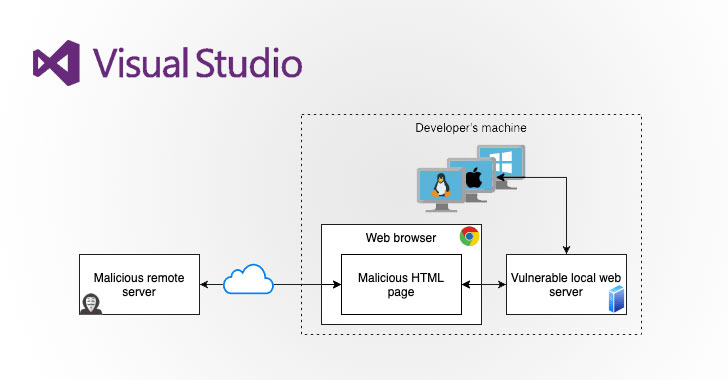
Severe security flaws uncovered in popular Visual Studio Code extensions could enable attackers to compromise local machines as well as build and deployment systems through a developer's integrated development environment (IDE). The vulnerable extensions could be exploited to run arbitrary code on a developer's system remotely, in what could ultimately pave the way for supply chain attacks. Some of the extensions in question are "LaTeX Workshop," "Rainbow Fart," "Open in Default Browser," and "Instant Markdown," all of which have cumulatively racked up about two million installations between them. "Developer machines usually hold significant credentials, allowing them (directly or indirectly) to interact with many parts of the product," researchers from open-source security platform Snyk  said  in a deep-dive published on May 26. "Leaking a developer's private key can allow a malicious stakeholder to clone important...
ThreatsDay Bulletin: Wi-Fi Hack, npm Worm, DeFi Theft, Phishing Blasts— and 15 More Stories

ThreatsDay Bulletin: Wi-Fi Hack, npm Worm, DeFi Theft, Phishing Blasts— and 15 More Stories

Dec 04, 2025 Cybersecurity / Hacking News
Think your Wi-Fi is safe? Your coding tools? Or even your favorite financial apps? This week proves again how hackers, companies, and governments are all locked in a nonstop race to outsmart each other. Here's a quick rundown of the latest cyber stories that show how fast the game keeps changing. DeFi exploit drains funds Critical yETH Exploit Used to Steal $9M A critical exploit targeting Yearn Finance's yETH pool on Ethereum has been exploited by unknown threat actors, resulting in the theft of approximately $9 million from the protocol. The attack is said to have abused a flaw in how the protocol manages its internal accounting, stemming from the fact that a cache containing calculated values to save on gas fees was never cleared when the pool was completely emptied. "The attacker achieved this by minting an astronomical number of tokens – 235 septillion yETH (a 41-digit number) – while depositing only 16 wei, worth approxim...
Expert Insights Articles Videos
Cybersecurity Resources