#1 Trusted Cybersecurity News Platform
Followed by 5.20+ million
The Hacker News Logo
Subscribe – Get Latest News

Search results for google.admin.login | Breaking Cybersecurity News | The Hacker News

Is Your Google Workspace as Secure as You Think it is?

Is Your Google Workspace as Secure as You Think it is?

Oct 28, 2025 Cloud Security / Data Protection
The New Reality for Lean Security Teams If you're the first security or IT hire at a fast-growing startup, you've likely inherited a mandate that's both simple and maddeningly complex: secure the business without slowing it down. Most organizations using Google Workspace start with an environment built for collaboration, not resilience. Shared drives, permissive settings, and constant integrations make life easy for employees—and equally easy for attackers. The good news is that Google Workspace provides an excellent security foundation. The challenge lies in properly configuring it, maintaining visibility, and closing the blind spots that Google's native controls leave open. This article breaks down the key practices every security team—especially small, lean ones—should follow to harden Google Workspace and defend against modern cloud threats. 1. Lock Down the Basics Enforce Multi-Factor Authentication (MFA) MFA is the single most effective way to stop account compromise. In ...
Google, Paypal, Facebook Internal IP disclosure vulnerability

Google, Paypal, Facebook Internal IP disclosure vulnerability

Dec 31, 2012
Do you have any idea about an Internal IP Address or a Private IP Address that too assigned for Multinational Companies? Yeah, today we are gonna discuss about Internal IP or Private IP address Disclosure. Disclosure of an Internal IP like 192.168.*.* or 172.16.*.* , can really Impact ? Most security researchers call it as "bull shit" vulnerability. But when it comes to impact calculation even if the server is behind a firewall or NAT, an attacker can see internal IP of the remote host and this may be used to further attacks. Internet Giants like Facebook, Google, PayPal and Serious National Security organizations like FBI, Pentagon and NASA are taking initiatives for their Security Issues. At same, we at ' The Hacker News ' stand together for organizations that talk about national security in a serious way. I guess,its the time to understand about the flaws and its impacts where I would like to share my findings about our Internet Giants and Organiza...
Google Apps Flaw Allowed Hacker to Hijack Account and Disable Two-factor Authentication

Google Apps Flaw Allowed Hacker to Hijack Account and Disable Two-factor Authentication

Jan 23, 2015
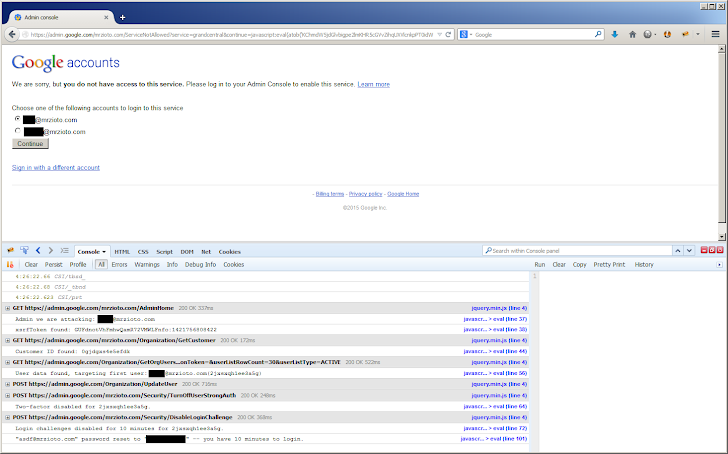
A critical cross-site scripting ( XSS ) vulnerability in the Google Apps administrator console allowed cyber criminals to force a Google Apps admins to execute just about any request on the https://admin.google.com/ domain. The Google Apps admin console allows administrators to manage their organization's account. Administrators can use the console to add new users, configure permissions, manage security settings and enable Google services for your domain. The feature is primarily used by many businesses, especially those using Gmail as the e-mail service for their domain. The XSS flaw allowed attackers to force the admin to do the following actions: Creating new users with "super admin" rights Disabling two-factor authentication ( 2FA ) and other security measures from existing accounts or from multiple domains Modifying domain settings so that all incoming e-mails are redirected to addresses controlled by the attacker Hijack an account/email by resett...
cyber security

2025 Cloud Security Risk Report

websiteSentinelOneCloud Security / Artificial Intelligence
Learn 5 key risks to cloud security such as cloud credential theft, lateral movements, AI services, and more.
cyber security

Most AI Risk Isn't in Models, It's in Your SaaS Stack

websiteRecoAI Security / (SaaS Security
Your models aren't the problem. The sprawl of your SaaS apps, AI and agents are. Here's where to start.
Passwd: A walkthrough of the Google Workspace Password Manager

Passwd: A walkthrough of the Google Workspace Password Manager

Dec 23, 2025 Password Security / Enterprise Software
Passwd is designed specifically for organizations operating within Google Workspace. Rather than competing as a general consumer password manager, its purpose is narrow, and business-focused: secure credential storage, controlled sharing, and seamless Workspace integration. The platform emphasizes practicality over feature overload, aiming to provide a reliable system for teams that already rely on Google's tools.  Security as the starting point Encryption and data protection are the basic building blocks of Passwd. Every credential, file, or sensitive asset gets encrypted with AES-256, an extremely secure encryption standard that is widely recognized. Encryption happens before storage, keeping data protected throughout its lifecycle.  Passwd is based on a zero-knowledge architecture; only the users, not Passwd, are able to access decrypted data. It does not have any visibility of the stored passwords or secrets. The structure reflects an enterprise mindset: Centralize...
Perfection is a Myth. Leverage Isn't: How Small Teams Can Secure Their Google Workspace

Perfection is a Myth. Leverage Isn't: How Small Teams Can Secure Their Google Workspace

May 05, 2025 Cloud Security / Security Operations
Let's be honest: if you're one of the first (or the first) security hires at a small or midsize business, chances are you're also the unofficial CISO, SOC, IT Help Desk, and whatever additional roles need filling. You're not running a security department. You are THE security department. You're getting pinged about RFPs in one area, and reviewing phishing alerts in another, all while sifting through endless FP alerts across the board. The tools meant to help are often creating more work than they solve. Security teams end up choosing between letting things slip or becoming the "Department of No." Chances are you inherited your company's Google Workspace. Thankfully, Google handles the infrastructure, the uptime, and the spam filtering. But while Google takes care of a lot, it doesn't cover everything, and it can be difficult for security teams to operationalize all of Google's underlying capabilities without significant engineering work. It's your job to se...
Two Million stolen Facebook, Twitter login credentials found on 'Pony Botnet' Server

Two Million stolen Facebook, Twitter login credentials found on 'Pony Botnet' Server

Dec 04, 2013
Security researchers at Trustwave's SpiderLabs found a Netherlands-based Pony Botnet Controller Server with almost two Million usernames and passwords, stolen by cybercriminals from users of Facebook, Twitter, Google, Yahoo and other websites. In a blog post, the researchers mentioned that after the Pony Version 1.9  Source code was made public and they found a way to get into the Botnet 's Admin area, from where they collected stolen database and statistics. The Pony Control panel, written in Russian language, indicated Facebook was the worst impacted and two Russian Social Media sites i.e. vk.com and odnoklassniki.ru, credentials were also included in the database. It is not clear at this time that how exactly the login credentials were originally obtained, but one possibility is that, they were captured using some keyloggers or similar malware. Statistics of stolen login credentials: 1,580,000 website login credentials stolen (including 318,121 Facebook...
BankBot Returns On Play Store – A Never Ending Android Malware Story

BankBot Returns On Play Store – A Never Ending Android Malware Story

Nov 20, 2017
Even after so many efforts by Google for making its Play Store away from malware, shady apps somehow managed to fool its anti-malware protections and infect people with malicious software. A team of researchers from several security firms has uncovered two new malware campaigns targeting Google Play Store users, of which one spreads a new version of BankBot , a persistent family of banking Trojan that imitates real banking applications in efforts to steal users' login details. BankBot has been designed to display fake overlays on legitimate bank apps from major banks around the world, including Citibank, WellsFargo, Chase, and DiBa, to steal sensitive information, including logins and credit card details. With its primary purpose of displaying fake overlays, BankBot has the ability to perform a broad range of tasks, such as sending and intercepting SMS messages, making calls, tracking infected devices, and stealing contacts. Google removed at least four previous versions...
Flaw in Elementor and Beaver Addons Let Anyone Hack WordPress Sites

Flaw in Elementor and Beaver Addons Let Anyone Hack WordPress Sites

Dec 13, 2019
Attention WordPress users! Your website could easily get hacked if you are using " Ultimate Addons for Beaver Builder ," or " Ultimate Addons for Elementor " and haven't recently updated them to the latest available versions. Security researchers have discovered a critical yet easy-to-exploit authentication bypass vulnerability in both widely-used premium WordPress plugins that could allow remote attackers to gain administrative access to sites without requiring any password. What's more worrisome is that opportunistic attackers have already started exploiting this vulnerability in the wild within 2 days of its discovery in order to compromise vulnerable WordPress websites and install a malicious backdoor for later access. Both vulnerable plugins, made by software development company Brainstorm Force, are currently powering over hundreds of thousands of WordPress websites using Elementor and Beaver Builder frameworks, helping website admins and de...
New Android Trojan Crocodilus Abuses Accessibility to Steal Banking and Crypto Credentials

New Android Trojan Crocodilus Abuses Accessibility to Steal Banking and Crypto Credentials

Mar 29, 2025 Threat Intelligence / Mobile Security
Cybersecurity researchers have discovered a new Android banking malware called Crocodilus that's primarily designed to target users in Spain and Turkey. "Crocodilus enters the scene not as a simple clone, but as a fully-fledged threat from the outset, equipped with modern techniques such as remote control, black screen overlays, and advanced data harvesting via accessibility logging," ThreatFabric said . As with other banking trojans of its kind, the malware is designed to facilitate device takeover ( DTO ) and ultimately conduct fraudulent transactions. An analysis of the source code and the debug messages reveals that the malware author is Turkish-speaking. The Crocodilus artifacts analyzed by the Dutch mobile security company masquerade as Google Chrome (package name: "quizzical.washbowl.calamity"), which act as a dropper capable of  bypassing Android 13+ restrictions .  Once installed and launched, the app requests permission to Android's access...
How Attackers Can Own a Business Without Touching the Endpoint

How Attackers Can Own a Business Without Touching the Endpoint

Apr 19, 2024 Identity Protection / Endpoint Security
Attackers are increasingly making use of "networkless" attack techniques targeting cloud apps and identities. Here's how attackers can (and are) compromising organizations – without ever needing to touch the endpoint or conventional networked systems and services.  Before getting into the details of the attack techniques being used, let's discuss why these attacks are becoming more prevalent.  SaaS adoption is changing the make-up of company IT  The SaaS revolution and  product-led growth  have had a huge impact on the structure of company networks, and where core business systems and data reside.  Most organizations today are using tens to hundreds of SaaS applications across business functions. Some are entirely SaaS-native, with no traditional network to speak of, but most have adopted a hybrid model with a mixture of on-premise, cloud, and SaaS services forming the...
What Is Attack Surface Management?

What Is Attack Surface Management?

Feb 03, 2025 Attack Surface Management
Attack surfaces are growing faster than security teams can keep up – to stay ahead, you need to know what's exposed and where attackers are most likely to strike. With cloud adoption dramatically increasing the ease of exposing new systems and services to the internet, prioritizing threats and managing your attack surface from an attacker's perspective has never been more important. In this guide, we look at why attack surfaces are growing and how to monitor and manage them properly with  tools like Intruder . Let's dive in. What is your attack surface? First, it's important to understand what we mean when we talk about an attack surface. An attack surface is the sum of your digital assets that are 'reachable' by an attacker – whether they are secure or vulnerable, known or unknown, in active use or not. You can also have both internal and external attack surfaces - imagine for example a malicious email attachment landing in a colleague's inbox, vs a new FTP server being...
ThreatsDay Bulletin: $176M Crypto Fine, Hacking Formula 1, Chromium Vulns, AI Hijack & More

ThreatsDay Bulletin: $176M Crypto Fine, Hacking Formula 1, Chromium Vulns, AI Hijack & More

Oct 23, 2025 Cybersecurity / Hacking News
Criminals don't need to be clever all the time; they just follow the easiest path in: trick users, exploit stale components, or abuse trusted systems like OAuth and package registries. If your stack or habits make any of those easy, you're already a target. This week's ThreatsDay highlights show exactly how those weak points are being exploited — from overlooked misconfigurations to sophisticated new attack chains that turn ordinary tools into powerful entry points. Lumma Stealer Stumbles After Doxxing Drama Decline in Lumma Stealer Activity After Doxxing Campaign The activity of the Lumma Stealer (aka Water Kurita) information stealer has witnessed a "sudden drop" since last months after the identities of five alleged core group members were exposed as part of what's said to be an aggressive underground exposure campaign dubbed Lumma Rats since late August 2025. The targeted individuals are affiliated with the malware's development and administ...
⚡ Weekly Recap: Chrome 0-Day, Ivanti Exploits, MacOS Stealers, Crypto Heists and More

⚡ Weekly Recap: Chrome 0-Day, Ivanti Exploits, MacOS Stealers, Crypto Heists and More

Jul 07, 2025 Cybersecurity / Hacking
Everything feels secure—until one small thing slips through. Even strong systems can break if a simple check is missed or a trusted tool is misused. Most threats don't start with alarms—they sneak in through the little things we overlook. A tiny bug, a reused password, a quiet connection—that's all it takes. Staying safe isn't just about reacting fast. It's about catching these early signs before they blow up into real problems. That's why this week's updates matter. From stealthy tactics to unexpected entry points, the stories ahead reveal how quickly risk can spread—and what smart teams are doing to stay ahead. Dive in. ⚡ Threat of the Week U.S. Disrupts N. Korea IT Worker Scheme — Prosecutors said they uncovered the North Korean IT staff working at over 100 U.S. companies using fictitious or stolen identities and not only drawing salaries, but also stealing secret data and plundering virtual currency more than $900,000 in one incident targeting an unnamed blockchain company in ...
Expert Insights Articles Videos
Cybersecurity Resources