#1 Trusted Cybersecurity News Platform
Followed by 5.20+ million
The Hacker News Logo
Subscribe – Get Latest News
Salesforce Security Handbook

Search results for chrome/new-tab-page | Breaking Cybersecurity News | The Hacker News

How to Fix Chrome Massive Memory Usage? Simply Try 'Chrome 45' for Faster Performance

How to Fix Chrome Massive Memory Usage? Simply Try 'Chrome 45' for Faster Performance

Sep 04, 2015
Rejoice Chrome users! Google has made major improvements to its Chrome web browser that would once again make it one of the least memory eater browsers in the market. Although Chrome is used by hundreds of millions of people worldwide due to its simplicity and power, most people aren't happy with it because it uses too much memory and power. Google has now solved these problems. The most recent release of Chrome ( Chrome 45 ) is intended to make your browsing experience faster and more efficient. Google launched Chrome 45 for Windows, Mac, Linux, and Android two days ago, but the company announced in an official blog post Friday that the new version includes several new updates that focus on making the browser load faster and use less memory. Also Read:  I keep 200+ Browser Tabs Open, and My Computer Runs Absolutely Fine. Here's My Secret Chrome 45 Uses 10% Less RAM A major issue reported by Chrome users was the browser's consumption of PC mem...
ShadyPanda Turns Popular Browser Extensions with 4.3 Million Installs Into Spyware

ShadyPanda Turns Popular Browser Extensions with 4.3 Million Installs Into Spyware

Dec 01, 2025 Browser Security / Spyware
A threat actor known as ShadyPanda has been linked to a seven-year-long browser extension campaign that has amassed over 4.3 million installations over time. Five of these extensions started off as legitimate programs before malicious changes were introduced in mid-2024, according to a report from Koi Security, attracting 300,000 installs. These extensions have since been taken down. "These extensions now run hourly remote code execution – downloading and executing arbitrary JavaScript with full browser access," security researcher Tuval Admoni said in a report shared with The Hacker News. "They monitor every website visit, exfiltrate encrypted browsing history, and collect complete browser fingerprints." To make matters worse, one of the extensions, Clean Master, was featured and verified by Google at one point. This trust-building exercise allowed the attackers to expand their user base and silently issue malicious updates years later without attracting any...
A New Cryptocurrency Mining Virus is Spreading Through Facebook

A New Cryptocurrency Mining Virus is Spreading Through Facebook

May 01, 2018
If you receive a link for a video, even if it looks exciting, sent by someone (or your friend) on Facebook messenger—just don't click on it without taking a second thought. Cybersecurity researchers from Trend Micro are warning users of a malicious Chrome extension which is spreading through Facebook Messenger and targeting users of cryptocurrency trading platforms to steal their accounts' credentials. Dubbed FacexWorm , the attack technique used by the malicious extension first emerged in August last year, but researchers noticed the malware re-packed a few new malicious capabilities earlier this month. New capabilities include stealing account credentials from websites, like Google and cryptocurrency sites, redirecting victims to cryptocurrency scams, injecting miners on the web page for mining cryptocurrency, and redirecting victims to the attacker's referral link for cryptocurrency-related referral programs. It is not the first malware to abuse Facebook Messenger...
cyber security

The 2026 CISO Budget Benchmark

websiteWizEnterprise Security / Cloud Security
See how 300+ CISOs are planning 2026 budgets: top trends in AI, cloud, staffing, and tool consolidation shaping next year's security priorities.
cyber security

2025 Cloud Security Survey Report

websiteSentinelOneCloud Security / Identity Protection
Learn from 400+ security leaders and practitioners to get the latest insights and trends on cloud security
7 Chrome Extensions Spreading Through Facebook Caught Stealing Passwords

7 Chrome Extensions Spreading Through Facebook Caught Stealing Passwords

May 11, 2018
Luring users on social media to visit lookalike version of popular websites that pop-up a legitimate-looking Chrome extension installation window is one of the most common modus operandi of cybercriminals to spread malware. Security researchers are again warning users of a new malware campaign that has been active since at least March this year and has already infected more than 100,000 users worldwide. Dubbed Nigelthorn, the malware is rapidly spreading through socially engineered links on Facebook and infecting victims' systems with malicious browser extensions that steal their social media credentials, install cryptocurrency miners, and engage them in click fraud. The malware was pushed through at least seven different Chrome browser extensions—all were hosted on Google's official Chrome Web Store. These malicious Chrome browser extensions were first discovered by researchers at cybersecurity firm Radware, after a "well-protected network" of one of its custo...
Despite Issues, 6 Reasons Why Windows 10 is Best Windows Ever

Despite Issues, 6 Reasons Why Windows 10 is Best Windows Ever

Aug 03, 2015
Windows 10 is built with the power features of Windows 7 and 8.1, which makes it a robust operating system. It gained 65 million users in the first three days after its release. Still counting and making Windows 10 as a universal platform for all the devices running the same operating system. By Introducing " Windows as a service " utility, The Microsoft is offering Windows 10 Free Upgrade to all the users running Windows 7 or 8.1 as a Windows update, and not as a separate product. From now on, the company will provide regular updates for Windows in the same manner Apple does with its Mac OS X operating system that gets regular updates on a yearly basis and has been known as OS X for over 15 years. Despite some privacy issues , including " Wi-Fi Sense " and " Bandwidth sharing for Windows Update ", and few more, Windows 10 offers a bevy of new and advanced features that makes the operating system unique from others. Also Read: How to Fix 35+ Windows 10 Privacy Iss...
I keep 200+ Browser Tabs Open, and My Computer Runs Absolutely Fine. Here’s My Secret.

I keep 200+ Browser Tabs Open, and My Computer Runs Absolutely Fine. Here's My Secret.

Jun 12, 2015
I don't know about your part, but I make heavy use of tabs. I currently have 200+ tabs open in my Google Chrome Web browser. And sometimes the number is even more. For me it's a daily thing, as I regularly open new tabs because of my habit of reading lots of stuff online, including cyber security updates, hacking news, knowledgeable articles of various categories, new recipes to cook something delicious and, of course, funny viral videos. Browsers — Everything for us, But Biggest Memory Eaters! I think you'll agree with me when I say: It's really hard to manage so many tabs on Chrome — and Firefox too. But worse still is the obstruction in the performance of your computer, as the tabs continue to run background processes and feed on your system's memory. It gets difficult to sort through them, everything slows down, and sometimes it crashes the browser itself. Doesn't it? But, I really don't face any issue while surfing on 200+ tabs at one time ...
How to Disable Mixed Content Security Warning in Google Chrome

How to Disable Mixed Content Security Warning in Google Chrome

Apr 20, 2015
If you are really upset with Chrome browsers warnings that your HTTPS enabled website contains unsecured third-party contents that sometimes force your users to close the tab, Google has solved this problem for you. With the release of the next version of Google's popular browser, Chrome 43 , it may be easier for developers and system administrators to ensure HTTPS websites are not compromised by insecure HTTP resources. Until now, the current browsers of Google flag a ' mixed-content warning ' in the form of a yellow triangle over the padlock if any HTTPS page loads any resource from an unencrypted HTTP URL. What's mixed content? And… ...Why should I worry about Mixed content if I am using HTTPS on my web pages? If, say, your website has HTTPS enabled but your website's pages are loading contents, such as images, retrieved through regular, clear text HTTP URLs, then it is believed that the connection is only partially encrypted. Partial...
Popular Chrome Extensions Leak API Keys, User Data via HTTP and Hard-Coded Credentials

Popular Chrome Extensions Leak API Keys, User Data via HTTP and Hard-Coded Credentials

Jun 05, 2025 Browser Security / Online Safety
Cybersecurity researchers have flagged several popular Google Chrome extensions that have been found to transmit data in HTTP and hard-code secrets in their code, exposing users to privacy and security risks. "Several widely used extensions [...] unintentionally transmit sensitive data over simple HTTP," Yuanjing Guo, a security researcher in the Symantec's Security Technology and Response team, said . "By doing so, they expose browsing domains, machine IDs, operating system details, usage analytics, and even uninstall information, in plaintext." The fact that the network traffic is unencrypted also means that they are susceptible to adversary-in-the-middle (AitM) attacks, allowing malicious actors on the same network such as a public Wi-Fi to intercept and, even worse, modify this data, which could lead to far more serious consequences. The list of identified extensions are below - SEMRush Rank (extension ID: idbhoeaiokcojcgappfigpifhpkjgmab) and P...
Ad-Blocking Chrome Extension Caught Injecting Ads in Google Search Pages

Ad-Blocking Chrome Extension Caught Injecting Ads in Google Search Pages

Oct 15, 2021
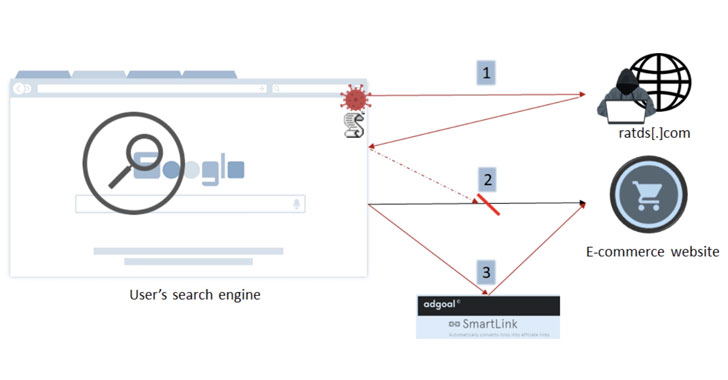
A new deceptive ad injection campaign has been found leveraging an ad blocker extension for Google Chrome and Opera web browsers to sneakily insert ads and affiliate codes on websites, according to new research from cybersecurity firm Imperva. The findings come following the discovery of rogue domains distributing an ad injection script in late August 2021 that the researchers connected to an add-on called AllBlock. The  extension  has since been pulled from both the Chrome Web Store and Opera add-ons marketplaces. While AllBlock is designed to block ads legitimately, the JavaScript code is injected into every new tab opened on the browser. It works by identifying and sending all links in a web page — typically on search engine results pages — to a remote server, which responds back with a list of websites to replace the genuine links with, leading to a scenario where upon clicking a link, the victim is redirected to a different page. "When the user clicks on any modifie...
Microsoft Edge: The Windows 10 Web Browser

Microsoft Edge: The Windows 10 Web Browser

Apr 30, 2015
Meet Microsoft's replacement to its old web browser Internet Explorer. The Project Spartan Web browser for Windows 10 has now an official name — Microsoft Edge . Yes, Microsoft's new web browser shipping on all Windows 10 devices, from computers to smartphones and tablets, is dubbed Microsoft Edge . The company just announced in its Build developer conference that Edge is going to be its primary/default web browser built into Windows 10 . Microsoft Edge is the successor to Internet Explorer and designed to be basic and minimalist for the future. Highlights of Microsoft Edge: There aren't many details about the unique features of Microsoft Edge yet, but here's what we know about Microsoft Edge so far: It has built-in Cortana support, Microsoft's virtual assistant. It has a built-in reading list, web note-taking and sharing features. The rendering engine is called EdgeHTML. The design focuses on minimalism and simplicity. It has a super useful and we...
⚡ Weekly Recap: APT Campaigns, Browser Hijacks, AI Malware, Cloud Breaches and Critical CVEs

⚡ Weekly Recap: APT Campaigns, Browser Hijacks, AI Malware, Cloud Breaches and Critical CVEs

May 26, 2025 Cybersecurity / Hacking News
Cyber threats don't show up one at a time anymore. They're layered, planned, and often stay hidden until it's too late. For cybersecurity teams, the key isn't just reacting to alerts—it's spotting early signs of trouble before they become real threats. This update is designed to deliver clear, accurate insights based on real patterns and changes we can verify. With today's complex systems, we need focused analysis—not noise. What you'll see here isn't just a list of incidents, but a clear look at where control is being gained, lost, or quietly tested. ⚡ Threat of the Week Lumma Stealer, DanaBot Operations Disrupted — A coalition of private sector companies and law enforcement agencies have taken down the infrastructure associated with Lumma Stealer and DanaBot . Charges have also been unsealed against 16 individuals for their alleged involvement in the development and deployment of DanaBot. The malware is equipped to siphon data from victim computers, hijack banking session...
New Cache Side Channel Attack Can De-Anonymize Targeted Online Users

New Cache Side Channel Attack Can De-Anonymize Targeted Online Users

Jul 15, 2022
A group of academics from the New Jersey Institute of Technology (NJIT) has warned of a novel technique that could be used to defeat  anonymity protections  and identify a unique website visitor. "An attacker who has complete or partial control over a website can learn whether a specific target (i.e., a unique individual) is browsing the website," the researchers  said . "The attacker knows this target only through a public identifier, such as an email address or a Twitter handle." The cache-based targeted  de-anonymization attack  is a  cross-site leak  that involves the adversary leveraging a service such as Google Drive, Dropbox, or YouTube to privately share a resource (e.g., image, video, or a YouTube playlist) with the target, followed by embedding the shared resource into the attack website. This can be achieved by, say, privately sharing the resource with the target using the victim's email address or the appropriate username associated wit...
⚡ Weekly Recap: NFC Fraud, Curly COMrades, N-able Exploits, Docker Backdoors & More

⚡ Weekly Recap: NFC Fraud, Curly COMrades, N-able Exploits, Docker Backdoors & More

Aug 18, 2025 Cybersecurity / Hacking News
Power doesn't just disappear in one big breach. It slips away in the small stuff—a patch that's missed, a setting that's wrong, a system no one is watching. Security usually doesn't fail all at once; it breaks slowly, then suddenly. Staying safe isn't about knowing everything—it's about acting fast and clear before problems pile up. Clarity keeps control. Hesitation creates risk. Here are this week's signals—each one pointing to where action matters most. ⚡ Threat of the Week Ghost Tap NFC-Based Mobile Fraud Takes Off — A new Android trojan called PhantomCard has become the latest malware to abuse near-field communication (NFC) to conduct relay attacks for facilitating fraudulent transactions in attacks targeting banking customers in Brazil. In these attacks, users who end up installing the malicious apps are instructed to place their credit/debit card on the back of the phone to begin the verification process, only for the card data to be sent to an attacker-controlled NFC relay...
How to Speed Up Firefox With Multi-Process, If It's Not Working By Default

How to Speed Up Firefox With Multi-Process, If It's Not Working By Default

Jun 19, 2017
After years of waiting, Mozilla last week launched Firefox 54 for Windows, Mac, Linux, and Android, with multi-process support — a "major improvement" to improve your browsing experience — but many users are still struggling to take advantage of this feature. Mozilla's multi-process support in Firefox has been in development for over eight years as part of a project, codenamed Electrolysis or E10S, which aimed at improving responsiveness and speed by streamlining memory use by different processes. Describing the latest release as the largest change to Firefox code ever, Mozilla says it has worked hard to avoid increased memory consumption, and slower performance, as Firefox now uses up to four processes to run web page content across all open tabs. In other words, Firefox is finally making use of "significantly less RAM" of your computer, as heavy web pages in one tab will now have a much lower impact on responsiveness and speed in other tabs. ...
Expert Insights Articles Videos
Cybersecurity Resources