-->
#1 Trusted Cybersecurity News Platform
Followed by 5.20+ million
The Hacker News Logo
Subscribe – Get Latest News
Security Service Edge

Search results for VS Code Server | Breaking Cybersecurity News | The Hacker News

North Korea-Linked Hackers Target Developers via Malicious VS Code Projects

North Korea-Linked Hackers Target Developers via Malicious VS Code Projects

Jan 20, 2026 Cyber Espionage / Malware
The North Korean threat actors associated with the long-running Contagious Interview campaign have been observed using malicious Microsoft Visual Studio Code (VS Code) projects as lures to deliver a backdoor on compromised endpoints. The latest finding demonstrates continued evolution of the new tactic that was first discovered in December 2025, Jamf Threat Labs said. "This activity involved the deployment of a backdoor implant that provides remote code execution capabilities on the victim system," security researcher Thijs Xhaflaire said in a report shared with The Hacker News. First disclosed by OpenSourceMalware last month, the attack essentially involves instructing prospective targets to clone a repository on GitHub, GitLab, or Bitbucket, and launch the project in VS Code as part of a supposed job assessment. The end goal of these efforts is to abuse VS Code task configuration files to execute malicious payloads staged on Vercel domains, depending on the oper...
Microsoft Warns Developers of Fake Next.js Job Repos Delivering In-Memory Malware

Microsoft Warns Developers of Fake Next.js Job Repos Delivering In-Memory Malware

Feb 26, 2026 Supply Chain Attack / Malware
A "coordinated developer-targeting campaign" is using malicious repositories disguised as legitimate Next.js projects and technical assessments to trick victims into executing them and establish persistent access to compromised machines. "The activity aligns with a broader cluster of threats that use job-themed lures to blend into routine developer workflows and increase the likelihood of code execution," the Microsoft Defender Security Research Team said in a report published this week. The tech giant said the campaign is characterized by the use of multiple entry points that lead to the same outcome, where attacker-controlled JavaScript is retrieved at runtime and executed to facilitate command-and-control (C2). The attacks rely on the threat actors setting up fake repositories on trusted developer platforms like Bitbucket, using names like "Cryptan-Platform-MVP1" to trick developers looking for jobs into running them as part of an assessment proces...
Over 100 VS Code Extensions Exposed Developers to Hidden Supply Chain Risks

Over 100 VS Code Extensions Exposed Developers to Hidden Supply Chain Risks

Oct 15, 2025 Software Supply Chain / Malware
New research has uncovered that publishers of over 100 Visual Studio Code (VS Code) extensions leaked access tokens that could be exploited by bad actors to update the extensions, posing a critical software supply chain risk. "A leaked VS Code Marketplace or Open VSX PAT [personal access token] allows an attacker to directly distribute a malicious extension update across the entire install base," Wiz security researcher Rami McCarthy said in a report shared with The Hacker News. "An attacker who discovered this issue would have been able to directly distribute malware to the cumulative 150,000 install base." The cloud security firm noted in many cases publishers failed to account for the fact that VS Code extensions, while distributed as .vsix files, can be unzipped and inspected, exposing hard-coded secrets embedded into them. In all, Wiz said it found over 550 validated secrets, distributed across more than 500 extensions from hundreds of distinct publishers....
cyber security

5 Cloud Security Risks You Can’t Afford to Ignore

websiteSentinelOneEnterprise Security / Cloud Security
Get expert analysis, attacker insights, and case studies in our 2025 risk report.
cyber security

Accelerate your AI Initiatives

websiteZsclaerZero Trust / AI Security
See how Zscaler’s new innovations are delivering a unified approach to secure your AI journey.
Over 70 Malicious npm and VS Code Packages Found Stealing Data and Crypto

Over 70 Malicious npm and VS Code Packages Found Stealing Data and Crypto

May 26, 2025 Cybersecurity / Cryptocurrency
As many as 60 malicious npm packages have been discovered in the package registry with malicious functionality to harvest hostnames, IP addresses, DNS servers, and user directories to a Discord-controlled endpoint. The packages, published under three different accounts, come with an install‑time script that's triggered during npm install, Socket security researcher Kirill Boychenko said in a report published last week. The libraries have been collectively downloaded over 3,000 times. "The script targets Windows, macOS, or Linux systems, and includes basic sandbox‑evasion checks, making every infected workstation or continuous‑integration node a potential source of valuable reconnaissance," the software supply chain security firm said . The names of the three accounts, each of which published 20 packages within an 11-day time period, are listed below. The accounts no longer exist on npm - bbbb335656 cdsfdfafd1232436437, and  sdsds656565 The malicious code, per So...
Vibe-Coded Malicious VS Code Extension Found with Built-In Ransomware Capabilities

Vibe-Coded Malicious VS Code Extension Found with Built-In Ransomware Capabilities

Nov 07, 2025 Supply Chain Attack / Malware
Cybersecurity researchers have flagged a malicious Visual Studio Code (VS Code) extension with basic ransomware capabilities that appears to be created with the help of artificial intelligence – in other words, vibe-coded. Secure Annex researcher John Tuckner, who flagged the extension " susvsex ," said it does not attempt to hide its malicious functionality. The extension was uploaded on November 5, 2025, by a user named "suspublisher18" along with the description "Just testing" and the email address "donotsupport@example[.]com." "Automatically zips, uploads, and encrypts files from C:\Users\Public\testing (Windows) or /tmp/testing (macOS) on first launch," reads the description of the extension. As of November 6, Microsoft has stepped in to remove it from the official VS Code Extension Marketplace.  According to details shared by "suspublisher18," the extension is designed to automatically activate itself on any even...
Newly Discovered Bugs in VSCode Extensions Could Lead to Supply Chain Attacks

Newly Discovered Bugs in VSCode Extensions Could Lead to Supply Chain Attacks

May 27, 2021
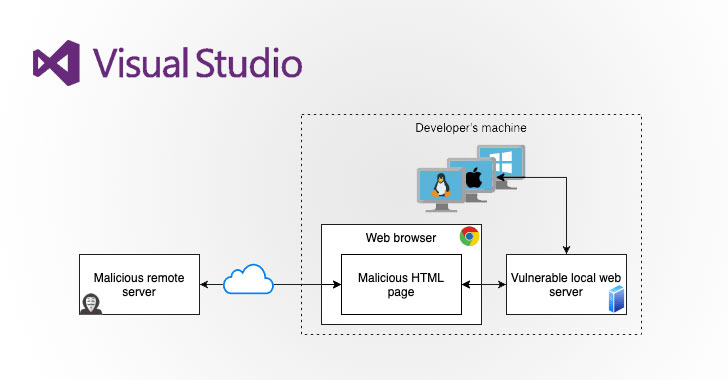
Severe security flaws uncovered in popular Visual Studio Code extensions could enable attackers to compromise local machines as well as build and deployment systems through a developer's integrated development environment (IDE). The vulnerable extensions could be exploited to run arbitrary code on a developer's system remotely, in what could ultimately pave the way for supply chain attacks. Some of the extensions in question are "LaTeX Workshop," "Rainbow Fart," "Open in Default Browser," and "Instant Markdown," all of which have cumulatively racked up about two million installations between them. "Developer machines usually hold significant credentials, allowing them (directly or indirectly) to interact with many parts of the product," researchers from open-source security platform Snyk  said  in a deep-dive published on May 26. "Leaking a developer's private key can allow a malicious stakeholder to clone important...
Researchers Find Malicious VS Code, Go, npm, and Rust Packages Stealing Developer Data

Researchers Find Malicious VS Code, Go, npm, and Rust Packages Stealing Developer Data

Dec 09, 2025 Malware / Threat Analysis
Cybersecurity researchers have discovered two new extensions on Microsoft Visual Studio Code (VS Code) Marketplace that are designed to infect developer machines with stealer malware. The VS Code extensions masquerade as a premium dark theme and an artificial intelligence (AI)-powered coding assistant, but, in actuality, harbor covert functionality to download additional payloads, take screenshots, and siphon data. The captured information is then sent to an attacker-controlled server. "Your code. Your emails. Your Slack DMs. Whatever's on your screen, they're seeing it too," Koi Security's Idan Dardikman said . "And that's just the start. It also steals your WiFi passwords, reads your clipboard, and hijacks your browser sessions." The names of the extensions are below - BigBlack.bitcoin-black (16 installs) - Removed by Microsoft on December 5, 2025  BigBlack.codo-ai (25 installs) - Removed by Microsoft on December 8, 2025 Microsoft's l...
North Korea-linked Actors Exploit React2Shell to Deploy New EtherRAT Malware

North Korea-linked Actors Exploit React2Shell to Deploy New EtherRAT Malware

Dec 09, 2025 Vulnerability / Malware
Threat actors with ties to North Korea have likely become the latest to exploit the recently disclosed critical React2Shell security flaw in React Server Components (RSC) to deliver a previously undocumented remote access trojan dubbed EtherRAT . "EtherRAT leverages Ethereum smart contracts for command-and-control (C2) resolution, deploys five independent Linux persistence mechanisms, and downloads its own Node.js runtime from nodejs.org," Sysdig said in a report published Monday. The cloud security firm said the activity exhibits significant overlap with a long-running campaign codenamed Contagious Interview , which has been observed leveraging the EtherHiding technique to distribute malware since February 2025. Contagious Interview is the name given to a series of attacks in which blockchain and Web3 developers, among others, are targeted through fake job interviews, coding assignments, and video assessments, leading to the deployment of malware. These efforts typi...
Critical Flaws Found in Four VS Code Extensions with Over 125 Million Installs

Critical Flaws Found in Four VS Code Extensions with Over 125 Million Installs

Feb 18, 2026 Vulnerability / Software Security
Cybersecurity researchers have disclosed multiple security vulnerabilities in four popular Microsoft Visual Studio Code (VS Code) extensions that, if successfully exploited, could allow threat actors to steal local files and execute code remotely. The extensions, which have been collectively installed more than 125 million times, are Live Server, Code Runner, Markdown Preview Enhanced, and Microsoft Live Preview. "Our research demonstrates that a hacker needs only one malicious extension, or a single vulnerability within one extension, to perform lateral movement and compromise entire organizations," OX Security researchers Moshe Siman Tov Bustan and Nir Zadok said in a report shared with The Hacker News. Details of the vulnerabilities are as follows - CVE-2025-65717 (CVSS score: 9.1) - A vulnerability in Live Server that allows attackers to exfiltrate local files, tricking a developer into visiting a malicious website when the extension is running, causing JavaScrip...
Self-Spreading 'GlassWorm' Infects VS Code Extensions in Widespread Supply Chain Attack

Self-Spreading 'GlassWorm' Infects VS Code Extensions in Widespread Supply Chain Attack

Oct 24, 2025 DevOps / Malware
Cybersecurity researchers have discovered a self-propagating worm that spreads via Visual Studio Code (VS Code) extensions on the Open VSX Registry and the Microsoft Extension Marketplace, underscoring how developers have become a prime target for attacks. The sophisticated threat, codenamed GlassWorm by Koi Security, is the second such supply chain attack to hit the DevOps space within a span of a month after the Shai-Hulud worm that targeted the npm ecosystem in mid-September 2025. What makes the attack stand out is the use of the Solana blockchain for command-and-control (C2), making the infrastructure resilient to takedown efforts. It also uses Google Calendar as a C2 fallback mechanism. Another novel aspect is that the GlassWorm campaign relies on "invisible Unicode characters that make malicious code literally disappear from code editors," Idan Dardikman said in a technical report. "The attacker used Unicode variation selectors – special characters that are...
Evelyn Stealer Malware Abuses VS Code Extensions to Steal Developer Credentials and Crypto

Evelyn Stealer Malware Abuses VS Code Extensions to Steal Developer Credentials and Crypto

Jan 20, 2026 Cloud Security / Developer Security
Cybersecurity researchers have disclosed details of a malware campaign that's targeting software developers with a new information stealer called Evelyn Stealer by weaponizing the Microsoft Visual Studio Code (VS Code) extension ecosystem. "The malware is designed to exfiltrate sensitive information, including developer credentials and cryptocurrency-related data. Compromised developer environments can also be abused as access points into broader organizational systems," Trend Micro said in an analysis published Monday. The activity is designed to single out organizations with software development teams that rely on VS Code and third-party extensions, along with those with access to production systems, cloud resources, or digital assets, it added. It's worth noting that details of the campaign were first documented by Koi Security last month, when details emerged of three VS Code extensions – BigBlack.bitcoin-black, BigBlack.codo-ai, and BigBlack.mrbigblacktheme...
Fake Moltbot AI Coding Assistant on VS Code Marketplace Drops Malware

Fake Moltbot AI Coding Assistant on VS Code Marketplace Drops Malware

Jan 28, 2026 Malware / AI Security
Cybersecurity researchers have flagged a new malicious Microsoft Visual Studio Code (VS Code) extension for Moltbot (formerly Clawdbot) on the official Extension Marketplace that claims to be a free artificial intelligence (AI) coding assistant, but stealthily drops a malicious payload on compromised hosts. The extension, named "ClawdBot Agent - AI Coding Assistant" ("clawdbot.clawdbot-agent"), has since been taken down by Microsoft. It was published by a user named "clawdbot" on January 27, 2026.  Moltbot has taken off in a big way, crossing more than 85,000 stars on GitHub as of writing. The open-source project, created by Austrian developer Peter Steinberger, allows users to run a personal AI assistant powered by a large language model (LLM) locally on their own devices and interact with it over already established communication platforms like WhatsApp, Telegram, Slack, Discord, Google Chat, Signal, iMessage, Microsoft Teams, and WebChat.
Malicious npm Packages Harvest Crypto Keys, CI Secrets, and API Tokens

Malicious npm Packages Harvest Crypto Keys, CI Secrets, and API Tokens

Feb 23, 2026 AI Security / DevOps
Cybersecurity researchers have disclosed what they say is an active "Shai-Hulud-like" supply chain worm campaign that has leveraged a cluster of at least 19 malicious npm packages to enable credential harvesting and cryptocurrency key theft. The campaign has been codenamed SANDWORM_MODE by supply chain security company Socket. As with prior Shai-Hulud attack waves , the malicious code embedded into the packages comes with capabilities to siphon system information, access tokens, environment secrets, and API keys from developer environments and automatically propagate by abusing stolen npm and GitHub identities to extend its reach. "The sample retains Shai-Hulud hallmarks and adds GitHub API exfiltration with DNS fallback, hook-based persistence, SSH propagation fallback, MCP server injection with embedded prompt injection targeting AI coding assistants, and LLM API Key harvesting," the company said . The packages, published to npm by two npm publisher aliases,...
GlassWorm Malware Discovered in Three VS Code Extensions with Thousands of Installs

GlassWorm Malware Discovered in Three VS Code Extensions with Thousands of Installs

Nov 10, 2025 Malware / Threat Intelligence
Cybersecurity researchers have disclosed a new set of three extensions associated with the GlassWorm campaign, indicating continued attempts on part of threat actors to target the Visual Studio Code (VS Code) ecosystem. The extensions in question , which are still available for download, are listed below - ai-driven-dev.ai-driven-dev (3,402 downloads) adhamu.history-in-sublime-merge (4,057 downloads) yasuyuky.transient-emacs (2,431 downloads) GlassWorm, first documented by Koi Security late last month, refers to a campaign in which threat actors leverage VS Code extensions on the Open VSX Registry and the Microsoft Extension Marketplace to harvest Open VSX, GitHub, and Git credentials, drain funds from 49 different cryptocurrency wallet extensions, and drop additional tools for remote access. What makes the malware notable is that it uses invisible Unicode characters to hide malicious code in code editors and abuses the pilfered credentials to compromise additional extens...
Malicious VSX Extension "SleepyDuck" Uses Ethereum to Keep Its Command Server Alive

Malicious VSX Extension "SleepyDuck" Uses Ethereum to Keep Its Command Server Alive

Nov 03, 2025 Cryptocurrency / Threat Intelligence
Cybersecurity researchers have flagged a new malicious extension in the Open VSX registry that harbors a remote access trojan called SleepyDuck . According to Secure Annex's John Tuckner, the extension in question, juan-bianco.solidity-vlang (version 0.0.7), was first published on October 31, 2025, as a completely benign library that was subsequently updated to version 0.0.8 on November 1 to include new malicious capabilities after reaching 14,000 downloads. "The malware includes sandbox evasion techniques and utilizes an Ethereum contract to update its command and control address in case the original address is taken down," Tuckner added . Campaigns distributing rogue extensions targeting Solidity developers have been repeatedly detected across both the Visual Studio Extension Marketplace and Open VSX. In July 2025, Kaspersky disclosed that a Russian developer lost $500,000 in cryptocurrency assets after installing one such extension through Cursor. In the latest...
Malicious VS Code AI Extensions with 1.5 Million Installs Steal Developer Source Code

Malicious VS Code AI Extensions with 1.5 Million Installs Steal Developer Source Code

Jan 26, 2026 AI Security / Vulnerability
Cybersecurity researchers have discovered two malicious Microsoft Visual Studio Code (VS Code) extensions that are advertised as artificial intelligence (AI)-powered coding assistants, but also harbor covert functionality to siphon developer data to China-based servers. The extensions, which have 1.5 million combined installs and are still available for download from the official Visual Studio Marketplace , are listed below - ChatGPT - 中文版 (ID: whensunset.chatgpt-china) - 1,340,869 installs ChatGPT - ChatMoss(CodeMoss)(ID: zhukunpeng.chat-moss) - 151,751 installs Koi Security said the extensions are functional and work as expected, but they also capture every file being opened and every source code modification to servers located in China without users' knowledge or consent. The campaign has been codenamed MaliciousCorgi. "Both contain identical malicious code -- the same spyware infrastructure running under different publisher names," security researcher Tuval ...
Cursor AI Code Editor Flaw Enables Silent Code Execution via Malicious Repositories

Cursor AI Code Editor Flaw Enables Silent Code Execution via Malicious Repositories

Sep 12, 2025 AI Security / Vulnerability
A security weakness has been disclosed in the artificial intelligence (AI)-powered code editor Cursor that could trigger code execution when a maliciously crafted repository is opened using the program. The issue stems from the fact that an out-of-the-box security setting is disabled by default, opening the door for attackers to run arbitrary code on users' computers with their privileges. "Cursor ships with Workspace Trust disabled by default, so VS Code-style tasks configured with runOptions.runOn: 'folderOpen' auto-execute the moment a developer browses a project," Oasis Security said in an analysis. "A malicious .vscode/tasks.json turns a casual 'open folder' into silent code execution in the user's context." Cursor is an AI-powered fork of Visual Studio Code, which supports a feature called Workspace Trust to allow developers to safely browse and edit code regardless of where it came from or who wrote it. With this option disab...
Researchers Reveal Reprompt Attack Allowing Single-Click Data Exfiltration From Microsoft Copilot

Researchers Reveal Reprompt Attack Allowing Single-Click Data Exfiltration From Microsoft Copilot

Jan 15, 2026 Prompt Injection / Enterprise Security
Cybersecurity researchers have disclosed details of a new attack method dubbed Reprompt that could allow bad actors to exfiltrate sensitive data from artificial intelligence (AI) chatbots like Microsoft Copilot in a single click, while bypassing enterprise security controls entirely. "Only a single click on a legitimate Microsoft link is required to compromise victims," Varonis security researcher Dolev Taler said in a report published Wednesday. "No plugins, no user interaction with Copilot." "The attacker maintains control even when the Copilot chat is closed, allowing the victim's session to be silently exfiltrated with no interaction beyond that first click." Following responsible disclosure, Microsoft has addressed the security issue. The attack does not affect enterprise customers using Microsoft 365 Copilot. At a high level, Reprompt employs three techniques to achieve a data‑exfiltration chain - Using the "q" URL parameter in...
Developer Alert: NPM Packages for Node.js Hiding Dangerous TurkoRat Malware

Developer Alert: NPM Packages for Node.js Hiding Dangerous TurkoRat Malware

May 19, 2023 DevOpsSec / Supply Chain
Two malicious packages discovered in the npm package repository have been found to conceal an open source information stealer malware called  TurkoRat . The packages – named nodejs-encrypt-agent and nodejs-cookie-proxy-agent – were collectively downloaded approximately 1,200 times and were available for more than two months before they were identified and taken down. ReversingLabs, which broke down the details of the campaign, described TurkoRat as an information stealer capable of harvesting sensitive information such as login credentials, website cookies, and data from cryptocurrency wallets.  While nodejs-encrypt-agent came fitted with the malware inside, nodejs-cookie-proxy-agent was found to disguise the trojan as a dependency under the name axios-proxy. nodejs-encrypt-agent was also engineered to masquerade as another legitimate npm module known as  agent-base , which has been downloaded over 25 million times to date. The list of the rogue packages and their a...
Expert Insights Articles Videos
Cybersecurity Resources