#1 Trusted Cybersecurity News Platform
Followed by 5.20+ million
The Hacker News Logo
Subscribe – Get Latest News

Search results for Google Chrome password stealer | Breaking Cybersecurity News | The Hacker News

Chaes Banking Trojan Hijacks Chrome Browser with Malicious Extensions

Chaes Banking Trojan Hijacks Chrome Browser with Malicious Extensions

Jan 27, 2022
A financially-motivated malware campaign has compromised over 800 WordPress websites to deliver a banking trojan dubbed Chaes targeting Brazilian customers of Banco do Brasil, Loja Integrada, Mercado Bitcoin, Mercado Livre, and Mercado Pago. First documented by  Cybereason  in November 2020, the info-stealing malware is delivered via a sophisticated infection chain that's engineered to harvest sensitive consumer information, including login credentials, credit card numbers, and other financial information. "Chaes is characterized by the multiple-stage delivery that utilizes scripting frameworks such as JScript, Python, and NodeJS, binaries written in Delphi, and malicious Google Chrome extensions," Avast researchers Anh Ho and Igor Morgenstern  said . "The ultimate goal of Chaes is to steal credentials stored in Chrome and intercept logins of popular banking websites in Brazil." The attack sequence is triggered when users visit one of the infected websites...
New Emotet Variant Stealing Users' Credit Card Information from Google Chrome

New Emotet Variant Stealing Users' Credit Card Information from Google Chrome

Jun 09, 2022
Image Source: Toptal The notorious Emotet malware has turned to deploy a new module designed to siphon credit card information stored in the Chrome web browser. The credit card stealer, which exclusively singles out Chrome, has the ability to exfiltrate the collected information to different remote command-and-control (C2) servers, according to enterprise security company  Proofpoint , which observed the component on June 6. The development comes amid a  spike  in  Emotet   activity  since it was resurrected late last year following a 10-month-long hiatus in the wake of a law enforcement operation that  took down its attack infrastructure  in January 2021. Emotet, attributed to a threat actor known as TA542 (aka Mummy Spider or Gold Crestwood), is an advanced, self-propagating and modular trojan that's delivered via email campaigns and is used as a distributor for other payloads such as ransomware. As of April 2022, Emotet is still the ...
Malware Using Google MultiLogin Exploit to Maintain Access Despite Password Reset

Malware Using Google MultiLogin Exploit to Maintain Access Despite Password Reset

Jan 03, 2024 Malware / Data Theft
Information stealing malware are actively taking advantage of an undocumented Google OAuth endpoint named MultiLogin to hijack user sessions and allow continuous access to Google services even after a password reset. According to CloudSEK, the  critical exploit  facilitates session persistence and cookie generation, enabling threat actors to maintain access to a valid session in an unauthorized manner. The technique was first revealed by a threat actor named PRISMA on October 20, 2023, on their Telegram channel. It has since been  incorporated  into  various malware-as-a-service (MaaS) stealer families , such as Lumma, Rhadamanthys, Stealc, Meduza, RisePro, and WhiteSnake. The MultiLogin authentication endpoint is primarily designed for synchronizing Google accounts across services when users sign in to their accounts in the Chrome web browser (i.e.,  profiles ).  A reverse engineering of the Lumma Stealer code has revealed that the technique tar...
cyber security

2025 Cloud Security Risk Report

websiteSentinelOneCloud Security / Artificial Intelligence
Learn 5 key risks to cloud security such as cloud credential theft, lateral movements, AI services, and more.
cyber security

Most AI Risk Isn't in Models, It's in Your SaaS Stack

websiteRecoAI Security / (SaaS Security
Your models aren't the problem. The sprawl of your SaaS apps, AI and agents are. Here's where to start.
FormBook—Cheap Password Stealing Malware Used In Targeted Attacks

FormBook—Cheap Password Stealing Malware Used In Targeted Attacks

Oct 05, 2017
It seems sophisticated hackers have changed the way they conduct targeted cyber operations—instead of investing in zero-days and developing their malware; some hacking groups have now started using ready-made malware just like script kiddies. Possibly, this could be a smart move for state-sponsored hackers to avoid being attributed easily. Security researchers from multiple security firms, including Arbor Networks and FireEye , independently discovered a series of malware campaigns primarily targeting aerospace, defence contractors and manufacturing sectors in various countries, including the United States, Thailand, South Korea and India. What's common? All these attack campaigns, conducted by various hacking groups, eventually install same information and password stealer malware—dubbed FormBook —on the targeted systems. FormBook is nothing but a " malware-as-as-service ," which is an affordable piece of data-stealing and form-grabbing malware that has been ...
Two New Platforms Found Offering Cybercrime-as-a-Service to 'Wannabe Hackers'

Two New Platforms Found Offering Cybercrime-as-a-Service to 'Wannabe Hackers'

Jul 15, 2017
Cybercrime has continued to evolve and today exists in a highly organised form. Cybercrime has increasingly been commercialised, and itself become big business by renting out an expanded range of hacking tools and technologies, from exploit kits to ransomware, to help anyone build threats and launch attacks. In past few years, we have witnessed the increase in the popularity of malware-as-a-service (MaaS), which is today a prosperous business on the underground black market that offers an array of services, including ransomware-as-a-service , DDoS-as-a-service , phishing-as-a-service, and much more. Two such services have recently been spotted by two separate group of researchers, which we have detailed in this article. Ovidiy Stealer — $7 Password-Stealing Malware For Everyone A new credential stealing malware that targets primarily web browsers is being marketed at Russian-speaking web forums for as cheap as $7, allowing anyone with even little technical knowledge ...
AutoHotkey-Based Password Stealer Targeting  US, Canadian Banking Users

AutoHotkey-Based Password Stealer Targeting US, Canadian Banking Users

Dec 29, 2020
Threat actors have been discovered distributing a new credential stealer written in AutoHotkey (AHK) scripting language as part of an ongoing campaign that started early 2020. Customers of financial institutions in the US and Canada are among the primary targets for credential exfiltration, with a specific focus on banks such as Scotiabank, Royal Bank of Canada, HSBC, Alterna Bank, Capital One, Manulife, and EQ Bank. Also included in the list is an Indian banking firm ICICI Bank. AutoHotkey  is an open-source custom scripting language for Microsoft Windows aimed at providing easy hotkeys for macro-creation and software automation that allows users to automate repetitive tasks in any Windows application. The multi-stage infection chain commences with a malware-laced Excel file that's embedded with a Visual Basic for Applications (VBA)  AutoOpen  macro, which is subsequently used to drop and execute the downloader client script ("adb.ahk") via a legitimate portable AHK...
Sophisticated BundleBot Malware Disguised as Google AI Chatbot and Utilities

Sophisticated BundleBot Malware Disguised as Google AI Chatbot and Utilities

Jul 21, 2023 Cyber Threat / Malware
A new malware strain known as BundleBot has been stealthily operating under the radar by taking advantage of  .NET single-file deployment techniques , enabling threat actors to capture sensitive information from compromised hosts. "BundleBot is abusing the dotnet bundle (single-file), self-contained format that results in very low or no static detection at all," Check Point  said  in a report published this week, adding it is "commonly distributed via Facebook Ads and compromised accounts leading to websites masquerading as regular program utilities, AI tools, and games." Some of these websites aim to mimic Google Bard, the company's conversational generative artificial intelligence chatbot, enticing victims into downloading a bogus RAR archive ("Google_AI.rar") hosted on legitimate cloud storage services such as Dropbox. The archive file, when unpacked, contains an executable file ("GoogleAI.exe"), which is the .NET single-file, self-con...
A Google Drive 'Feature' Could Let Attackers Trick You Into Installing Malware

A Google Drive 'Feature' Could Let Attackers Trick You Into Installing Malware

Aug 22, 2020
An unpatched security weakness in Google Drive could be exploited by malware attackers to distribute malicious files disguised as legitimate documents or images, enabling bad actors to perform spear-phishing attacks comparatively with a high success rate. The latest security issue—of which Google is aware but, unfortunately, left unpatched—resides in the " manage versions " functionality offered by Google Drive that allows users to upload and manage different versions of a file, as well as in the way its interface provides a new version of the files to the users. Logically, the manage versions functionally should allow Google Drive users to update an older version of a file with a new version having the same file extension, but it turns out that it's not the case. According to A. Nikoci, a system administrator by profession who reported the flaw to Google and later disclosed it to The Hacker News, the affected functionally allows users to upload a new version wit...
Hackers Using Fake Video Conferencing Apps to Steal Web3 Professionals' Data

Hackers Using Fake Video Conferencing Apps to Steal Web3 Professionals' Data

Dec 07, 2024 Malware / Web3 Security
Cybersecurity researchers have warned of a new scam campaign that leverages fake video conferencing apps to deliver an information stealer called Realst targeting people working in Web3 under the guise of fake business meetings. "The threat actors behind the malware have set up fake companies using AI to make them increase legitimacy," Cado Security researcher Tara Gould said . "The company reaches out to targets to set up a video call, prompting the user to download the meeting application from the website, which is Realst infostealer." The activity has been codenamed Meeten by the security company, owing to the use of names such as Clusee, Cuesee, Meeten, Meetone, and Meetio for the bogus sites. The attacks entail approaching prospective targets on Telegram to discuss a potential investment opportunity, urging them to join a video call hosted on one of the dubious platforms. Users who end up on the site are prompted to download a Windows or macOS version dep...
Iranian Hackers Deploy WezRat Malware in Attacks Targeting Israeli Organizations

Iranian Hackers Deploy WezRat Malware in Attacks Targeting Israeli Organizations

Nov 15, 2024 Cyber Espionage / Malware
Cybersecurity researchers have shed light on a new remote access trojan and information stealer used by Iranian state-sponsored actors to conduct reconnaissance of compromised endpoints and execute malicious commands. Cybersecurity company Check Point has codenamed the malware WezRat , stating it has been detected in the wild since at least September 1, 2023, based on artifacts uploaded to the VirusTotal platform. "WezRat can execute commands, take screenshots, upload files, perform keylogging, and steal clipboard content and cookie files," it said in a technical report. "Some functions are performed by separate modules retrieved from the command and control (C&C) server in the form of DLL files, making the backdoor's main component less suspicious." WezRat is assessed to be the work of Cotton Sandstorm, an Iranian hacking group that's better known under the cover names Emennet Pasargad and, more recently, Aria Sepehr Ayandehsazan (ASA). The malware w...
New Malvertising Campaigns Spreading Backdoors, Malicious Chrome Extensions

New Malvertising Campaigns Spreading Backdoors, Malicious Chrome Extensions

Dec 03, 2021
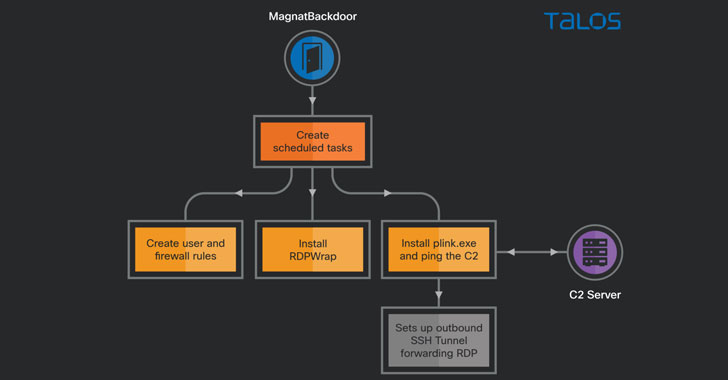
A series of malicious campaigns have been leveraging fake installers of popular apps and games such as Viber, WeChat, NoxPlayer, and Battlefield as a lure to trick users into downloading a new backdoor and an undocumented malicious Google Chrome extension with the goal of stealing credentials and data stored in the compromised systems as well as maintaining persistent remote access. Cisco Talos attributed the malware payloads to an unknown actor that goes by the alias " magnat ," noting that "these two families have been subject to constant development and improvement by their authors." The attacks are believed to have commenced in late 2018, with intermittent activity observed towards the end of 2019 and through early 2020, followed by fresh spikes since April 2021, while mainly singling out users in Canada, followed by the U.S., Australia, Italy, Spain, and Norway. A noteworthy aspect of the intrusions is the use of malvertising as a means to strike individua...
Microsoft Defender Flaw Exploited to Deliver ACR, Lumma, and Meduza Stealers

Microsoft Defender Flaw Exploited to Deliver ACR, Lumma, and Meduza Stealers

Jul 24, 2024 Malvertising / Threat Intelligence
A now-patched security flaw in the Microsoft Defender SmartScreen has been exploited as part of a new campaign designed to deliver information stealers such as ACR Stealer, Lumma , and Meduza . Fortinet FortiGuard Labs said it detected the stealer campaign targeting Spain, Thailand, and the U.S. using booby-trapped files that exploit CVE-2024-21412 (CVSS score: 8.1). The high-severity vulnerability allows an attacker to sidestep SmartScreen protection and drop malicious payloads. Microsoft addressed this issue as part of its monthly security updates released in February 2024. "Initially, attackers lure victims into clicking a crafted link to a URL file designed to download an LNK file," security researcher Cara Lin said . "The LNK file then downloads an executable file containing an [HTML Application] script." The HTA file serves as a conduit to decode and decrypt PowerShell code responsible for fetching a decoy PDF file and a shellcode injector that, in tur...
New EDDIESTEALER Malware Bypasses Chrome's App-Bound Encryption to Steal Browser Data

New EDDIESTEALER Malware Bypasses Chrome's App-Bound Encryption to Steal Browser Data

May 30, 2025 Browser Security / Malware
A new malware campaign is distributing a novel Rust-based information stealer dubbed EDDIESTEALER using the popular ClickFix social engineering tactic initiated via fake CAPTCHA verification pages. "This campaign leverages deceptive CAPTCHA verification pages that trick users into executing a malicious PowerShell script, which ultimately deploys the infostealer, harvesting sensitive data such as credentials, browser information, and cryptocurrency wallet details," Elastic Security Labs researcher Jia Yu Chan said in an analysis. The attack chains begin with threat actors compromising legitimate websites with malicious JavaScript payloads that serve bogus CAPTCHA check pages, which prompt site visitors to "prove you are not [a] robot" by following a three-step process, a prevalent tactic called ClickFix . This involves instructing the potential victim to open the Windows Run dialog prompt, paste an already copied command into the "verification window"...
New Banshee Stealer Targets 100+ Browser Extensions on Apple macOS Systems

New Banshee Stealer Targets 100+ Browser Extensions on Apple macOS Systems

Aug 16, 2024 Malware / Browser Security
Cybersecurity researchers have uncovered new stealer malware that's designed to specifically target Apple macOS systems. Dubbed Banshee Stealer, it's offered for sale in the cybercrime underground for a steep price of $3,000 a month and works across both x86_64 and ARM64 architectures.  "Banshee Stealer targets a wide range of browsers, cryptocurrency wallets, and around 100 browser extensions, making it a highly versatile and dangerous threat," Elastic Security Labs said in a Thursday report. The web browsers and crypto wallets targeted by the malware comprise Safari, Google Chrome, Mozilla Firefox, Brave, Microsoft Edge, Vivaldi, Yandex, Opera, OperaGX, Exodus, Electrum, Coinomi, Guarda, Wasabi Wallet, Atomic, and Ledger. It's also equipped to harvest system information and data from iCloud Keychain passwords and Notes, as well as incorporate a slew of anti-analysis and anti-debugging measures to determine if it's running in a virtual environment in a...
OtterCookie v4 Adds VM Detection and Chrome, MetaMask Credential Theft Capabilities

OtterCookie v4 Adds VM Detection and Chrome, MetaMask Credential Theft Capabilities

May 09, 2025 Malware / Browser Security
The North Korean threat actors behind the Contagious Interview campaign have been observed using updated versions of a cross-platform malware called OtterCookie with capabilities to steal credentials from web browsers and other files. NTT Security Holdings, which detailed the new findings, said the attackers have "actively and continuously" updated the malware, introducing versions v3 and v4 in February and April 2025, respectively. The Japanese cybersecurity company is tracking the cluster under the name WaterPlum , which is also known as CL-STA-0240, DeceptiveDevelopment, DEV#POPPER, Famous Chollima, PurpleBravo, and Tenacious Pungsan. OtterCookie was first documented by NTT last year after having observed it in attacks since September 2024. Delivered by means of a JavaScript payload via a malicious npm package, trojanized GitHub or Bitbucket repository, or a bogus videoconferencing app, it's designed to contact an external server to execute commands on compromis...
Expert Insights Articles Videos
Cybersecurity Resources