-->
#1 Trusted Cybersecurity News Platform
Followed by 5.20+ million
The Hacker News Logo
Subscribe – Get Latest News
Security Service Edge

The Hacker News | #1 Trusted Source for Cybersecurity News — Index Page

NASA sub-domain and Australian Police targeted by Hackers

NASA sub-domain and Australian Police targeted by Hackers

Mar 20, 2012
NASA sub-domain and Australian Police targeted by Hackers Hacker with name " Black Jester " hack another subdomain (  http://airtrafficconflictresolutions.arc.nasa.gov )   of  NASA. Hacker compromise the database of site and leak password hashes of Users and Database Info also. The leaked info posed on Pastebin Note . In Another Attack, Hacker - S3rver.exe managed to breach the official website of the International Police Association of Australia (ipa-australiapolice.com.au). A Pastebin paste made by the hackers contains the site’s database structure along with names, usernames, email addresses and password hashes, Softpedia Reported. The hackers claim that they have warned International Police Association representatives that the site contains some serious vulnerabilities, but apparently they did nothing to secure it. The hackers also tried to root the servers, but apparently it can’t be rooted.
Casa Presidencial website defaced by Latinhack

Casa Presidencial website defaced by Latinhack

Mar 20, 2012
Casa Presidencial website defaced by Latinhack The  Casa Presidencial website  was in temporary control of hackers on  Sunday . The minister explained that the hack was noticed while doing a backup of the site. The cyber-attack was attributed to a group called Latinhack, whose members have perpetrated more than 13,000 attacks on various government sites in Spain, the United Kingdom, Venezuela, Chile and the Dominican Republic. He also said the website's information was never at risk because it is physically stored in different places at separate servers, so these events do not affect users. The prez's website is based on Joomla's Content Management System (CMS) which according to experts is vulnerable to hacks if not regularly maintained.
Pakistani Hackers attacks 31 government and 46 educational institutions Websites

Pakistani Hackers attacks 31 government and 46 educational institutions Websites

Mar 20, 2012
Pakistani Hackers attacks 31 government and 46 educational institutions Websites Maharashtra police said, websites of more than 46 educational institutions and 31 government websites based in the district were allegedly hacked by a group reportedly based in Pakistan. KhantastiC, a hacker who claimed to be a part of Pakistan Net Army (PNA) reported on 'zone-h.net' the number of 'Rajasthan.gov.in' domain named websites hacked by him since January 16, 2012. Muslim Liberation Army (MLA), an obscure group said to .be based in Lahore, allegedly hacked into  46 educational institutions websites. Cyber Crime Branch has launched investigations after receiving complaints in this regard.
cyber security

5 Cloud Security Risks You Can’t Afford to Ignore

websiteSentinelOneEnterprise Security / Cloud Security
Get expert analysis, attacker insights, and case studies in our 2025 risk report.
cyber security

Red Report 2026: Analysis of 1.1M Malicious Files and 15.5M Actions

websitePicus SecurityAttack Surface / Cloud Security
New research shows 80% of top ATT&CK techniques now target evasion to remain undetected. Get your copy now.
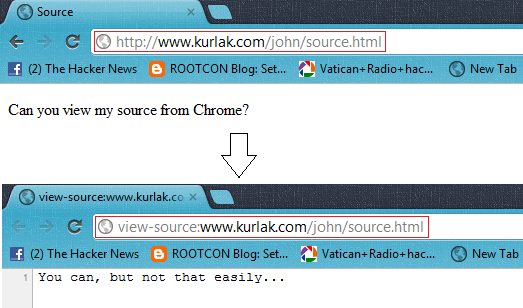
Exclusive - Source Code Spoofing with HTML5 and the LRO Character

Exclusive - Source Code Spoofing with HTML5 and the LRO Character

Mar 20, 2012
Exclusive - Source Code Spoofing with HTML5 and the LRO Character Article Written by  John Kurlak for The Hacker News,He is  senior studying Computer Science at Virginia Tech. Today John will teach us that How to Spoof the Source Code of a web page. For example,   Open  http://www.kurlak.com/john/source.html  and Try to View Source Code of the Page ;-) Can you View ?? About eight months ago, I learned about HTML5’s new JavaScript feature, history.replaceState(). The history.replaceState() function allows a site developer to modify the URL of the current history entry without refreshing the page. For example, I could use the history.replaceState() function to change the URL of my page in the address bar from “ http://www.kurlak.com/example.html ” to “ http://www.kurlak.com/example2.html ” When I first learned of the history.replaceState() function, I was both skeptical and curious. First, I wanted to see if history.replaceState() supported changing ...
Mercury v1.0 -  Framework for bug hunters to find Android vulnerabilities

Mercury v1.0 - Framework for bug hunters to find Android vulnerabilities

Mar 20, 2012
Mercury v1.0  - Framework for bug hunters to find Android vulnerabilities A free framework for bug hunters to find vulnerabilities, write proof-of-concept exploits and play in Android. Use dynamic analysis on Android applications and devices for quicker security assessments. Share publicly known methods of exploitation on Android and proof-of-concept exploits for applications and devices. The easy extensions interface allows users to write custom modules and exploits for Mercury Replace custom applications and scripts that perform single tasks with a framework that provides many tools. Mercury allows you to: Interact with the 4 IPC endpoints - activities, broadcast receivers, content providers and services Use a proper shell that allows you to play with the underlying Linux OS from the point of view of an unprivileged application (you will be amazed at how much you can still see) Find information on installed packages with optional search filters to allow ...
Kaspersky finds Malware that resides in your RAM

Kaspersky finds Malware that resides in your RAM

Mar 20, 2012
Kaspersky finds Malware that resides in your RAM Kaspersky Lab researchers have discovered a drive-by download attack that evades hard-drive checkers by installing malware that lives in the computer's memory. The 'fileless' bot is more difficult for antivirus software to detect, and resides in memory until the machine is rebooted. This Malware doesn't create any files on the affected systems was dropped on to the computers of visitors to popular news sites in Russia in a drive-by download attack.Drive-by download attacks are one of the primary methods of distributing malware over the web. They usually exploit vulnerabilities in outdated software products to infect computers without requiring user interaction. The attack code loaded an exploit for a known Java vulnerability (CVE-2011-3544), but it wasn't hosted on the affected websites themselves. Once the malware infected a Microsoft machine, the bot disabled User Account Control, contacted a command and control...
The Pirate Bay plans Low Orbit Server Drones to beat #Censorship

The Pirate Bay plans Low Orbit Server Drones to beat #Censorship

Mar 20, 2012
The Pirate Bay plans Low Orbit Server Drones to beat Censorship One of the world's largest BitTorrent sites " The Pirate Bay " is going to put servers on GPS-controlled aircraft drones in order to evade authorities who are looking to shut the site down. In a Sunday blog post, The Pirate Bay announced new " Low Orbit Server Stations " that will house the site's servers and files on unmanned, GPS-controlled, aircraft drones. TPB said: With the development of GPS controlled drones, far-reaching cheap radio equipment and tiny new computers like the Raspberry Pi, we’re going to experiment with sending out some small drones that will float some kilometers up in the air. This way our machines will have to be shut down with aeroplanes in order to shut down the system. A real act of war. We’re just starting so we haven’t figured everything out yet. But we can’t limit ourselves to hosting things just on land anymore. These Low Orbit Server Stations (LOSS) are jus...
Fake LinkedIn Emails Link to Blackhole Exploit Malware

Fake LinkedIn Emails Link to Blackhole Exploit Malware

Mar 19, 2012
Fake LinkedIn Emails Link to Blackhole Exploit Malware Cyber Criminals have been busy pumping out spam emails that pose as legitimate LinkedIn notices, enticing you to click on a link in order to read what message some random stranger has left for you. The incident was identified by researchers at security provider GFI Labs . If your Click the links, It will send you directly to a site housing a blackhole exploit kit that will attempt to take advantage of any system vulnerabilities in order to infect your PC with malware, Exactly which attempts to drop Cridex onto the PC. Cridex malware variant from the wild caught on camera that shows CAPTCHA tests used by some online services are still weak and can be broken by malware. The spammers did a good job crafting the bogus LinkedIn notices LinkedIn logo at the top left, familiar blue coloring, no obvious spelling mistakes, disguised links and even a spoofed sender’s address it’s pretty easy to spot the fake emails when you...
Expert Insights Articles Videos
Cybersecurity Resources