#1 Trusted Cybersecurity News Platform
Followed by 5.20+ million
The Hacker News Logo
Subscribe – Get Latest News
Salesforce Security Handbook

Search results for web.whatsapp.com | Breaking Cybersecurity News | The Hacker News

WhatsApp Web — New WhatsApp Feature Allows You to Chat From Your Browser

WhatsApp Web — New WhatsApp Feature Allows You to Chat From Your Browser

Jan 21, 2015
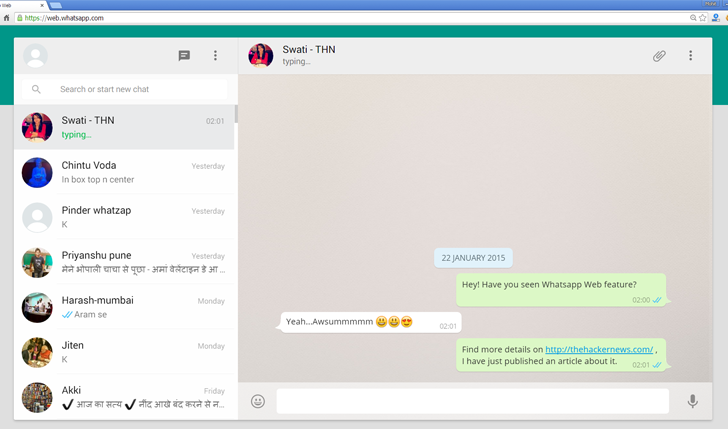
The most popular smartphone messaging service WhatsApp is now able to communicate with friends from their PC. No Rumours at all !! Enjoy WhatsApp from your desktop from now on. Last month, it was leaked that Whatsapp was working on a web client and finally from today they are introducing it to the public. The feature is called " WhatsApp Web ," which gives its users the ability to read and send messages directly from their web browsers. HOW TO USE WHATSAPP ON PC/DESKTOP Interested WhatsApp users simply need to open Chrome and navigate to https://web.whatsapp.com A QR code will appear on the web page, which must be scanned using WhatsApp mobile application to activate the service. By scanning the  QR code  that appears, users will automatically have paired their mobile WhatsApp with the WhatsApp web client, as shown.  WhatsApp Web requires that you install and run the latest Whatsapp version of the Android app on your phone. The feature currently work...
WhatsApp Web Client Now Available on Firefox and Opera Browsers

WhatsApp Web Client Now Available on Firefox and Opera Browsers

Feb 26, 2015
It's been a long time coming, but now the users of Firefox and Opera browsers don't need to rely on the Chrome browser to access WhatsApp Web client, as the most popular smartphone messaging service has announced that the Web-based version of its service now works on Firefox and Opera web browsers   too. WHATSAPP WEB AVAILABLE FOR OPERA & FIREFOX Almost a month ago, WhatsApp launched the web client of its service but the access was limited only to the Google Chrome users. Now, the company is giving more choices to desktop users by launching WhatsApp Web Today for Opera and Firefox browsers , though you'll still have to wait a little long if you're a Safari user. WhatsApp Web is nothing than an extension of the core mobile WhatsApp application. It syncs conversations from your smartphone devices to your PCs, with everything stored on the mobile device itself. HOW TO USE WHATSAPP ON PC/DESKTOP In order to install WhatsApp web in your PC or laptop running...
How To Use WhatsApp Web Client on iPhone and Other iOS Devices

How To Use WhatsApp Web Client on iPhone and Other iOS Devices

Aug 20, 2015
WhatsApp Web client support is now available for iOS users. That's right, now iOS users can access their instant messaging facility on the web; without taking the other route (via jailbreaking). Eight months ago, on January 21, 2015, WhatsApp was made available on web browsers , and let Android, Windows Phone 8.0 and 8.1, Nokia S60, Nokia S40 Single SIM EVO, BlackBerry and BB10 smartphones enjoy the service. However, there was no web solution for iOS users at that time because of limitations of the platform and high-security standards adopted by Apple, so they were forced to wait for the service. However, iOS users' wait for WhatsApp Web is over now, and they can also enjoy WhatsApp Web – Same WhatsApp account on iPhone and desktops. Yesterday, WhatsApp enabled its web client interface for iPhone users. How to Use WhatsApp on iPhone and iOS Devices? Interested WhatsApp users simply need to open Safari browser and navigate to https://web.whatsa...
cyber security

10 Must-Have Features Your BAS Should Deliver

websitePicus SecurityBreach and Attack Simulation
Evaluating Breach and Attack Simulation? Use this guide to distinguish marketing claims from real proof.
cyber security

Pentesting With Proof. Zero-Day, Zero-Pay and the #1 AI Hacker Behind It

websiteXBOWPenetration Testing
Real exploits, no fluff. The AI that topped HackerOne powers every on-demand pentest.
Beware of Fake 'WhatsApp Web' Spreading Banking Trojan

Beware of Fake 'WhatsApp Web' Spreading Banking Trojan

Feb 07, 2015
Cybercriminals are known to take advantage of everything that captures public attention in order to spread malware, and the recently launched web client of the most popular WhatsApp messaging application seems to be their next target. Last month, the messaging giant WhatsApp, with 700 million users worldwide, finally launched its web client to the public. The feature is called " WhatsApp Web ," which gives its users the ability to read and send messages directly from their web browsers. FAKE WHATSAPP WEB SPREADING BANKING TROJANS However, malicious hackers have taken the advantage of the latest WhatsApp Web and have started fooling users all over the world with fake downloads masquerading as a desktop variant of the WhatsApp mobile application. Security researchers at Kaspersky Labs have spotted a seemingly genuine WhatsApp Web for Windows in spam campaign available for fake download that actually spreads financial malware Trojans to the systems worldwide. ...
131 Chrome Extensions Caught Hijacking WhatsApp Web for Massive Spam Campaign

131 Chrome Extensions Caught Hijacking WhatsApp Web for Massive Spam Campaign

Oct 20, 2025 Browser Security / Malware
Cybersecurity researchers have uncovered a coordinated campaign that leveraged 131 rebranded clones of a WhatsApp Web automation extension for Google Chrome to spam Brazilian users at scale. The 131 spamware extensions share the same codebase, design patterns, and infrastructure, according to supply chain security company Socket. The browser add-ons collectively have about 20,905 active users. "They are not classic malware, but they function as high-risk spam automation that abuses platform rules," security researcher Kirill Boychenko said. "The code injects directly into the WhatsApp Web page, running alongside WhatsApp's own scripts, automates bulk outreach and scheduling in ways that aim to bypass WhatsApp's anti-spam enforcement." The end goal of the campaign is to blast outbound messaging via WhatsApp in a manner that bypasses the messaging platform's rate limits and anti-spam controls. The activity is assessed to have been ongoing for at lea...
WhatsApp vulnerability can be misused for Spreading Malware

WhatsApp vulnerability can be misused for Spreading Malware

Sep 13, 2012
A Cross site scripting (XSS) vulnerability in WhatsApp website reported to The Hacker News by Edgard Chammas. WhatsApp is one of the most famous cross-platform mobile messaging app for iPhone, BlackBerry, Android, Windows Phone and Nokia used to send text, video, images, audio b/w Whatsapp users. Cross-site scripting (XSS) is a type of computer security vulnerability typically found in Web applications, such as web browsers through breaches of browser security, that enables attackers to inject client-side script into Web pages viewed by other users. Reported vulnerability exist on payment procedure page as shown in above picture. The Sample code given below to demonstrate the vulnerability. Recently, there has been an increase in web malware and spam activities and such vulnerabilities can be misused by attackers to spread Malwares and rogue applications. Edgard also demonstrate that How this can be used to trick users to download a fake application (Malware...
Researchers Warn of Self-Spreading WhatsApp Malware Named SORVEPOTEL

Researchers Warn of Self-Spreading WhatsApp Malware Named SORVEPOTEL

Oct 03, 2025 Malware / Online Security
Brazilian users have emerged as the target of a new self-propagating malware dubbed SORVEPOTEL that spreads via the popular messaging app WhatsApp. The campaign, codenamed Water Saci by Trend Micro, weaponizes the trust with the platform to extend its reach across Windows systems, adding the attack is "engineered for speed and propagation" rather than data theft or ransomware. "SORVEPOTEL has been observed to spread across Windows systems through convincing phishing messages with malicious ZIP file attachments," researchers Jeffrey Francis Bonaobra, Maristel Policarpio, Sophia Nilette Robles, Cj Arsley Mateo, Jacob Santos, and Paul John Bardon said . "Interestingly, the phishing message that contains the malicious file attachment requires users to open it on a desktop, suggesting that threat actors might be more interested in targeting enterprises rather than consumers." Once the attachment is opened, the malware automatically propagates via the deskt...
WhatsApp Malware 'Maverick' Hijacks Browser Sessions to Target Brazil's Biggest Banks

WhatsApp Malware 'Maverick' Hijacks Browser Sessions to Target Brazil's Biggest Banks

Nov 11, 2025 Malware / Botnet
Threat hunters have uncovered similarities between a banking malware called Coyote and a newly disclosed malicious program dubbed Maverick that has been propagated via WhatsApp. According to a report from CyberProof, both malware strains are written in .NET, target Brazilian users and banks, and feature identical functionality to decrypt, targeting banking URLs and monitor banking applications. More importantly, both include the ability to spread through WhatsApp Web . Maverick was first documented by Trend Micro early last month, attributing it to a threat actor dubbed Water Saci . The campaign involves two components: A self-propagating malware referred to as SORVEPOTEL that's spread via the desktop web version of WhatsApp and is used to deliver a ZIP archive containing the Maverick payload. The malware is designed to monitor active browser window tabs for URLs that match a hard-coded list of financial institutions in Latin America. Should the URLs match, it establishes con...
New Sneaky Xamalicious Android Malware Hits Over 327,000 Devices

New Sneaky Xamalicious Android Malware Hits Over 327,000 Devices

Dec 27, 2023 Privacy / App Security
A new Android backdoor has been discovered with potent capabilities to carry out a range of malicious actions on infected devices. Dubbed  Xamalicious  by the McAfee Mobile Research Team, the malware is so named for the fact that it's developed using an open-source mobile app framework called Xamarin and abuses the operating system's accessibility permissions to fulfill its objectives. It's also capable of gathering metadata about the compromised device and contacting a command-and-control (C2) server to fetch a second-stage payload, but only after determining if it fits the bill. The second stage is "dynamically injected as an assembly DLL at runtime level to take full control of the device and potentially perform fraudulent actions such as clicking on ads, installing apps, among other actions financially motivated without user consent," security researcher Fernando Ruiz  said . The cybersecurity firm said it identified 25 apps that come with this active thr...
CTM360 Exposes a Global WhatsApp Hijacking Campaign: HackOnChat

CTM360 Exposes a Global WhatsApp Hijacking Campaign: HackOnChat

Nov 20, 2025 Online Fraud / Web Security
CTM360 has identified a rapidly expanding WhatsApp account-hacking campaign targeting users worldwide via a network of deceptive authentication portals and impersonation pages. The campaign, internally dubbed HackOnChat, abuses WhatsApp's familiar web interface, using social engineering tactics to trick users into compromising their accounts. Investigators identified thousands of malicious URLs being hosted on inexpensive top-level domains and rapidly generated through modern website-building platforms, allowing attackers to deploy new pages at scale. The campaign's activity logs show hundreds of incidents in recent weeks, with a noticeable surge across the Middle East and Asia. Read the full report here: https://www.ctm360.com/reports/hackonchat-unmasking-the-whatsapp-hacking-scam The hacking operations and the exploitation techniques Two techniques dominate these hacking operations. The Session Hijacking , where threat actors misuse the linked-device functionality to hijack act...
Malicious Go, npm Packages Deliver Cross-Platform Malware, Trigger Remote Data Wipes

Malicious Go, npm Packages Deliver Cross-Platform Malware, Trigger Remote Data Wipes

Aug 07, 2025 Malware / Threat Intelligence
Cybersecurity researchers have discovered a set of 11 malicious Go packages that are designed to download additional payloads from remote servers and execute them on both Windows and Linux systems. "At runtime the code silently spawns a shell, pulls a second-stage payload from an interchangeable set of .icu and .tech command-and-control (C2) endpoints, and executes it in memory," Socket security researcher Olivia Brown said . The list of identified packages is below - github.com/stripedconsu/linker github.com/agitatedleopa/stm github.com/expertsandba/opt github.com/wetteepee/hcloud-ip-floater github.com/weightycine/replika github.com/ordinarymea/tnsr_ids github.com/ordinarymea/TNSR_IDS github.com/cavernouskina/mcp-go github.com/lastnymph/gouid github.com/sinfulsky/gouid github.com/briefinitia/gouid
New Apple Zero-Days Exploited to Target Egyptian ex-MP with Predator Spyware

New Apple Zero-Days Exploited to Target Egyptian ex-MP with Predator Spyware

Sep 23, 2023 Zero Day / Vulnerability
The  three zero-day flaws  addressed by Apple on September 21, 2023, were leveraged as part of an iPhone exploit chain in an attempt to deliver a spyware strain called  Predator  targeting former Egyptian member of parliament Ahmed Eltantawy between May and September 2023. "The targeting took place after Eltantawy publicly  stated his plans  to run for President in the 2024 Egyptian elections," the Citizen Lab  said , attributing the attack with high confidence to the Egyptian government owing to it being a known customer of the commercial spying tool. According to a joint investigation conducted by the Canadian interdisciplinary laboratory and Google's Threat Analysis Group (TAG), the mercenary surveillance tool is said to have been delivered via links sent on SMS and WhatsApp. "In August and September 2023, Eltantawy's Vodafone Egypt mobile connection was persistently selected for targeting via network injection; when Eltantawy visited certain we...
Brazil Hit by Banking Trojan Spread via WhatsApp Worm and RelayNFC NFC Relay Fraud

Brazil Hit by Banking Trojan Spread via WhatsApp Worm and RelayNFC NFC Relay Fraud

Dec 03, 2025 Banking Security / Malware
The threat actor known as Water Saci is actively evolving its tactics, switching to a sophisticated, highly layered infection chain that uses HTML Application (HTA) files and PDFs to propagate via WhatsApp a worm that deploys a banking trojan in attacks targeting users in Brazil. The latest wave is characterized by the attackers shifting from PowerShell to a Python-based variant that spreads the malware in a worm-like manner over WhatsApp Web. "Their new multi-format attack chain and possible use of artificial intelligence (AI) to convert propagation scripts from PowerShell to Python exemplifies a layered approach that has enabled Water Saci to bypass conventional security controls, exploit user trust across multiple channels, and ramp up their infection rates," Trend Micro researchers Jeffrey Francis Bonaobra, Sarah Pearl Camiling, Joe Soares, Byron Gelera, Ian Kenefick, and Emmanuel Panopio said . In these attacks, users receive messages from trusted contacts on WhatsA...
iPhone Hacking Campaign Using MDM Software Is Broader Than Previously Known

iPhone Hacking Campaign Using MDM Software Is Broader Than Previously Known

Jul 25, 2018
India-linked highly targeted mobile malware campaign, first unveiled two weeks ago , has been found to be part of a broader campaign targeting multiple platforms, including windows devices and possibly Android as well. As reported in our previous article , earlier this month researchers at Talos threat intelligence unit discovered a group of Indian hackers abusing mobile device management (MDM) service to hijack and spy on a few targeted iPhone users in India. Operating since August 2015, the attackers have been found abusing MDM service to remotely install malicious versions of legitimate apps, including Telegram, WhatsApp, and PrayTime, onto targeted iPhones. These modified apps have been designed to secretly spy on iOS users, and steal their real-time location, SMS, contacts, photos and private messages from third-party chatting applications. During their ongoing investigation, Talos researchers identified a new MDM infrastructure and several malicious binaries – designed...
Python-Based WhatsApp Worm Spreads Eternidade Stealer Across Brazilian Devices

Python-Based WhatsApp Worm Spreads Eternidade Stealer Across Brazilian Devices

Nov 19, 2025 Malware / Cyber Attack
Cybersecurity researchers have disclosed details of a new campaign that leverages a combination of social engineering and WhatsApp hijacking to distribute a Delphi-based banking trojan named Eternidade Stealer as part of attacks targeting users in Brazil. "It uses Internet Message Access Protocol (IMAP) to dynamically retrieve command-and-control (C2) addresses, allowing the threat actor to update its C2 server," Trustwave SpiderLabs researchers Nathaniel Morales, John Basmayor, and Nikita Kazymirskyi said in a technical breakdown of the campaign shared with The Hacker News. "It is distributed through a WhatsApp worm campaign, with the actor now deploying a Python script, a shift from previous PowerShell-based scripts to hijack WhatsApp and spread malicious attachments. The findings come close on the heels of another campaign dubbed Water Saci that has targeted Brazilian users with a worm that propagates via WhatsApp Web known as SORVEPOTEL, which then acts as a c...
Large-Scale ClickFix Phishing Attacks Target Hotel Systems with PureRAT Malware

Large-Scale ClickFix Phishing Attacks Target Hotel Systems with PureRAT Malware

Nov 10, 2025 Malware / Cybercrime
Cybersecurity researchers have called attention to a massive phishing campaign targeting the hospitality industry that lures hotel managers to ClickFix-style pages and harvest their credentials by deploying malware like PureRAT . "The attacker's modus operandi involved using a compromised email account to send malicious messages to multiple hotel establishments," Sekoia said . "This campaign leverages spear-phishing emails that impersonate Booking.com to redirect victims to malicious websites, employing the ClickFix social engineering tactic to deploy PureRAT." The end goal of the campaign is to steal credentials from compromised systems that grant threat actors unauthorized access to booking platforms like Booking.com or Expedia, which are then either sold on cybercrime forums or used to send fraudulent emails to hotel customers to conduct fraud. The activity is assessed to be active since at least April 2025 and operational as of early October 2025. It...
⚡ Weekly Recap: Zero-Day Exploits, Developer Malware, IoT Botnets, and AI-Powered Scams

⚡ Weekly Recap: Zero-Day Exploits, Developer Malware, IoT Botnets, and AI-Powered Scams

May 12, 2025 Cybersecurity / Hacking News
What do a source code editor, a smart billboard, and a web server have in common? They've all become launchpads for attacks—because cybercriminals are rethinking what counts as "infrastructure." Instead of chasing high-value targets directly, threat actors are now quietly taking over the overlooked: outdated software, unpatched IoT devices, and open-source packages. It's not just clever—it's reshaping how intrusion, persistence, and evasion happen at scale. ⚡ Threat of the Week 5Socks Proxy Using IoT, EoL Systems Dismantled in Law Enforcement Operation — A joint law enforcement operation undertaken by Dutch and U.S. authorities dismantled a criminal proxy network, known as anyproxy[.]net and 5socks[.]net, that was powered by thousands of infected Internet of Things (IoT) and end-of-life (EoL) devices, enlisting them into a botnet for providing anonymity to malicious actors. The illicit platform, active since 2004, advertised more than 7,000 online proxies daily, with infected ...
⚡ Weekly Recap: Fortinet Exploit, Chrome 0-Day, BadIIS Malware, Record DDoS, SaaS Breach & More

⚡ Weekly Recap: Fortinet Exploit, Chrome 0-Day, BadIIS Malware, Record DDoS, SaaS Breach & More

Nov 24, 2025 Cybersecurity / Hacking News
This week saw a lot of new cyber trouble. Hackers hit Fortinet and Chrome with new 0-day bugs. They also broke into supply chains and SaaS tools. Many hid inside trusted apps, browser alerts, and software updates. Big firms like Microsoft, Salesforce, and Google had to react fast — stopping DDoS attacks, blocking bad links, and fixing live flaws. Reports also showed how fast fake news, AI risks, and attacks on developers are growing. Here's what mattered most in security this week. ⚡ Threat of the Week Fortinet Warns of Another Silently Patched and Actively Exploited FortiWeb Flaw — Fortinet has warned that a new security flaw in FortiWeb has been exploited in the wild. The medium-severity vulnerability, tracked as CVE-2025-58034, carries a CVSS score of 6.7 out of a maximum of 10.0. It has been addressed in version 8.0.2. "An Improper Neutralization of Special Elements used in an OS Command ('OS Command Injection') vulnerability [CWE-78] in FortiWeb may allow an a...
New Android Malware Wave Hits Banking via NFC Relay Fraud, Call Hijacking, and Root Exploits

New Android Malware Wave Hits Banking via NFC Relay Fraud, Call Hijacking, and Root Exploits

Aug 14, 2025 Mobile Security / Banking Fraud
Cybersecurity researchers have disclosed a new Android trojan called PhantomCard that abuses near-field communication (NFC) to conduct relay attacks for facilitating fraudulent transactions in attacks targeting banking customers in Brazil. "PhantomCard relays NFC data from a victim's banking card to the fraudster's device," ThreatFabric said in a report. "PhantomCard is based on Chinese-originating NFC relay malware-as-a-service." The Android malware, distributed via fake Google Play web pages mimicking apps for card protection, goes by the name "Proteção Cartões" (package name "com.nfupay.s145" or "com.rc888.baxi.English"). The bogus pages also feature deceptive positive reviews to persuade victims into installing the app. It's currently not known how links to these pages are distributed, but it likely involves smishing or a similar social engineering technique. Once the app is installed and opened, it requests victim...
New Malware Technique Could Exploit Windows UI Framework to Evade EDR Tools

New Malware Technique Could Exploit Windows UI Framework to Evade EDR Tools

Dec 11, 2024 Malware / Endpoint Security
A newly devised technique leverages a Windows accessibility framework called UI Automation (UIA) to perform a wide range of malicious activities without tipping off endpoint detection and response (EDR) solutions. "To exploit this technique, a user must be convinced to run a program that uses UI Automation," Akamai security researcher Tomer Peled said in a report shared with The Hacker News. "This can lead to stealthy command execution, which can harvest sensitive data, redirect browsers to phishing websites, and more." Even worse, local attackers could take advantage of this security blindspot to execute commands and read/write messages from/to messaging applications like Slack and WhatsApp. On top of that, it could also be potentially weaponized to manipulate UI elements over a network. First available in Windows XP as part of the Microsoft .NET Framework, UI Automation is designed to provide programmatic access to various user interface (UI) elements and h...
Expert Insights Articles Videos
Cybersecurity Resources