-->
#1 Trusted Cybersecurity News Platform
Followed by 5.20+ million
The Hacker News Logo
Subscribe – Get Latest News
Security Service Edge

Search results for how to run code in browser vs code | Breaking Cybersecurity News | The Hacker News

Newly Discovered Bugs in VSCode Extensions Could Lead to Supply Chain Attacks

Newly Discovered Bugs in VSCode Extensions Could Lead to Supply Chain Attacks

May 27, 2021
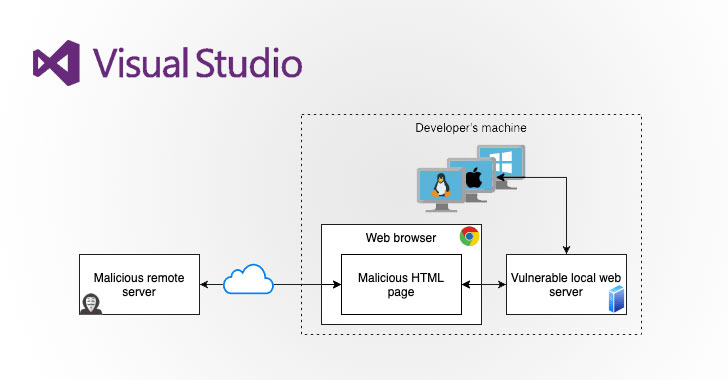
Severe security flaws uncovered in popular Visual Studio Code extensions could enable attackers to compromise local machines as well as build and deployment systems through a developer's integrated development environment (IDE). The vulnerable extensions could be exploited to run arbitrary code on a developer's system remotely, in what could ultimately pave the way for supply chain attacks. Some of the extensions in question are "LaTeX Workshop," "Rainbow Fart," "Open in Default Browser," and "Instant Markdown," all of which have cumulatively racked up about two million installations between them. "Developer machines usually hold significant credentials, allowing them (directly or indirectly) to interact with many parts of the product," researchers from open-source security platform Snyk  said  in a deep-dive published on May 26. "Leaking a developer's private key can allow a malicious stakeholder to clone important...
Malicious Pull Request Targets 6,000+ Developers via Vulnerable Ethcode VS Code Extension

Malicious Pull Request Targets 6,000+ Developers via Vulnerable Ethcode VS Code Extension

Jul 08, 2025
Cybersecurity researchers have flagged a supply chain attack targeting a Microsoft Visual Studio Code (VS Code) extension called Ethcode that has been installed a little over 6,000 times. The compromise, per ReversingLabs , occurred via a GitHub pull request that was opened by a user named Airez299 on June 17, 2025. First released by 7finney in 2022, Ethcode is a VS Code extension that's used to deploy and execute solidity smart contracts in Ethereum Virtual Machine ( EVM )-based blockchains. An EVM is a decentralized computation engine that's designed to run smart contracts on the Ethereum network. According to the supply chain security company, the GitHub project received its last non-malicious update on September 6, 2024. That changed last month when Airez299 opened a pull request with the message "Modernize codebase with viem integration and testing framework." The user claimed to have added a new testing framework with Mocha integration and contract testin...
Cursor AI Code Editor Flaw Enables Silent Code Execution via Malicious Repositories

Cursor AI Code Editor Flaw Enables Silent Code Execution via Malicious Repositories

Sep 12, 2025 AI Security / Vulnerability
A security weakness has been disclosed in the artificial intelligence (AI)-powered code editor Cursor that could trigger code execution when a maliciously crafted repository is opened using the program. The issue stems from the fact that an out-of-the-box security setting is disabled by default, opening the door for attackers to run arbitrary code on users' computers with their privileges. "Cursor ships with Workspace Trust disabled by default, so VS Code-style tasks configured with runOptions.runOn: 'folderOpen' auto-execute the moment a developer browses a project," Oasis Security said in an analysis. "A malicious .vscode/tasks.json turns a casual 'open folder' into silent code execution in the user's context." Cursor is an AI-powered fork of Visual Studio Code, which supports a feature called Workspace Trust to allow developers to safely browse and edit code regardless of where it came from or who wrote it. With this option disab...
cyber security

GitLab Security Best Practices

websiteWizDevSecOps / Compliance
Learn how to reduce real-world GitLab risk by implementing essential hardening steps across the full software delivery lifecycle.
cyber security

SANS ICS Command Briefing: Preparing for What Comes Next in Industrial Security

websiteSANSICS Security / Security Training
Experts discuss access control, visibility, recovery, and governance for ICS/OT in the year ahead.
⚡ Weekly Recap: Firewall Flaws, AI-Built Malware, Browser Traps, Critical CVEs & More

⚡ Weekly Recap: Firewall Flaws, AI-Built Malware, Browser Traps, Critical CVEs & More

Jan 26, 2026 Hacking News / Cybersecurity
Security failures rarely arrive loudly. They slip in through trusted tools, half-fixed problems, and habits people stop questioning. This week’s recap shows that pattern clearly. Attackers are moving faster than defenses, mixing old tricks with new paths. “Patched” no longer means safe, and every day, software keeps becoming the entry point. What follows is a set of small but telling signals. Short updates that, together, show how quickly risk is shifting and why details can’t be ignored. ⚡ Threat of the Week Improperly Patched Flaw Exploited Again in Fortinet Firewalls — Fortinet confirmed that it's working to completely plug a FortiCloud SSO authentication bypass vulnerability following reports of fresh exploitation activity on fully-patched firewalls. "We have identified a number of cases where the exploit was to a device that had been fully upgraded to the latest release at the time of the attack, which suggested a new attack path," the company said. The activi...
⚡ Weekly Recap: Apple 0-Days, WinRAR Exploit, LastPass Fines, .NET RCE, OAuth Scams & More

⚡ Weekly Recap: Apple 0-Days, WinRAR Exploit, LastPass Fines, .NET RCE, OAuth Scams & More

Dec 15, 2025 Hacking News / Cybersecurity
If you use a smartphone, browse the web, or unzip files on your computer, you are in the crosshairs this week. Hackers are currently exploiting critical flaws in the daily software we all rely on—and in some cases, they started attacking before a fix was even ready. Below, we list the urgent updates you need to install right now to stop these active threats. ⚡ Threat of the Week Apple and Google Release Fixes for Actively Exploited Flaws — Apple released security updates for iOS, iPadOS, macOS, tvOS, watchOS, visionOS, and Safari web browser to address two zero-days that the company said have been exploited in highly targeted attacks. CVE-2025-14174 has been described as a memory corruption issue, while the second, CVE-2025-43529, is a use-after-free bug. They can both be exploited using maliciously crafted web content to execute arbitrary code. CVE-2025-14174 was also addressed by Google in its Chrome browser since it resides in its open-source Almost Native Graphics Layer Engi...
⚡ Weekly Recap: APT Campaigns, Browser Hijacks, AI Malware, Cloud Breaches and Critical CVEs

⚡ Weekly Recap: APT Campaigns, Browser Hijacks, AI Malware, Cloud Breaches and Critical CVEs

May 26, 2025 Cybersecurity / Hacking News
Cyber threats don't show up one at a time anymore. They’re layered, planned, and often stay hidden until it’s too late. For cybersecurity teams, the key isn’t just reacting to alerts—it’s spotting early signs of trouble before they become real threats. This update is designed to deliver clear, accurate insights based on real patterns and changes we can verify. With today’s complex systems, we need focused analysis—not noise. What you’ll see here isn’t just a list of incidents, but a clear look at where control is being gained, lost, or quietly tested. ⚡ Threat of the Week Lumma Stealer, DanaBot Operations Disrupted — A coalition of private sector companies and law enforcement agencies have taken down the infrastructure associated with Lumma Stealer and DanaBot . Charges have also been unsealed against 16 individuals for their alleged involvement in the development and deployment of DanaBot. The malware is equipped to siphon data from victim computers, hijack banking session...
⚡ Weekly Recap: Fortinet Exploit, Chrome 0-Day, BadIIS Malware, Record DDoS, SaaS Breach & More

⚡ Weekly Recap: Fortinet Exploit, Chrome 0-Day, BadIIS Malware, Record DDoS, SaaS Breach & More

Nov 24, 2025 Cybersecurity / Hacking News
This week saw a lot of new cyber trouble. Hackers hit Fortinet and Chrome with new 0-day bugs. They also broke into supply chains and SaaS tools. Many hid inside trusted apps, browser alerts, and software updates. Big firms like Microsoft, Salesforce, and Google had to react fast — stopping DDoS attacks, blocking bad links, and fixing live flaws. Reports also showed how fast fake news, AI risks, and attacks on developers are growing. Here’s what mattered most in security this week. ⚡ Threat of the Week Fortinet Warns of Another Silently Patched and Actively Exploited FortiWeb Flaw — Fortinet has warned that a new security flaw in FortiWeb has been exploited in the wild. The medium-severity vulnerability, tracked as CVE-2025-58034, carries a CVSS score of 6.7 out of a maximum of 10.0. It has been addressed in version 8.0.2. "An Improper Neutralization of Special Elements used in an OS Command ('OS Command Injection') vulnerability [CWE-78] in FortiWeb may allow an a...
ThreatsDay Bulletin: Wi-Fi Hack, npm Worm, DeFi Theft, Phishing Blasts— and 15 More Stories

ThreatsDay Bulletin: Wi-Fi Hack, npm Worm, DeFi Theft, Phishing Blasts— and 15 More Stories

Dec 04, 2025 Cybersecurity / Hacking News
Think your Wi-Fi is safe? Your coding tools? Or even your favorite financial apps? This week proves again how hackers, companies, and governments are all locked in a nonstop race to outsmart each other. Here’s a quick rundown of the latest cyber stories that show how fast the game keeps changing. DeFi exploit drains funds Critical yETH Exploit Used to Steal $9M A critical exploit targeting Yearn Finance's yETH pool on Ethereum has been exploited by unknown threat actors, resulting in the theft of approximately $9 million from the protocol. The attack is said to have abused a flaw in how the protocol manages its internal accounting, stemming from the fact that a cache containing calculated values to save on gas fees was never cleared when the pool was completely emptied. "The attacker achieved this by minting an astronomical number of tokens – 235 septillion yETH (a 41-digit number) – while depositing only 16 wei, worth approxim...
⚡ Weekly Recap: Proxy Botnet, Office Zero-Day, MongoDB Ransoms, AI Hijacks & New Threats

⚡ Weekly Recap: Proxy Botnet, Office Zero-Day, MongoDB Ransoms, AI Hijacks & New Threats

Feb 02, 2026 Hacking News / Cybersecurity
Every week brings new discoveries, attacks, and defenses that shape the state of cybersecurity. Some threats are stopped quickly, while others go unseen until they cause real damage. Sometimes a single update, exploit, or mistake changes how we think about risk and protection. Every incident shows how defenders adapt — and how fast attackers try to stay ahead. This week’s recap brings you the key moments that matter most, in one place, so you can stay informed and ready for what’s next. ⚡ Threat of the Week Google Disrupts IPIDEA Residential Proxy Network — Google has crippled IPIDEA, a massive residential proxy network consisting of user devices that are being used as the last-mile link in cyberattack chains. According to the tech giant, not only do these networks permit bad actors to conceal their malicious traffic, but they also open up users who enroll their devices to further attacks. Residential IP addresses in the U.S., Canada, and Europe were seen as the most desirable. ...
⚡ Weekly Recap: Lazarus Hits Web3, Intel/AMD TEEs Cracked, Dark Web Leak Tool & More

⚡ Weekly Recap: Lazarus Hits Web3, Intel/AMD TEEs Cracked, Dark Web Leak Tool & More

Nov 03, 2025 Cybersecurity / Hacking News
Cyberattacks are getting smarter and harder to stop. This week, hackers used sneaky tools, tricked trusted systems, and quickly took advantage of new security problems—some just hours after being found. No system was fully safe. From spying and fake job scams to strong ransomware and tricky phishing, the attacks came from all sides. Even encrypted backups and secure areas were put to the test. Keep reading for the full list of the biggest cyber news from this week—clearly explained and easy to follow. ⚡ Threat of the Week Motex Lanscope Flaw Exploited to Drop Gokcpdoor — A suspected Chinese cyber espionage actor known as Tick has been attributed to a target campaign that has leveraged a recently disclosed critical security flaw in Motex Lanscope Endpoint Manager (CVE-2025-61932, CVSS score: 9.3) to infiltrate target networks and deploy a backdoor called Gokcpdoor. Sophos, which disclosed details of the activity, said it was "limited to sectors aligned with their intelligence...
How the Browser Became the Main Cyber Battleground

How the Browser Became the Main Cyber Battleground

Jul 29, 2025 Endpoint Protection / Identity Management
Until recently, the cyber attacker methodology behind the biggest breaches of the last decade or so has been pretty consistent: Compromise an endpoint via software exploit, or social engineering a user to run malware on their device;  Find ways to move laterally inside the network and compromise privileged identities; Repeat as needed until you can execute your desired attack — usually stealing data from file shares, deploying ransomware, or both.  But attacks have fundamentally changed as networks have evolved. With the SaaS-ification of enterprise IT, core business systems aren’t locally deployed and centrally managed in the way they used to be. Instead, they’re logged into over the internet, and accessed via a web browser. Attacks have shifted from targeting local networks to SaaS services, accessed through employee web browsers. Under the shared responsibility model, the part that’s left to the business consuming a SaaS service is mostly constrained to how they ma...
⚡ Weekly Recap: Bootkit Malware, AI-Powered Attacks, Supply Chain Breaches, Zero-Days & More

⚡ Weekly Recap: Bootkit Malware, AI-Powered Attacks, Supply Chain Breaches, Zero-Days & More

Sep 15, 2025 Cybersecurity / Hacking News
In a world where threats are persistent, the modern CISO’s real job isn't just to secure technology—it's to preserve institutional trust and ensure business continuity. This week, we saw a clear pattern: adversaries are targeting the complex relationships that hold businesses together, from supply chains to strategic partnerships. With new regulations and the rise of AI-driven attacks, the decisions you make now will shape your organization's resilience for years to come. This isn't just a threat roundup; it's the strategic context you need to lead effectively. Here’s your full weekly recap, packed with the intelligence to keep you ahead. ⚡ Threat of the Week New HybridPetya Ransomware Bypasses UEFI Secure Boot — A copycat version of the infamous Petya/NotPetya malware dubbed HybridPetya has been spotted. But no telemetry exists to suggest HybridPetya has been deployed in the wild yet. It also differs in one key respect: It can compromise the secure boot featu...
⚡ Weekly Recap: Chrome 0-Day, Ivanti Exploits, MacOS Stealers, Crypto Heists and More

⚡ Weekly Recap: Chrome 0-Day, Ivanti Exploits, MacOS Stealers, Crypto Heists and More

Jul 07, 2025 Cybersecurity / Hacking
Everything feels secure—until one small thing slips through. Even strong systems can break if a simple check is missed or a trusted tool is misused. Most threats don’t start with alarms—they sneak in through the little things we overlook. A tiny bug, a reused password, a quiet connection—that’s all it takes. Staying safe isn’t just about reacting fast. It’s about catching these early signs before they blow up into real problems. That’s why this week’s updates matter. From stealthy tactics to unexpected entry points, the stories ahead reveal how quickly risk can spread—and what smart teams are doing to stay ahead. Dive in. ⚡ Threat of the Week U.S. Disrupts N. Korea IT Worker Scheme — Prosecutors said they uncovered the North Korean IT staff working at over 100 U.S. companies using fictitious or stolen identities and not only drawing salaries, but also stealing secret data and plundering virtual currency more than $900,000 in one incident targeting an unnamed blockchain company in ...
Expert Insights Articles Videos
Cybersecurity Resources