#1 Trusted Cybersecurity News Platform
Followed by 5.20+ million
The Hacker News Logo
Subscribe – Get Latest News
Salesforce Security Handbook

Search results for future chrome | Breaking Cybersecurity News | The Hacker News

Google Chrome to Distrust Symantec SSLs for Mis-issuing 30,000 EV Certificates

Google Chrome to Distrust Symantec SSLs for Mis-issuing 30,000 EV Certificates

Mar 24, 2017
Google announced its plans to punish Symantec by gradually distrusting its SSL certificates after the company was caught improperly issuing 30,000 Extended Validation (EV) certificates over the past few years. The Extended Validation (EV) status of all certificates issued by Symantec-owned certificate authorities will no longer be recognized by the Chrome browser for at least a year until Symantec fixes its certificate issuance processes so that it can be trusted again. Extended validation certificates are supposed to provide the highest level of trust and authentication, where before issuing a certificate, Certificate Authority must verify the requesting entity's legal existence and identity. The move came into effect immediately after Ryan Sleevi, a software engineer on the Google Chrome team, made this announcement on Thursday in an online forum . "This is also coupled with a series of failures following the previous set of misissued certificates from Symantec, c...
Google Chrome 64-bit Browser Finally Released As a Stable Version

Google Chrome 64-bit Browser Finally Released As a Stable Version

Aug 27, 2014
Along with the release of Chrome 37 for Windows, Mac, and Linux , Google today also released a long-awaited 64-bit stable version of its Chrome browser for Windows systems. The company has been working on the 64-bit support for Windows 7 and Windows 8 since June. Back in June, Google first released Chrome 64-bit only in the browser's Dev and Canary channels. Then in July, the beta channel received the same update, and now, finally Chrome 64-bit is available in the stable channel. The new 64-bit version of Chrome offers three main advantages: Speed Security Stability Therefore, for those of you on a compatible 64-bit system, this new version will offer faster performance as well as security and stability enhancements in comparison to 32-bit version. But, Chrome 64-bit is still an opt-in process. So, if you want to take advantage of it, you can hit the new "Windows 64-bit" download link over at google.com/chrome . SPEED ENHANCEMENT Google claims that certain ...
Hiding URLs in Google Chrome Could Be A Good Decision?

Hiding URLs in Google Chrome Could Be A Good Decision?

May 05, 2014
The collection of slashes and hyphens in URLs of websites make it look complicated and messy, now the new experimental version of the Google Chrome browser bury the whole URL into the top-level domain name. Google's new experiment to the recent update to Chrome 's publicly available Canary browser indicates that in the coming weeks Google may eventually hide the full URLs of the websites and will show only the website name and domain even if you are navigating within the website, something familiar with the mobile version of Safari. Chrome Canary is an early build and a leading-edge of the next version of Google's web browser and a couple of days ago, Google pushed an update to both of its Chrome Canary and beta builds that hide long URLs of a website from the address bar. OMNIBOX - NEW ADDRESS BAR The field that is mostly known as address bar is now better known as "omnibox", a single bar at the top of the screen that gives you ability to type terms you want to ...
cyber security

Enhance Microsoft Intune to Optimize Endpoint Management

websiteAction1Patching / Endpoint Management
Pairing Intune with a dedicated patching tool improves control and visibility for remote teams. See how.
cyber security

Default Admin Rights Are a Hacker's Dream – and Keeper is Their Nightmare

websiteKeeper SecurityPrivilege Management / Zero Trust
Eliminate standing admin rights and enable Just-in-Time access across all Windows, Linux and macOS endpoints.
Google Chrome to Label Sensitive HTTP Pages as "Not Secure"

Google Chrome to Label Sensitive HTTP Pages as "Not Secure"

Sep 09, 2016
Although over three months remaining, Google has planned a New Year gift for the Internet users, who're concerned about their privacy and security. Starting in January of 2017, the world's most popular web browser Chrome will begin labeling HTTP sites that transmit passwords or ask for credit card details as " Not Secure " — the first step in Google's plan to discourage the use of sites that don't use encryption. The change will take effect with the release of Chrome 56 in January 2017 and affect certain unsecured web pages that feature entry fields for sensitive data, like passwords and payment card numbers, according to a post today on the Google Security Blog . Unencrypted HTTP has been considered dangerous particularly for login pages and payment forms, as it could allow a man-in-the-middle attacker to intercept passwords, login session, cookies and credit card data as they travel across the network. In the following release, Chrome will flag ...
Enhancing TLS Security: Google Adds Quantum-Resistant Encryption in Chrome 116

Enhancing TLS Security: Google Adds Quantum-Resistant Encryption in Chrome 116

Aug 11, 2023 Encryption / Browser Security
Google has announced plans to add support for quantum-resistant encryption algorithms in its Chrome browser, starting with version 116. "Chrome will begin supporting  X25519Kyber768  for establishing symmetric secrets in  TLS , starting in Chrome 116, and available behind a flag in Chrome 115," Devon O'Brien  said  in a post published Thursday. Kyber was  chosen  by the U.S. Department of Commerce's National Institute of Standards and Technology (NIST) as the candidate for general encryption in a bid to tackle future cyber attacks posed by the advent of quantum computing.  Kyber-768  is roughly the security equivalent of  AES-192 . The encryption algorithm has already been adopted by  Cloudflare ,  Amazon Web Services , and IBM. X25519Kyber768 is a hybrid algorithm that combines the output of  X25519 , an elliptic curve algorithm widely used for key agreement in TLS, and Kyber-768 to create a strong session key to en...
Google Unveils Chrome OS to Rival Microsoft Windows

Google Unveils Chrome OS to Rival Microsoft Windows

Dec 08, 2010
Google has made its most direct challenge to Microsoft with the launch of its new operating system, Chrome OS, which aims to surpass Windows. This marks a significant move in the battle for the future of personal computing. With Chrome OS, users can get online much faster. The system powers up instantly and logs onto the web within seconds. During the first public demonstration in San Francisco, Google showcased that a user could be surfing the net within 60 seconds of turning on their computer. Chrome OS also brings users closer to storing all their photographs, music, and emails online instead of on a hard drive. These files would be kept in the "cloud" on the internet and accessed from any device with an internet connection. Eric Schmidt, Google's Chief Executive, stated, "Cloud computing will define computing as we know it." The first computers running Chrome OS, made by Acer and Samsung, will go on sale in mid-next year—more than six months behind schedule....
Chrome Flaw Allows Sites to Secretly Record Audio/Video Without Indication

Chrome Flaw Allows Sites to Secretly Record Audio/Video Without Indication

May 30, 2017
What if your laptop is listening to everything that is being said during your phone calls or other people near your laptop and even recording video of your surrounding without your knowledge? Sounds really scary! Isn't it? But this scenario is not only possible but is hell easy to accomplish. A UX design flaw in the Google's Chrome browser could allow malicious websites to record audio or video without alerting the user or giving any visual indication that the user is being spied on. AOL developer Ran Bar-Zik reported the vulnerability to Google on April 10, 2017, but the tech giant declined to consider this vulnerability a valid security issue, which means that there is no official patch on the way. How Browsers Works With Camera & Microphone Before jumping onto vulnerability details, you first need to know that web browser based audio-video communication relies on WebRTC (Web Real-Time Communications) protocol – a collection of communications protocols th...
Chrome Limits Websites' Direct Access to Private Networks for Security Reasons

Chrome Limits Websites' Direct Access to Private Networks for Security Reasons

Jan 17, 2022
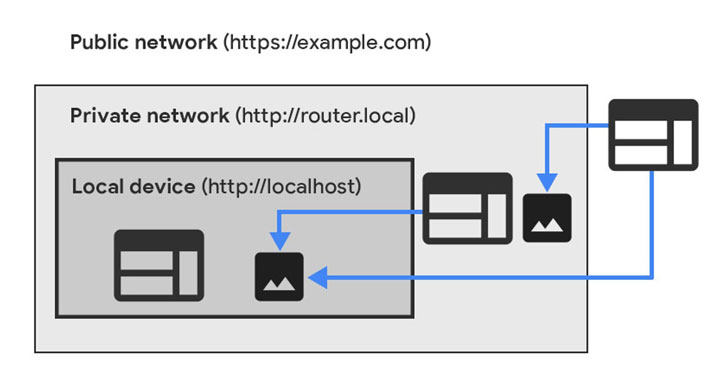
Google Chrome has announced plans to prohibit public websites from directly accessing endpoints located within private networks as part of an upcoming major security shakeup to prevent intrusions via the browser. The proposed change is set to be rolled out in two phases consisting of releases Chrome 98 and Chrome 101 scheduled in the coming months via a newly implemented W3C specification called private network access ( PNA ). "Chrome will start sending a  CORS  preflight request ahead of any private network request for a subresource, which asks for explicit permission from the target server," Titouan Rigoudy and Eiji Kitamura  said . "This preflight request will carry a new header, Access-Control-Request-Private-Network: true, and the response to it must carry a corresponding header, Access-Control-Allow-Private-Network: true." What this means is that starting with Chrome version 101, any website accessible via the internet will be made to seek explicit permi...
Post-Quantum Cryptography: Finally Real in Consumer Apps?

Post-Quantum Cryptography: Finally Real in Consumer Apps?

Sep 29, 2023 Quantum Computing / Network Security
Most people are barely thinking about basic cybersecurity, let alone post-quantum cryptography. But the impact of a post-quantum world is coming for them regardless of whether or not it's keeping them up tonight.  Today, many rely on encryption in their daily lives to protect their fundamental digital privacy and security, whether for messaging friends and family, storing files and photos, or simply browsing the web. The question experts have been asking for a long time, with their eye on the advances in quantum computing, is, "How long before these defenses fail?"  The ticking clock of quantum computing One set of researchers is already sounding the alarms,  claiming  that they've found a way to break 2048-bit RSA encryption with a quantum computer. While the claims may be premature, they hint toward a scary future that is perhaps closer than we once thought. Breaking RSA encryption would represent a massive privacy and security vulnerability for virtually every...
Global Coalition and Tech Giants Unite Against Commercial Spyware Abuse

Global Coalition and Tech Giants Unite Against Commercial Spyware Abuse

Feb 07, 2024 Spyware / Zero-Day Vulnerability
A coalition of dozens of countries, including France, the U.K., and the U.S., along with tech companies such as Google, MDSec, Meta, and Microsoft, have signed a joint agreement to curb the abuse of commercial spyware to commit human rights abuses. The initiative, dubbed the  Pall Mall Process , aims to tackle the proliferation and irresponsible use of commercial cyber intrusion tools by establishing guiding principles and policy options for States, industry, and civil society in relation to the development, facilitation, purchase, and use of such tools. The declaration stated that "uncontrolled dissemination" of spyware offerings contributes to "unintentional escalation in cyberspace," noting it poses risks to cyber stability, human rights, national security, and digital security. "Where these tools are used maliciously, attacks can access victims' devices, listen to calls, obtain photos and remotely operate a camera and microphone via 'zero-click...
Google Drops Cookie Prompt in Chrome, Adds IP Protection to Incognito

Google Drops Cookie Prompt in Chrome, Adds IP Protection to Incognito

Apr 23, 2025 Privacy / Artificial Intelligence
Google on Tuesday revealed that it will no longer offer a standalone prompt for third-party cookies in its Chrome browser as part of its Privacy Sandbox initiative. "We've made the decision to maintain our current approach to offering users third-party cookie choice in Chrome, and will not be rolling out a new standalone prompt for third-party cookies," Anthony Chavez, vice president of Privacy Sandbox at Google, said . "Users can continue to choose the best option for themselves in Chrome's Privacy and Security Settings." Back in July 2024, the tech giant said it had abandoned its plans to deprecate third-party tracking cookies and that it intends to roll out a new experience instead that lets users make an informed choice. Google said feedback from publishers, developers, regulators, and the ads industry has made it clear there are "divergent perspectives" on making changes that could affect the availability of third-party cookies. In its...
Google's Chrome 11 fixes $16,500 worth of bugs !!

Google's Chrome 11 fixes $16,500 worth of bugs !!

Apr 28, 2011
Google's Chrome web browser is now at version 11, and its release is marked by a record payout for security fixes as well as a speech translation feature. A total of 27 security vulnerabilities are fixed in the latest stable release for Windows, Mac, Linux and Chrome Frame. Individual rewards were from $500 up to $3,000 for a particularly nasty looking bug that allowed a possible URL bar spoof leading to navigation errors and interrupted page loads. Among the researchers Google gave thanks to was Braden Thomas of Apple Product Security. This is most likely because Chrome's underlying open source browser engine Webkit is the same one that runs Safari. Chrome users will now also be able to play around with speech translation, thanks to a new speech input through HTML feature. Using the Google Translate application, you can speak after clicking a microphone at the bottom right of the input box. You'll be able to read and listen to the translated result. This isn't ne...
In-Brief: Spotify Hack, Secret of Chrome OS, MIT Bug Bounty, Nanowire Batteries

In-Brief: Spotify Hack, Secret of Chrome OS, MIT Bug Bounty, Nanowire Batteries

Apr 26, 2016
1. Spotify Hacked! Change your Password ASAP If you are one of the millions of people around the world who love to listen to music on Spotify, you may need to change your password immediately. Has Spotify been hacked? The company says no, but some Spotify users have claimed their profiles were hijacked, and details were changed without knowledge, including passwords and email addresses, TC  reported . Spotify apparently suffered a security breach that leaked hundreds of Spotify accounts details, including emails, usernames, passwords and account type, which was published last week to the popular anonymous file sharing website Pastebin. Spotify is investigating the Pastebin leaks of Spotify user information. 2. Over 1 Million Android Apps Are Coming to Chrome OS Google is ready to integrate millions of Android applications onto its Chrome OS platform by bringing the entire Play Store to it. Redditor 'TheWiseYoda' first spotted a new option to "Enable And...
Google Chrome Switches to ML-KEM for Post-Quantum Cryptography Defense

Google Chrome Switches to ML-KEM for Post-Quantum Cryptography Defense

Sep 17, 2024 Browser Security / Quantum Computing
Google has announced that it will be switching from KYBER to ML-KEM in its Chrome web browser as part of its ongoing efforts to defend against the risk posed by cryptographically relevant quantum computers ( CRQCs ). "Chrome will offer a key share prediction for hybrid ML-KEM (codepoint 0x11EC)," David Adrian, David Benjamin, Bob Beck, and Devon O'Brien of the Chrome Team said . "The PostQuantumKeyAgreementEnabled flag and enterprise policy will apply to both Kyber and ML-KEM." The changes are expected to take effect in Chrome version 131, which is on track for release in early November 2024. Google noted that the two hybrid post-quantum key exchange approaches are essentially incompatible with each other, prompting it to abandon KYBER. "The changes to the final version of ML-KEM make it incompatible with the previously deployed version of Kyber," the company said. "As a result, the codepoint in TLS for hybrid post-quantum key exchange is ch...
New UULoader Malware Distributes Gh0st RAT and Mimikatz in East Asia

New UULoader Malware Distributes Gh0st RAT and Mimikatz in East Asia

Aug 19, 2024 Threat Intelligence / Cryptocurrency
A new type of malware called UULoader is being used by threat actors to deliver next-stage payloads like Gh0st RAT and Mimikatz . The Cyberint Research Team, which discovered the malware, said it's distributed in the form of malicious installers for legitimate applications targeting Korean and Chinese speakers. There is evidence pointing to UULoader being the work of a Chinese speaker due to the presence of Chinese strings in program database (PDB) files embedded within the DLL file. "UULoader's 'core' files are contained in a Microsoft Cabinet archive (.cab) file which contains two primary executables (an .exe and a .dll) which have had their file header stripped," the company said in a technical report shared with The Hacker News. One of the executables is a legitimate binary that's susceptible to DLL side-loading, which is used to sideload the DLL file that ultimately loads the final stage, an obfuscate file named "XamlHost.sys" that...
⚡ THN Weekly Recap: Top Cybersecurity Threats, Tools and Tips [3 February]

⚡ THN Weekly Recap: Top Cybersecurity Threats, Tools and Tips [3 February]

Feb 03, 2025 Cybersecurity / Recap
This week, our news radar shows that every new tech idea comes with its own challenges. A hot AI tool is under close watch, law enforcement is shutting down online spots that help cybercriminals, and teams are busy fixing software bugs that could let attackers in. From better locks on our devices to stopping sneaky tricks online, simple steps are making a big difference.  Let's take a closer look at how these efforts are shaping a safer digital world. ⚡ Threat of the Week DeepSeek's Popularity Invites Scrutiny — The overnight popularity of DeepSeek, an artificial intelligence (AI) platform originating from China, has led to extensive scrutiny of its models, with several analyses finding ways to jailbreak its system and produce malicious or prohibited content. While jailbreaks and prompt injections are a persistent concern in mainstream AI products, the findings also show that the model lacks enough protections to prevent potential abuse by malicious actors . The AI chatbot ha...
c
Expert Insights Articles Videos
Cybersecurity Resources