#1 Trusted Cybersecurity News Platform
Followed by 5.20+ million
The Hacker News Logo
Subscribe – Get Latest News
Salesforce Security Handbook

Search results for computer virus | Breaking Cybersecurity News | The Hacker News

iPhone Chip Supplier TSMC Stops Production After Computer Virus Attack

iPhone Chip Supplier TSMC Stops Production After Computer Virus Attack

Aug 06, 2018
Taiwan Semiconductor Manufacturing Company (TSMC)—Apple's sole supplier of SoC components for iPhones and iPads, and Qualcomm's major manufacturing partner—shut down several of its chip-fabrication factories Friday night after being hit by a computer virus. The world's largest makers of semiconductors and processors TSMC lost an entire day of production after several of its factories systems were halted by a computer virus in the middle of the ramp-up for chips to be used by Apple's future lines of iPhones. Though the popular chip maker has been attacked by viruses in the past, this is the first time a virus has affected TSMC's production lines, making the incident a real big deal. Without revealing many details, TSMC said a number of its computer systems and fabrication tools were infected by the virus on Friday night, but since then it has recovered 80% of its impacted equipment, though others will be recovered by tomorrow. According to TSMC, the comput...
Hundreds Of Operations Canceled After Malware Hacks Hospitals Systems

Hundreds Of Operations Canceled After Malware Hacks Hospitals Systems

Nov 03, 2016
Computer viruses do not discriminate. They are not just hacking your email and online banking accounts anymore. Computer viruses do not distinguish between a personal computer or a hospital machine delivering therapy to patients — and the results could prove deadly. Cyber attacks on hospitals have emerged as a significant cyber security risk in 2016, which not only threaten highly sensitive information but also potentially harm the very lives of those being protected. In the latest incident, hundreds of planned operations, outpatient appointments, and diagnostic procedures have been canceled at multiple hospitals in Lincolnshire, England, after a "major" computer virus compromised the National Health Service (NHS) network on Sunday. In a bright-red alert warning labeled "Major incident" on its website, the Northern Lincolnshire and Goole NHS Foundation Trust (NLAG) said its systems in Scunthorpe and Grimsby were infected with a virus on October 30. Th...
40th anniversary of the computer virus !

40th anniversary of the computer virus !

Mar 14, 2011
This year marks the 40th anniversary of Creeper, the world's first computer virus. From Creeper to Stuxnet, the last four decades saw the number of malware instances boom from 1,300 in 1990, to 50,000 in 2000, to over 200 million in 2010. Besides sheer quantity, viruses, which were originally used as academic proof of concepts, quickly turned into geek pranks, then evolved into cybercriminal tools. By 2005, the virus scene had been monetized, and virtually all viruses were developed with the sole purpose of making money via more or less complex business models. In the following story, FortiGuard Labs looks at the most significant computer viruses over the last 40 years and explains their historical significance. 1971: Creeper: catch me if you can While theories on self-replicating automatas were developed by genius mathematician Von Neumann in the early 50s, the first real computer virus was released "in lab" in 1971 by an employee of a company working on building ARPANET, the ...
cyber security

Enhance Microsoft Intune to Optimize Endpoint Management

websiteAction1Patching / Endpoint Management
Pairing Intune with a dedicated patching tool improves control and visibility for remote teams. See how.
cyber security

Default Admin Rights Are a Hacker's Dream – and Keeper is Their Nightmare

websiteKeeper SecurityPrivilege Management / Zero Trust
Eliminate standing admin rights and enable Just-in-Time access across all Windows, Linux and macOS endpoints.
Ancient 'STONED' Virus Signatures found in Bitcoin Blockchain

Ancient 'STONED' Virus Signatures found in Bitcoin Blockchain

May 19, 2014
If you are dealing in cryptocurrency Bitcoin and have Microsoft's Security Essentials (MSE) installed on your system, then you could be infected by a virus called " DOS/STONED " from the Bitcoin BlockChain. With a number of high-profile cases of fraud, theft, and technical incompetence against the bitcoins, it seems like cyber criminals are looking to scam unsuspecting customers. Blockchain is Bitcoin's most popular bitcoin wallet and block explorer. It is a central part of the Bitcoin system that includes a log file in which all bitcoin transactions are recorded. It stores the wallet data in encrypted form and runs on privately owned dedicated hardware. In an discussion on the Microsoft discussion boards, a user go by the name ' edc678 ' claimed that  Microsoft's Security Essentials  is showing alerts of the signature of the STONED virus in the Bitcoin BlockChain, which could only allow an attacker to write small chunk of text to accomp...
Fake antivirus pop-ups hacking into computers !

Fake antivirus pop-ups hacking into computers !

Jan 08, 2011
MISSOULA - Univision Computers, a company based in Missoula, is warning people about a fake antivirus alert pop-ups that could not only damage your computer, but could pull personal information from it. The FBI says it's called "scareware" because criminals try to frighten you into buying fake antivirus software with a seemingly genuine security warning. And here's how it works: a pop-up message comes up saying you have a virus. And to fix the problem, all you have to do is install the software. "Frequently they'll ask you for a credit card for payment and promise that they will fix whatever's wrong with your computer. Clients who do that discover that they have a charge on their credit card, their credit card information is out there for the crook who invented the scareware and their computer is often even further infected and sometimes completely disabled," says Penny Lyons, Univision Computers Customer Service Representative. Using this virus, th...
TSMC Chip Maker Blames WannaCry Malware for Production Halt

TSMC Chip Maker Blames WannaCry Malware for Production Halt

Aug 07, 2018
Taiwan Semiconductor Manufacturing Company (TSMC)—the world's largest makers of semiconductors and processors—was forced to shut down several of its chip-fabrication factories over the weekend after being hit by a computer virus. Now, it turns out that the computer virus outbreak at Taiwan chipmaker was the result of a variant of WannaCry —a massive ransomware attack that wreaked havoc across the world by shutting down hospitals, telecom providers, and many businesses in May 2017. TSMC shut down an entire day of production this weekend after several of its factories systems were halted by a computer virus in the middle of the ramp-up for chips to be used by Apple's future lines of iPhones, which could impact revenue by approx $256 million. According to the semiconductor manufacturer, its computer systems were not direct attacked by any hacker, but instead, were exposed to the malware "when a supplier installed tainted software without a virus scan" to TSMC...
Ukrainian Man Arrested For Distributing NotPetya Ransomware And Helping Tax Evaders

Ukrainian Man Arrested For Distributing NotPetya Ransomware And Helping Tax Evaders

Aug 10, 2017
Ukrainian authorities have arrested a 51-year-old man accused of distributing the infamous Petya ransomware (Petya.A, also known as NotPetya) — the same computer virus that massively hit numerous businesses, organisations and banks in Ukraine as well as different parts of Europe around 45 days ago. However, the story is not as simple as it seems, which portrayed this man as a criminal. I recommend you to read complete article to understand the case better and then have an opinion accordingly. Sergey Neverov (Сергей Неверов), father of two sons and the resident of the southern city of Nikopol, is a video blogger and computer enthusiast who was arrested by the Ukrainian police on Monday, August 7 from his home. What Neverov Did? According to a press release published on Thursday by the Ukrainian cyber police department, Neverov uploaded a video, showing how to infect a computer with Petya.A ransomware—and also shared a download link for NotPetya malware to his soc...
Chameleon Virus that Spreads Across WiFi Access Points like Common Cold

Chameleon Virus that Spreads Across WiFi Access Points like Common Cold

Feb 26, 2014
Do you know, A Computer viruses could go Airborne over WiFi networks? Security researchers at the University of Liverpool  in Britain have demonstrated a WiFi virus that can spread between computer networks just like the ' common cold ' spreads between Humans. They have created a proof-of-concept which can infect the entire wireless network instead of a single computer at a time,  that replaces the firmware of the vulnerable Access Point (AP) with a virus-loaded version, and then propagates itself to the next victim on the WiFi network . The  WiFi  based virus named as ' Chameleon ', that can self-propagate over WiFi networks from access point to access point,  but  doesn't affect the working of the Wireless Access Point. This Virus is able to identify WiFi access points that are not protected by encryption and passwords, according to the research paper . It can badly hit less-protected open access WiFi networks available in coffee...
Virus War : Be aware of bogus e-mails !

Virus War : Be aware of bogus e-mails !

Dec 28, 2011
The past year reached a new record high for bogus e-mails that clog people's inboxes and can release damaging and costly viruses on computers. Nearly 90 percent of sent e-mail is a ruse to rip off unsuspecting Internet users, according to data released by the computer security firm Symantec. The firm projects 95 billion e-mails will be sent in 2010, an average of 400 per Internet user, according to data culled from Symantec and Internet World Stats, a marketing research firm. The number of phishing e-mails, those that hunt out passwords that can steal sensitive and financial information, increased 1.4 percent compared with 2009, according to Symantec. The news is especially troubling since e-commerce sales reached $200 billion in 2007, the latest data available from the U.S. Census Bureau. "The fact is that these spammers are getting better and better on exploiting people," said Jim Fisher, owner of Excel Computer Services in Florence. "They keep ratcheting up their capabilities." ...
Duqu computer virus Detected by Iran civil defense organization

Duqu computer virus Detected by Iran civil defense organization

Nov 13, 2011
Duqu computer virus Detected by Iran civil defense organization The virus is called W32.Duqu, or just Duqu create fear after the opening Pandora's Box of Stuxnet. The head of Iran's civil defense organization told the official IRNA news agency that computers at all main sites at risk were being checked and that Iran had developed software to combat the virus. First, Duqu is not deigned to harm industrial automation. The software basically attacks windows systems. Instead of sabotaging industrial control, Duqu has been general remote access capabilities. Duqu has a key logger and can save passwords etc.. The malware uses HTTP and HTTPS to communicate to a command and control (C&C) server at 206.183.111.97, which is hosted in India, the IP is inactive as of October 18th. Duqu infiltrates systems directly it is not a worm like Stuxnet and needs to be placed directly, e.g. through infected mails.Duqu also the certificate of C-Media Electronics Incorporation, a Taiwanese audio ch...
Flame spy virus going to Suicide

Flame spy virus going to Suicide

Jun 11, 2012
Flame spy virus going to Suicide The creators of the world's most complicated espionage virus Flame have sent a 'suicide' command that removes it from some infected computers. U.S. computer security researchers said on Sunday that the Flame computer virus, which struck at least 600 specific computer systems in Iran, Syria, Lebanon, Egypt, Sudan, Saudi Arabia and the Palestinian Authority, has gotten orders to vanish, leaving no trace. The 20-megabyte piece of malware already had a self-destruct module known as SUICIDE that removed all files and folders associated with Flame, but the purging command observed by Symantec researchers instead relied on a file called browse23.ocx that did much the same thing. According to Symantec, the 'suicide' command was "designed to completely remove Flame from the compromised computer," the BBC reports. Computers infected with Flame, including honeypots, have been routinely contacting its C&C servers to check for new commands. W...
BIOS based Virus discovered by Chinese Security Firm

BIOS based Virus discovered by Chinese Security Firm

Sep 19, 2011
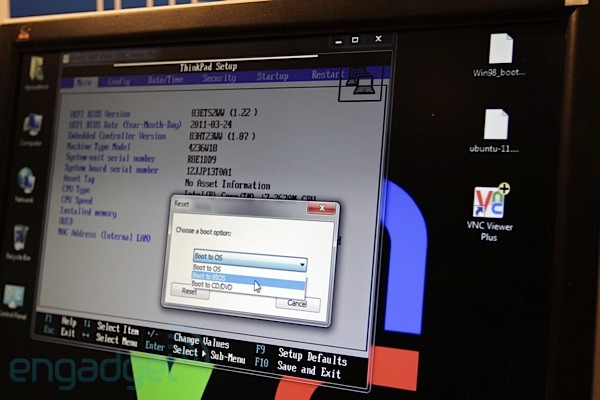
BIOS based Virus discovered by Chinese Security Firm A Chinese AV company 360 discovered a new Trojan, the " BMW Virus " (also called Mebromi), that can actually infect a computers BIOS: " BMW 360 Security Center virus is the latest catch of a high-risk virus, the virus that infected a chain BIOS (motherboard chip program), MBR (master boot drive) and Windows system files, reinstall the system, regardless of the victim computer, format the hard disk, or replace the hard disk can not completely remove the virus. " It uses the CBROM command-line tool to hook its extension into the BIOS. The next time the system boots, the BIOS extension adds additional code to the hard drive's master boot record (MBR) in order to infect the winlogon.exe / winnt.exe processes on Windows XP and 2003 / Windows 2000 before Windows boots. The next time Windows launches, the malicious code downloads a rootkit to prevent the drive's MBR from being cleaned by a virus scanner. But even if the drive is ...
Automated Skype calls spreading fake anti-virus warning

Automated Skype calls spreading fake anti-virus warning

Sep 19, 2011
Automated Skype calls spreading fake anti-virus warning Automated Skype calls spreading fake anti-virus warning, where an automated message (what I like to call a "Digital Dorothy") warns you in a semi-robotic voice that your computer's security is not up-to-date. "Attention: this is an automated computer system alert. Your computer protection service is not active. To activate computer protection, and repair your computer, go to [LINK]," says the robotic voice during a prerecorded message. The offered link takes the most gullible and curious ones to a page that shows the typical "Computer protection inactive. Scanning… Viruses found!" message that is meant to convince them to fork over a decent amount of money - in this case, $19.95 - in order to get the offered protection.Not content with the money, they also ask for their personal information. If you weren't aware of fake anti-virus (also known as scareware) scams like this you might well...
Stuxnet virus also infected Chevron's IT network

Stuxnet virus also infected Chevron's IT network

Nov 09, 2012
Stuxnet , a sophisticated computer virus created by the United States and Israel, to spy on and attack Iran's nuclear enrichment facilities in Natanz also infected Chevron 's network in 2010, immediately after it spread into the wild. This Government created virus Now Infecting Corporations also. Chevron oil giant found the virus in its systems after the malware' s existence was first reported in a blog post in July 2010, according to Mark Koelmel, general manager of the earth-sciences department at the big U.S. oil company. The U.S. government has never officially acknowledged the Stuxnet program. Stuxnet  which was designed to attack computer systems designed by German industrial giant Siemens for managing water supplies, oil rigs, power plants and other critical infrastructure has turned up in other countries. According to the Wall Street Journal, Chevron's experience with Stuxnet appears to be the result of the malware's unintentional release into...
Virus Attacks on Canadian Computer System

Virus Attacks on Canadian Computer System

Mar 26, 2011
Recently, Director of Information Technology, Per Kristensen stated that, a new type of the Qakbot virus appeared globally on March 15, 2011 and was observed in PCs in Nanaimo (Canada) at noon on March 16, 2011, as reported by Bclocal News on March 12, 2011. To safeguard important information about the city, the system was immediately put on a halt after the staff realized that the virus was swiftly circulating from PC to PC. Commenting on the matter, Per stated that, people can be sure that all their personal information and details are safe. He stated that, safeguarding their private information is their main concern. He added that, the city's system would not be turned on until they are sure that they sorted out the problem, as reported by Vancouver Sun on March 18, 2011. Kristensen stated that, the virus seems extremely complex, altering its signature to transfer through a computer various times. Kristensen stated that, the virus is classified as harmful and they are being ...
Authorities Seize Dark-Web Site Linked to the Netwalker Ransomware

Authorities Seize Dark-Web Site Linked to the Netwalker Ransomware

Jan 28, 2021
U.S. and Bulgarian authorities this week took control of the dark web site used by the NetWalker ransomware cybercrime group to publish data stolen from its victims. "We are striking back against the growing threat of ransomware by not only bringing criminal charges against the responsible actors, but also disrupting criminal online infrastructure and, wherever possible, recovering ransom payments extorted from victims,"  said  Acting Assistant Attorney General Nicholas L. McQuaid of the Justice Department's Criminal Division. "Ransomware victims should know that coming forward to law enforcement as soon as possible after an attack can lead to significant results like those achieved in today's multi-faceted operation." In connection with the takedown, a Canadian national named Sebastien Vachon-Desjardins from the city of Gatineau was charged in the U.S. state of Florida for extorting $27.6 million in cryptocurrency from ransom payments. Separately, the...
Targeted Ransomware Attacks Hit Several Spanish Companies

Targeted Ransomware Attacks Hit Several Spanish Companies

Nov 04, 2019
Everis , one of the largest IT consulting companies in Spain, suffered a targeted ransomware attack on Monday, forcing the company to shut down all its computer systems until the issue gets resolved completely. Ransomware is a computer virus that encrypts files on an infected system until a ransom is paid. According to several local media, Everis informed its employees about the devastating widespread ransomware attack, saying: "We are suffering a massive virus attack on the Everis network. Please keep the PCs off. The network has been disconnected with clients and between offices. We will keep you updated." "Please, urgently transfer the message directly to your teams and colleagues due to standard communication problems." According to cybersecurity consultant  Arnau Estebanell Castellví , the malware encrypted files on Everis's computers with an extension name resembling the company's name, i.e., " .3v3r1s ," which suggests the at...
c
Expert Insights Articles Videos
Cybersecurity Resources