#1 Trusted Cybersecurity News Platform
Followed by 5.20+ million
The Hacker News Logo
Subscribe – Get Latest News
Salesforce Security Handbook

Search results for Edge/extensions | Breaking Cybersecurity News | The Hacker News

ShadyPanda Turns Popular Browser Extensions with 4.3 Million Installs Into Spyware

ShadyPanda Turns Popular Browser Extensions with 4.3 Million Installs Into Spyware

Dec 01, 2025 Browser Security / Spyware
A threat actor known as ShadyPanda has been linked to a seven-year-long browser extension campaign that has amassed over 4.3 million installations over time. Five of these extensions started off as legitimate programs before malicious changes were introduced in mid-2024, according to a report from Koi Security, attracting 300,000 installs. These extensions have since been taken down. "These extensions now run hourly remote code execution – downloading and executing arbitrary JavaScript with full browser access," security researcher Tuval Admoni said in a report shared with The Hacker News. "They monitor every website visit, exfiltrate encrypted browsing history, and collect complete browser fingerprints." To make matters worse, one of the extensions, Clean Master, was featured and verified by Google at one point. This trust-building exercise allowed the attackers to expand their user base and silently issue malicious updates years later without attracting any...
New Malware Hits 300,000 Users with Rogue Chrome and Edge Extensions

New Malware Hits 300,000 Users with Rogue Chrome and Edge Extensions

Aug 10, 2024 Browser Security / Online Fraud
An ongoing, widespread malware campaign has been observed installing rogue Google Chrome and Microsoft Edge extensions via a trojan distributed via fake websites masquerading as popular software. "The trojan malware contains different deliverables ranging from simple adware extensions that hijack searches to more sophisticated malicious scripts that deliver local extensions to steal private data and execute various commands," the ReasonLabs research team said in an analysis. "This trojan malware, existing since 2021, originates from imitations of download websites with add-ons to online games and videos." The malware and the extensions have a combined reach of at least 300,000 users of Google Chrome and Microsoft Edge, indicating that the activity has a broad impact. At the heart of the campaign is the use of malvertising to push lookalike websites promoting known software like Roblox FPS Unlocker, YouTube, VLC media player, Steam, or KeePass to trick users s...
A Browser Extension Risk Guide After the ShadyPanda Campaign

A Browser Extension Risk Guide After the ShadyPanda Campaign

Dec 15, 2025 Browser Security / SaaS Security
In early December 2025, security researchers exposed a cybercrime campaign that had quietly hijacked popular Chrome and Edge browser extensions on a massive scale. A threat group dubbed ShadyPanda spent seven years playing the long game, publishing or acquiring harmless extensions, letting them run clean for years to build trust and gain millions of installs, then suddenly flipping them into malware via silent updates. In total, about 4.3 million users installed these once-legitimate add-ons, which suddenly went rogue with spyware and backdoor capabilities. This tactic was essentially a browser extension supply-chain attack. The ShadyPanda operators even earned featured and verified badges in the official Chrome Web Store and Microsoft Edge Add-ons site for some extensions, reinforcing user confidence. Because extension updates happen automatically in the background, the attackers were able to push out malicious code without users noticing a thing. Once activated in mid-2024, the...
cyber security

The Breach You Didn't Expect: Your AppSec Stack

websiteJFrogAppSec / DevSecOps
In a market undergoing mergers and acquisitions, vendor instability can put you in serious risk.
cyber security

How AI and Zero Trust Work Together to Catch Attacks With No Files or Indicators

websiteTHN WebinarZero Trust / Cloud Security
Modern cyberattacks hide in trusted tools and workflows, evading traditional defenses. Zero Trust and AI-powered cloud security give you the visibility and control to stop these invisible threats early.
Microsoft Edge Bug Could Have Allowed Attackers to Silently Install Malicious Extensions

Microsoft Edge Bug Could Have Allowed Attackers to Silently Install Malicious Extensions

Mar 27, 2024 Vulnerability / API Security
A now-patched security flaw in the Microsoft Edge web browser could have been abused to install arbitrary extensions on users' systems and carry out malicious actions.  "This flaw could have allowed an attacker to exploit a private API, initially intended for marketing purposes, to covertly install additional browser extensions with broad permissions without the user's knowledge," Guardio Labs security researcher Oleg Zaytsev  said  in a new report shared with The Hacker News. Tracked as  CVE-2024-21388  (CVSS score: 6.5), it was addressed by Microsoft in Edge stable version 121.0.2277.83 released on January 25, 2024, following responsible disclosure in November 2023. The Windows maker credited both Zaytsev and Jun Kokatsu for reporting the issue. "An attacker who successfully exploited this vulnerability could gain the privileges needed to install an extension," Microsoft said in an advisory for the flaw, adding it "could lead to a browser sandbo...
Microsoft Releases First Preview Builds of Chromium-based Edge Browser

Microsoft Releases First Preview Builds of Chromium-based Edge Browser

Apr 08, 2019
Microsoft today finally released the first new reborn version of its Edge browser that the company rebuilds from scratch using Chromium engine, the same open-source web rendering engine that powers Google's Chrome browser. However, the Chromium-based Edge browser builds haven't yet entered the stable or even the beta release; instead, Microsoft has released two testing-purpose preview builds for developers. Both previews build— "Canary"  that will be updated daily, and "Developer"  that will be updated every week—are now available for download from the Microsoft's new Edge insider website . Here's how Microsoft differentiates Canary and Developer builds: "Every night, we produce a build of Microsoft Edge — if it passes automated testing, we'll release it to the Canary channel. We use this same channel internally to validate bug fixes and test brand new features. The Canary channel is truly the bleeding edge, so you may discover bugs...
Featured Chrome Browser Extension Caught Intercepting Millions of Users' AI Chats

Featured Chrome Browser Extension Caught Intercepting Millions of Users' AI Chats

Dec 15, 2025 AI Security / Browser Security
A Google Chrome extension with a "Featured" badge and six million users has been observed silently gathering every prompt entered by users into artificial intelligence (AI)-powered chatbots like OpenAI ChatGPT, Anthropic Claude, Microsoft Copilot, DeepSeek, Google Gemini, xAI Grok, Meta AI, and Perplexity. The extension in question is Urban VPN Proxy , which has a 4.7 rating on the Google Chrome Web Store. It's advertised as the "best secured Free VPN access to any website, and unblock content." Its developer is a Delaware-based company named Urban Cyber Security Inc . On the Microsoft Edge Add-ons marketplace, it has 1.3 million installations .  Despite claiming that it allows users to "protect your online identity, stay protected, and hide your IP," an update was pushed to users on July 9, 2025, when version 5.5.0 was released with the AI data harvesting enabled by default using hard-coded settings. Specifically, this is achieved by means of a t...
Microsoft Edge: The Windows 10 Web Browser

Microsoft Edge: The Windows 10 Web Browser

Apr 30, 2015
Meet Microsoft's replacement to its old web browser Internet Explorer. The Project Spartan Web browser for Windows 10 has now an official name — Microsoft Edge . Yes, Microsoft's new web browser shipping on all Windows 10 devices, from computers to smartphones and tablets, is dubbed Microsoft Edge . The company just announced in its Build developer conference that Edge is going to be its primary/default web browser built into Windows 10 . Microsoft Edge is the successor to Internet Explorer and designed to be basic and minimalist for the future. Highlights of Microsoft Edge: There aren't many details about the unique features of Microsoft Edge yet, but here's what we know about Microsoft Edge so far: It has built-in Cortana support, Microsoft's virtual assistant. It has a built-in reading list, web note-taking and sharing features. The rendering engine is called EdgeHTML. The design focuses on minimalism and simplicity. It has a super useful and we...
Popular Chrome Extensions Leak API Keys, User Data via HTTP and Hard-Coded Credentials

Popular Chrome Extensions Leak API Keys, User Data via HTTP and Hard-Coded Credentials

Jun 05, 2025 Browser Security / Online Safety
Cybersecurity researchers have flagged several popular Google Chrome extensions that have been found to transmit data in HTTP and hard-code secrets in their code, exposing users to privacy and security risks. "Several widely used extensions [...] unintentionally transmit sensitive data over simple HTTP," Yuanjing Guo, a security researcher in the Symantec's Security Technology and Response team, said . "By doing so, they expose browsing domains, machine IDs, operating system details, usage analytics, and even uninstall information, in plaintext." The fact that the network traffic is unencrypted also means that they are susceptible to adversary-in-the-middle (AitM) attacks, allowing malicious actors on the same network such as a public Wi-Fi to intercept and, even worse, modify this data, which could lead to far more serious consequences. The list of identified extensions are below - SEMRush Rank (extension ID: idbhoeaiokcojcgappfigpifhpkjgmab) and P...
When Browsers Become the Attack Surface: Rethinking Security for Scattered Spider

When Browsers Become the Attack Surface: Rethinking Security for Scattered Spider

Sep 01, 2025 Browser Security / Threat Intelligence
As enterprises continue to shift their operations to the browser, security teams face a growing set of cyber challenges. In fact, over 80% of security incidents now originate from web applications accessed via Chrome, Edge, Firefox, and other browsers. One particularly fast-evolving adversary, Scattered Spider, has made it their mission to wreak havoc on enterprises by specifically targeting sensitive data on these browsers. Scattered Spider, also referred to as UNC3944, Octo Tempest, or Muddled Libra, has matured over the past two years through precision targeting of human identity and browser environments. This shift differentiates them from other notorious cybergangs like Lazarus Group, Fancy Bear, and REvil. If sensitive information such as your calendar, credentials, or security tokens is alive and well in browser tabs, Scattered Spider is able to acquire them.  In this article, you'll learn details about Scattered Spider's attack methods and how you can stop them in their ...
Over a Dozen Chrome Extensions Caught Hijacking Google Search Results for Millions

Over a Dozen Chrome Extensions Caught Hijacking Google Search Results for Millions

Feb 03, 2021
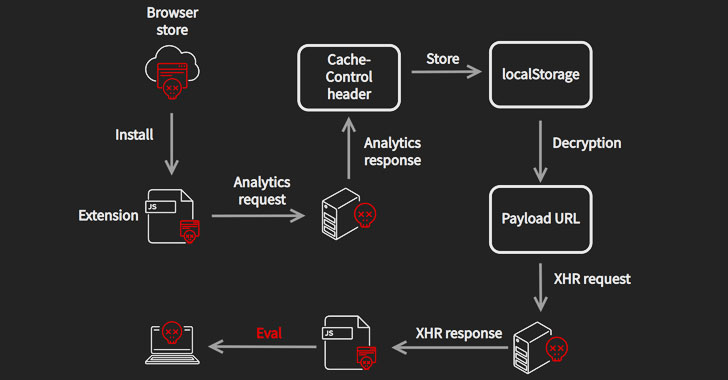
New details have emerged about a vast network of rogue extensions for Chrome and Edge browsers that were found to hijack clicks to links in search results pages to arbitrary URLs, including phishing sites and ads. Collectively called " CacheFlow " by Avast, the 28 extensions in question — including Video Downloader for Facebook, Vimeo Video Downloader, Instagram Story Downloader, VK Unblock — made use of a sneaky trick to mask its true purpose: Leverage  Cache-Control  HTTP header as a covert channel to retrieve commands from an attacker-controlled server. All the  backdoored browser add-ons  have been taken down by Google and Microsoft as of December 18, 2020, to prevent more users from downloading them from the official stores. According to telemetry data gathered by the firm, the top three infected countries were Brazil, Ukraine, and France, followed by Argentina, Spain, Russia, and the U.S. The CacheFlow sequence began when unsuspecting users downloaded on...
Securing GenAI in the Browser: Policy, Isolation, and Data Controls That Actually Work

Securing GenAI in the Browser: Policy, Isolation, and Data Controls That Actually Work

Dec 12, 2025 Data Protection / Browser Security
The browser has become the main interface to GenAI for most enterprises: from web-based LLMs and copilots, to GenAI‑powered extensions and agentic browsers like ChatGPT Atlas . Employees are leveraging the power of GenAI to draft emails, summarize documents, work on code, and analyze data, often by copying/pasting sensitive information directly into prompts or uploading files.  Traditional security controls were not designed to understand this new prompt‑driven interaction pattern, leaving a critical blind spot where risk is highest. Security teams are simultaneously under pressure to enable more GenAI platforms because they clearly boost productivity.  Simply blocking AI is unrealistic. The more sustainable approach is to secure GenAI platforms where they are accessed by users: inside the browser session. The GenAI browser threat model The GenAI‑in‑the‑browser threat model must be approached differently from traditional web browsing due to several key factors.  Us...
ThreatsDay Bulletin: 0-Days, LinkedIn Spies, Crypto Crimes, IoT Flaws and New Malware Waves

ThreatsDay Bulletin: 0-Days, LinkedIn Spies, Crypto Crimes, IoT Flaws and New Malware Waves

Nov 20, 2025 Cybersecurity / Hacking News
This week has been crazy in the world of hacking and online security. From Thailand to London to the US, we've seen arrests, spies at work, and big power moves online. Hackers are getting caught. Spies are getting better at their jobs. Even simple things like browser add-ons and smart home gadgets are being used to attack people. Every day, there's a new story that shows how quickly things are changing in the fight over the internet. Governments are cracking down harder on cybercriminals. Big tech companies are rushing to fix their security. Researchers keep finding weak spots in apps and devices we use every day. We saw fake job recruiters on LinkedIn spying on people, huge crypto money-laundering cases, and brand-new malware made just to beat Apple's Mac protections. All these stories remind us: the same tech that makes life better can very easily be turned into a weapon. Here's a simple look at the biggest cybersecurity news happening right now — from the hidde...
ThreatsDay Bulletin: CarPlay Exploit, BYOVD Tactics, SQL C2 Attacks, iCloud Backdoor Demand & More

ThreatsDay Bulletin: CarPlay Exploit, BYOVD Tactics, SQL C2 Attacks, iCloud Backdoor Demand & More

Oct 02, 2025 Threat Intelligence / Cyber Attacks
From unpatched cars to hijacked clouds, this week's Threatsday headlines remind us of one thing — no corner of technology is safe. Attackers are scanning firewalls for critical flaws, bending vulnerable SQL servers into powerful command centers, and even finding ways to poison Chrome's settings to sneak in malicious extensions. On the defense side, AI is stepping up to block ransomware in real time, but privacy fights over data access and surveillance are heating up just as fast. It's a week that shows how wide the battlefield has become — from the apps on our phones to the cars we drive. Don't keep this knowledge to yourself: share this bulletin to protect others, and add The Hacker News to your Google News list so you never miss the updates that could make the difference. Claude Now Finds Your Bugs Anthropic Touts Safety Protections Built Into Claude Sonnet 4.6 Anthropic said it has rolled out a number of safety and security improve...
The Ultimate Battle: Enterprise Browsers vs. Secure Browser Extensions

The Ultimate Battle: Enterprise Browsers vs. Secure Browser Extensions

Aug 12, 2025 Browser Security / Zero Trust
Most security tools can't see what happens inside the browser, but that's where the majority of work, and risk, now lives. Security leaders deciding how to close that gap often face a choice: deploy a dedicated Enterprise Browser or add an enterprise-grade control layer to the browsers employees already use and trust. The Ultimate Battle: Enterprise Browsers vs. Enterprise Browser Extensions examines this choice across nine "rounds": adoption, data protection, BYOD, productivity, management overhead, remote access, Zero Trust alignment, supply-chain security, and future-readiness, to show where each approach excels, and where trade-offs emerge. Each round uses practical, enterprise scenarios to compare the two models, making it easier to see not just what they can do, but how they perform at scale. The Browser Is Now the Workspace The browser has become the primary workspace for enterprise users. It is where sensitive data is created, accessed, and moved through copy/paste action...
Researchers Find Malicious VS Code, Go, npm, and Rust Packages Stealing Developer Data

Researchers Find Malicious VS Code, Go, npm, and Rust Packages Stealing Developer Data

Dec 09, 2025 Malware / Threat Analysis
Cybersecurity researchers have discovered two new extensions on Microsoft Visual Studio Code (VS Code) Marketplace that are designed to infect developer machines with stealer malware. The VS Code extensions masquerade as a premium dark theme and an artificial intelligence (AI)-powered coding assistant, but, in actuality, harbor covert functionality to download additional payloads, take screenshots, and siphon data. The captured information is then sent to an attacker-controlled server. "Your code. Your emails. Your Slack DMs. Whatever's on your screen, they're seeing it too," Koi Security's Idan Dardikman said . "And that's just the start. It also steals your WiFi passwords, reads your clipboard, and hijacks your browser sessions." The names of the extensions are below - BigBlack.bitcoin-black (16 installs) - Removed by Microsoft on December 5, 2025  BigBlack.codo-ai (25 installs) - Removed by Microsoft on December 8, 2025 Microsoft's l...
Researchers Expose New Polymorphic Attack That Clones Browser Extensions to Steal Credentials

Researchers Expose New Polymorphic Attack That Clones Browser Extensions to Steal Credentials

Mar 10, 2025 Cybersecurity / Malware
Cybersecurity researchers have demonstrated a novel technique that allows a malicious web browser extension to impersonate any installed add-on. "The polymorphic extensions create a pixel perfect replica of the target's icon, HTML popup, workflows and even temporarily disables the legitimate extension, making it extremely convincing for victims to believe that they are providing credentials to the real extension," SquareX said in a report published last week. The harvested credentials could then be abused by the threat actors to hijack online accounts and gain unauthorized access to sensitive personal and financial information. The attack affects all Chromium-based web browsers, including Google Chrome, Microsoft Edge, Brave, Opera, and others. The approach banks on the fact that users commonly pin extensions to the browser's toolbar. In a hypothetical attack scenario, threat actors could publish a polymorphic extension to the Chrome Web Store (or any extension m...
Expert Insights Articles Videos
Cybersecurity Resources