-->
#1 Trusted Cybersecurity News Platform
Followed by 5.20+ million
The Hacker News Logo
Subscribe – Get Latest News
Security Service Edge

The Hacker News | #1 Trusted Source for Cybersecurity News — Index Page

Pre-Installed Malware Dropper Found On German Gigaset Android Phones

Pre-Installed Malware Dropper Found On German Gigaset Android Phones

Apr 07, 2021
In what appears to be a fresh twist in Android malware, users of Gigaset mobile devices are encountering unwanted apps that are being downloaded and installed through a pre-installed system update app. "The culprit installing these malware apps is the Update app, package name  com.redstone.ota.ui , which is a pre-installed system app," Malwarebytes researcher Nathan Collier  said . "This app is not only the mobile device's system updater, but also an auto installer known as Android/PUP.Riskware.Autoins.Redstone." The development was  first reported  by German author and blogger Günter Born last week. While the issue seems to be mainly affecting Gigaset phones, devices from a handful of other manufacturers appear to be impacted as well. The full list of devices that come with the pre-installed auto-installer includes Gigaset GS270, Gigaset GS160, Siemens GS270, Siemens GS160, Alps P40pro, and Alps S20pro+. According to Malwarebytes, the Update app installs ...
Experts uncover a new Banking Trojan targeting Latin American users

Experts uncover a new Banking Trojan targeting Latin American users

Apr 07, 2021
Researchers on Tuesday revealed details of a new banking trojan targeting corporate users in Brazil at least since 2019 across various sectors such as engineering, healthcare, retail, manufacturing, finance, transportation, and government. Dubbed " Janeleiro " by Slovak cybersecurity firm ESET, the malware aims to disguise its true intent via lookalike pop-up windows that are designed to resemble the websites of some of the biggest banks in the country, including Itaú Unibanco, Santander, Banco do Brasil, Caixa Econômica Federal, and Banco Bradesco. "These pop-ups contain fake forms, aiming to trick the malware's victims into entering their banking credentials and personal information that the malware captures and exfiltrates to its [command-and-control] servers," ESET researchers Facundo Muñoz and Matías Porolli said in a write-up. This modus operandi is not new to banking trojans. In August 2020, ESET uncovered a Latin American (LATAM) banking trojan call...
Watch Out! Mission Critical SAP Applications Are Under Active Attack

Watch Out! Mission Critical SAP Applications Are Under Active Attack

Apr 06, 2021
Cyber attackers are actively setting their sights on unsecured SAP applications in an attempt to steal information and sabotage critical processes, according to new research. "Observed exploitation could lead in many cases to full control of the unsecured SAP application, bypassing common security and compliance controls, and enabling attackers to steal sensitive information, perform financial fraud or disrupt mission-critical business processes by deploying ransomware or stopping operations," cybersecurity firm Onapsis and SAP  said  in a joint report published today. The Boston-based company said it detected over 300 successful exploitations out of a total of 1,500 attempts targeting previously known vulnerabilities and insecure configurations specific to SAP systems between mid-2020 to March 2021, with multiple brute-force attempts made by adversaries aimed at high-privilege SAP accounts as well as chaining together several flaws to strike SAP applications. Applicatio...
cyber security

Eliminate Shadow AI Blind Spots

websiteNudge SecuritySaaS Security / Shadow AI
Shadow AI is quietly accessing sensitive data across your SaaS environment. Learn how to close AI blind spots and get ahead of data exposure risks.
cyber security

OpenClaw: RCE, Leaked Tokens, and 21K Exposed Instances in 2 Weeks

websiteReco AIAttack Surface / AI Agents
The viral AI agent connects to Slack, Gmail, and Drive—and most security teams have zero visibility into it.
MITRE Madness: A Guide to Weathering the Upcoming Vendor Positioning Storm

MITRE Madness: A Guide to Weathering the Upcoming Vendor Positioning Storm

Apr 06, 2021
April is usually a whirlwind month for the cybersecurity industry as it coincides with the release of the highly regarded and influential MITRE ATT&CK test results. The ATT&CK test measures cybersecurity platforms' abilities to detect and react to emulated, multistep attacks that can be used as a barometer of platform effectiveness.  This means that every cybersecurity vendor will be tripping over themselves to push out blog posts, webinars, press releases, and more touting how great their services are and how the results validate their products. The result is a storm of spin and PR that is hard to navigate. An upcoming webinar offered by Cynet ( register here ) aims to help industry participants differentiate the spin from the real information when it comes to MITRE ATT&CK results. The Webinar will be led by renowned cybersecurity researcher and Chief Security Strategist for Cynet, Chris Roberts, and Director of Product Marketing for Cynet, George Tubin. The conver...
Hackers From China Target Vietnamese Military and Government

Hackers From China Target Vietnamese Military and Government

Apr 06, 2021
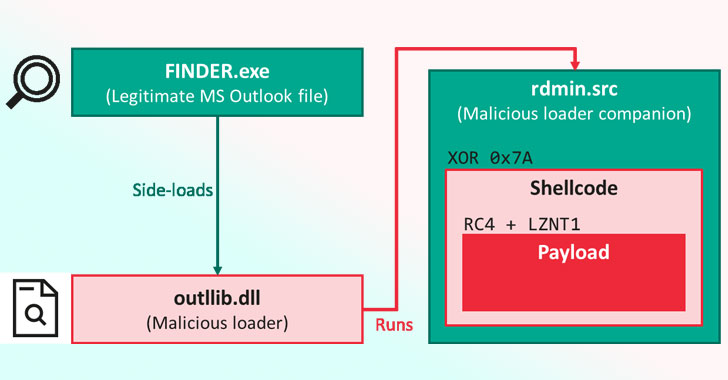
A hacking group related to a Chinese-speaking threat actor has been linked to an advanced cyberespionage campaign targeting government and military organizations in Vietnam. The attacks have been attributed with low confidence to the advanced persistent threat (APT) called  Cycldek  (or Goblin Panda, Hellsing, APT 27, and Conimes), which is known for using spear-phishing techniques to compromise diplomatic targets in Southeast Asia, India, and the U.S. at least since 2013. According to researchers from Kaspersky, the offensive, which was observed between June 2020 and January 2021, leverages a method called DLL side-loading to execute shellcode that decrypts a final payload dubbed " FoundCore ." DLL side-loading  has been a tried-and-tested technique used by various threat actors as an obfuscation tactic to bypass antivirus defenses. By loading malicious DLLs into legitimate executables, the idea is to mask their malicious activity under a trusted system or software ...
Expert Insights Articles Videos
Cybersecurity Resources