#1 Trusted Cybersecurity News Platform
Followed by 5.20+ million
The Hacker News Logo
Subscribe – Get Latest News
Salesforce Security Handbook

Search results for web privacy man | Breaking Cybersecurity News | The Hacker News

Online Trackers Increasingly Switching to Invasive CNAME Cloaking Technique

Online Trackers Increasingly Switching to Invasive CNAME Cloaking Technique

Feb 24, 2021
With browser makers steadily clamping down on third-party tracking, advertising technology companies are increasingly embracing a DNS technique to evade such defenses, thereby posing a threat to web security and privacy. Called  CNAME Cloaking , the practice of blurring the distinction between first-party and third-party cookies not only results in leaking sensitive private information without users' knowledge and consent but also "increases [the] web security threat surface," said a group of researchers Yana Dimova, Gunes Acar, Lukasz Olejnik, Wouter Joosen, and Tom Van Goethem in a new study. "This tracking scheme takes advantage of a CNAME record on a subdomain such that it is same-site to the including web site," the researchers  said  in the paper. "As such, defenses that block third-party cookies are rendered ineffective." The findings are expected to be presented in July at the 21st Privacy Enhancing Technologies Symposium (PETS 2021). Rise...
Join 'Reset The Net' Global Movement to Shut Off NSA Surveillance

Join 'Reset The Net' Global Movement to Shut Off NSA Surveillance

Jun 05, 2014
Privacy of Internet users is dead somewhere as the Intelligence agencies can watch our every move, hear our every conversation and read our every email and find out anything related to our personal and private life.  Last year, Edward Snowden revealed about the mass surveillance carried out by NSA and other countries intelligence agencies on every citizen of their country. The US Government has allotted a large share of its ' Black Budget ' for secret surveillance programs and to make this happen, NSA has used a number of unethical ways and labelled as legal solutions, harvesting hundreds of millions of Metadata from emails, web activity, chats, social networks, and everything else around the world. The revelations encouraged Internet users think about their privacy and digital rights, and the time came when different organisations started several campaigns to block mass surveillance and fight back against the U.S. National Security Agency ( NSA ). RESET YOU...
Google Sued Over Misleading Users About Location Tracking Feature

Google Sued Over Misleading Users About Location Tracking Feature

Aug 21, 2018
Google was in the news last week for a misleading claim that "with Location History off, the places you go are no longer stored," which is not true. Now, the search engine giant is once again in the news after a San Diego man has filed the first lawsuit against Google over this issue. Last week, the Associated Press investigation revealed that the search engine giant tracks movements of millions of iPhone and Android device users, even if they have disabled the "Location History" setting to prevent it. However, it turned out that to fully opt-out of having your location activities stored by Google, you also have to disable the 'Web and App Activity' control as well, about which the company has mentioned deep into its product documentation. In response to the AP investigation, Google defended itself by saying, "there are a number of different ways that Google may use location to improve people's experience," and that "we provide c...
cyber security

The Breach You Didn't Expect: Your AppSec Stack

websiteJFrogAppSec / DevSecOps
In a market undergoing mergers and acquisitions, vendor instability can put you in serious risk.
cyber security

How AI and Zero Trust Work Together to Catch Attacks With No Files or Indicators

websiteTHN WebinarZero Trust / Cloud Security
Modern cyberattacks hide in trusted tools and workflows, evading traditional defenses. Zero Trust and AI-powered cloud security give you the visibility and control to stop these invisible threats early.
Google DNS Service (8.8.8.8) Now Supports DNS-over-TLS Security

Google DNS Service (8.8.8.8) Now Supports DNS-over-TLS Security

Jan 10, 2019
Almost every activity on the Internet starts with a DNS query, a key function of the Internet that works as an Internet's directory where your device looks up for the server IP addresses after you enter a human-readable web address (e.g., thehackernews.com). Since DNS queries are sent in clear text over UDP or TCP without encryption, the information can reveal not only what websites an individual visits but is also vulnerable to spoofing attacks. To address these problems, Google announced Wednesday that its Public DNS (Domain Name System) service finally supports DNS-over-TLS security protocol, which means that the DNS queries and responses will be communicated over TLS-encrypted TCP connections. The DNS-over-TLS has been designed to make it harder for man-in-the-middle attackers to manipulate the DNS query or eavesdrop on your Internet connection. Launched over eight years ago, Google Public DNS, at IP addresses 8.8.8.8 and 8.8.4.4, is world's largest public Domai...
From today, Google Chrome starts marking all non-HTTPS sites 'Not Secure'

From today, Google Chrome starts marking all non-HTTPS sites 'Not Secure'

Jul 24, 2018
Starting today with the release of Chrome 68, Google Chrome prominently marks all non-HTTPS websites as 'Not Secure' in its years-long effort to make the web a more secure place for Internet users. So if you are still running an insecure HTTP (Hypertext Transfer Protocol) website, many of your visitors might already be greeted with a 'Not Secure' message on their Google Chrome browser warning them that they can't trust your website to be secure. By displaying ' Not Secure ,' Google Chrome means that your connection is not secure because there is no SSL Certificate to encrypt your connection between your computer and the website's server. So, anything sent over a non-HTTPS connection is in plain text, like your password or payment card information, allowing attackers to snoop or tamper with your data. The non-https connection has been considered dangerous particularly for web pages that transfer sensitive information—like login pages and payment...
Silent Circle's Blackphone - Privacy and Security Focused Smartphone for $629

Silent Circle's Blackphone - Privacy and Security Focused Smartphone for $629

Feb 24, 2014
Earlier this year encrypted communications firm Silent Circle and Spanish Smartphone maker Geeksphone  announced a  privacy-focused  encrypted  S martphone  called ' Blackphone ' and today the company has revealed it as ' Mobile World Congress ' in Barcelona. The Blackphone titled as, " world's first Smartphone which places privacy and control directly in the hands of its users, " has a fully customized version  customized version of Android called PrivatOS   and pre-installed with lots of  privacy-enabled applications, is now available for pre-order for about $629 . Silent Circle was co-founded by a respected Cryptographer  Phil Zimmermann,  best known as the creator of  Pretty Good Privacy (PGP) , which is a widely used email encryption software. The Blackphone handsets main focus is keeping all of your data secure, and to stop government agencies snooping on your communications. Blackphone will come with a set ...
This $5 Device Can Hack your Password-Protected Computers in Just One Minute

This $5 Device Can Hack your Password-Protected Computers in Just One Minute

Nov 16, 2016
You need to be more careful next time while leaving your computer unattended at your office, as it cost hackers just $5 and only 30 seconds to hack into any computer. Well-known hardware hacker Samy Kamkar has once again devised a cheap exploit tool, this time that takes just 30 seconds to install a privacy-invading backdoor into your computer, even if it is locked with a strong password. Dubbed PoisonTap , the new exploit tool runs freely available software on a tiny $5/£4 Raspberry Pi Zero microcomputer, which is attached to a USB adapter. The attack works even if the targeted computer is password-protected if a browser is left open in the computer's background. All an attacker need is to plug the nasty device in the target computer and wait. Here's How PoisonTap works: Once plugged into a Windows or Mac computer via USB port, the tiny device starts impersonating a new ethernet connection. Even if the victim's device is connected to a WiFi network, Poi...
GFI WebMonitor - Web monitoring and Security

GFI WebMonitor - Web monitoring and Security

May 20, 2012
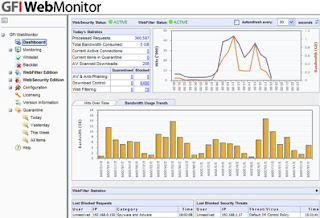
GFI WebMonitor - Web monitoring and Security With all the threats that Internet access can present to your users and your data, web security software is one of the most valuable investments you can make in your information security. Any solution should offer the following key protections: 1.       Site blocking 2.       Antivirus 3.       Reporting and logging GFI WebMonitor offers all that and more. GFI WebMonitor Unified Security includes both the web filtering and anti-malware capabilities, and can be installed as a standalone server or as an add-on to ISA or TMG. This web security suite can be installed on its own server or as a plug-in for TMG, and GFI offers a free 30-day-trial so you can evaluate it risk-free. Installation:  The installer for the TMG plug-in is straight-forward only requires a service restart, not a reboot. During the installation, you can choose to enable the option...
Improve Your Online Privacy And Security Using NordVPN

Improve Your Online Privacy And Security Using NordVPN

Sep 29, 2016
Today, most users surf the web unaware of the fact that websites collect their data and track their locations – and if this is not enough, then there are hackers and cyber criminals who can easily steal sensitive data from the ill-equipped. In short, the simple truth is that you have no or very little privacy when you're online. So, if you're worried about identity thieves, or ISPs spying on or throttling your traffic, the most efficient way to secure your privacy on the Internet is to avoid using public networks; use a Virtual Private Network (VPN) instead. When it comes to digital security, the first thing most users probably think of is a good Antivirus for protecting their sensitive data on their systems. But, what they forget is that the data they send over the Internet needs protection, too. That's where Virtual Private Network (VPN) services come in. VPN allows you to access a private network securely and to share data remotely through public networks, ...
Warning – 3 Popular VPN Services Are Leaking Your IP Address

Warning – 3 Popular VPN Services Are Leaking Your IP Address

Mar 15, 2018
Researchers found critical vulnerabilities in three popular VPN services that could leak users' real IP addresses and other sensitive data. VPN, or Virtual Private Network , is a great way to protect your daily online activities that work by encrypting your data and boosting security, as well as useful to obscure your actual IP address. While some choose VPN services for online anonymity and data security, one major reason many people use VPN is to hide their real IP addresses to bypass online censorship and access websites that are blocked by their ISPs. But what if when the VPN you thought is protecting your privacy is actually leaking your sensitive data and real location? A team of three ethical hackers hired by privacy advocate firm VPN Mentor revealed that three popular VPN service providers—HotSpot Shield, PureVPN, and Zenmate—with millions of customers worldwide were found vulnerable to flaws that could compromise user's privacy. The team includes applicat...
Firefox enables DNS-over-HTTPS by default (with Cloudflare) for all U.S. users

Firefox enables DNS-over-HTTPS by default (with Cloudflare) for all U.S. users

Feb 25, 2020
If you use the Firefox web browser, here's an important update that you need to be aware of. Starting today, Mozilla is activating the DNS-over-HTTPS security feature by default for all Firefox users in the U.S. by automatically changing their DNS server configuration in the settings. That means, from now onwards, Firefox will send all your DNS queries to the Cloudflare DNS servers instead of the default DNS servers set by your operating system, router, or network provider. As you may know, DNS-over-HTTPS (DoH) protocol performs DNS lookups — i.e., finding the server I.P. address of a certain domain name — over an encrypted connection to a DNS server rather than sending queries in the plaintext. This privacy-focused technology makes it harder for man-in-the-middle attackers, including your ISPs, to manipulate DNS queries, eavesdrop on your Internet connection, or learning what sites you visit. "This helps hide your browsing history from attackers on the network, ...
⚡ Weekly Recap: Chrome 0-Day, Ivanti Exploits, MacOS Stealers, Crypto Heists and More

⚡ Weekly Recap: Chrome 0-Day, Ivanti Exploits, MacOS Stealers, Crypto Heists and More

Jul 07, 2025 Cybersecurity / Hacking
Everything feels secure—until one small thing slips through. Even strong systems can break if a simple check is missed or a trusted tool is misused. Most threats don't start with alarms—they sneak in through the little things we overlook. A tiny bug, a reused password, a quiet connection—that's all it takes. Staying safe isn't just about reacting fast. It's about catching these early signs before they blow up into real problems. That's why this week's updates matter. From stealthy tactics to unexpected entry points, the stories ahead reveal how quickly risk can spread—and what smart teams are doing to stay ahead. Dive in. ⚡ Threat of the Week U.S. Disrupts N. Korea IT Worker Scheme — Prosecutors said they uncovered the North Korean IT staff working at over 100 U.S. companies using fictitious or stolen identities and not only drawing salaries, but also stealing secret data and plundering virtual currency more than $900,000 in one incident targeting an unnamed blockchain company in ...
Warning: Over 100 Tor Nodes Found Designed to Spy On Deep Web Users

Warning: Over 100 Tor Nodes Found Designed to Spy On Deep Web Users

Jul 26, 2016
Researchers have discovered over 100 malicious nodes on the Tor anonymity network that are "misbehaving" and potentially spying on Dark Web sites that use Tor to mask the identities of their operators. Two researchers, Amirali Sanatinia and Guevara Noubir, from Northwestern University, carried out an experiment on the Tor Network for 72 days and discovered at least 110 malicious Tor Hidden Services Directories (HSDirs) on the network. The nodes, also known as the Tor hidden services directories ( HSDirs ) are servers that act as introductory points and are configured to receive traffic and direct users to hidden services (" .onion " addresses). In other words, the hidden services directory or HSDir is a crucial element needed to mask the true IP address of users on the Tor Network. But, here's the issue: HSDir can be set up by anyone. "Tor's security and anonymity is based on the assumption that the large majority of its relays are honest and...
5 Things Google has Done for Gmail Privacy and Security

5 Things Google has Done for Gmail Privacy and Security

Mar 29, 2016
Over the past few years, Google has increasingly improved the online security and protections of its Gmail users. Besides two-factor authentication and HTTPS, Google has added new tools and features to Gmail that ensures users security and privacy, preventing cyber criminals and intelligence agencies to hack email accounts . 1. Enhanced State-Sponsored Attack Warnings Apple vs. FBI case urged every company to beef up the security parameters to prevent their services from not just hackers but also the law enforcement. Google for a while now has the capability to identify government-backed hackers , and notify potentially affected Gmail users so they can take action as soon as possible. Google recently announced on its blog post that it will alert Gmail users about the possibility of any state-sponsored attack by showing them a full-page warning with instructions about how to stay safe — very hard to miss or neglect. Meanwhile, the company revealed that ove...
Expert Insights Articles Videos
Cybersecurity Resources