#1 Trusted Cybersecurity News Platform
Followed by 5.20+ million
The Hacker News Logo
Subscribe – Get Latest News

Search results for chrome extension developer | Breaking Cybersecurity News | The Hacker News

Someone Hijacks A Popular Chrome Extension to Push Malware

Someone Hijacks A Popular Chrome Extension to Push Malware

Jul 31, 2017
Phishers have recently hacked an extension for Google Chrome after compromising the Chrome Web Store account of German developer team a9t9 software and abused to distribute spam messages to unsuspecting users. Dubbed Copyfish, the extension allows users to extract text from images, PDF documents and video, and has more than 37,500 users. Unfortunately, the Chrome extension of Copyfish has been hijacked and compromised by some unknown attacker, who equipped the extension with advertisement injection capabilities. However, its Firefox counterpart was not affected by the attack. The attackers even moved the extension to their developer account, preventing its developers from removing the infected extension from the store, even after being spotted that the extension has been compromised. "So far, the update looks like standard adware hack, but, as we still have no control over Copyfish, the thieves might update the extension another time… until we get it back," the de...
Hackers Hijacked Chrome Extension for Web Developers With Over 1 Million Users

Hackers Hijacked Chrome Extension for Web Developers With Over 1 Million Users

Aug 03, 2017
From past few years, spammers and cyber criminals were buying web extensions from their developers and then updating them without informing their users to inject bulk advertisements into every website user visits in order to generate large revenue. But now they have shifted their business model—instead of investing, spammers have started a new wave of phishing attacks aimed at hijacking popular browser extensions. Just two days ago, we reported how cyber criminals managed to compromise the Chrome Web Store account of a German developer team and hijacked Copyfish extension , and then modified it with ad-injection capabilities to distribute spam correspondence to users. Now just yesterday, another popular Chrome extension ' Web Developer ' was hijacked by some unknown attackers, who updated the software to directly inject advertisements into the web browser of over its 1 million users. Chris Pederick , the creator of Web Developer Chrome extension that offers various w...
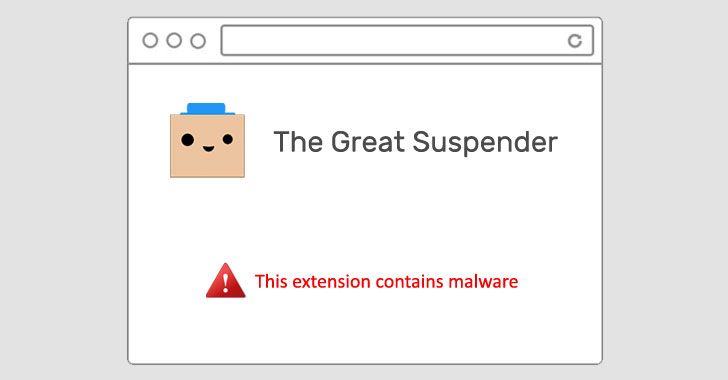
WARNING — Hugely Popular 'The Great Suspender' Chrome Extension Contains Malware

WARNING — Hugely Popular 'The Great Suspender' Chrome Extension Contains Malware

Feb 06, 2021
Google on Thursday removed The Great Suspender , a popular Chrome extension used by millions of users, from its Chrome Web Store for containing malware. It also took the unusual step of deactivating it from users' computers. "This extension contains malware,"  read  a terse notification from Google, but it has since emerged that the add-on stealthily added features that could be exploited to execute arbitrary code from a remote server, including tracking users online and committing advertising fraud. "The old maintainer appears to have sold the extension to parties unknown, who have malicious intent to exploit the users of this extension in advertising fraud, tracking, and more," Calum McConnell  said  in a GitHub post. The extension, which had more than two million installs before it was disabled, would suspend tabs that aren't in use, replacing them with a blank gray screen until they were reloaded upon returning to the tabs in question. Signs of the...
cyber security

2025 Cloud Security Risk Report

websiteSentinelOneCloud Security / Artificial Intelligence
Learn 5 key risks to cloud security such as cloud credential theft, lateral movements, AI services, and more.
cyber security

Most AI Risk Isn't in Models, It's in Your SaaS Stack

websiteRecoAI Security / (SaaS Security
Your models aren't the problem. The sprawl of your SaaS apps, AI and agents are. Here's where to start.
Dozens of Chrome Extensions Hacked, Exposing Millions of Users to Data Theft

Dozens of Chrome Extensions Hacked, Exposing Millions of Users to Data Theft

Dec 29, 2024 Endpoint Protection / Browser Security
A new attack campaign has targeted known Chrome browser extensions, leading to at least 35 extensions being compromised and exposing over 2.6 million users to data exposure and credential theft. The attack targeted publishers of browser extensions on the Chrome Web Store via a phishing campaign and used their access permissions to insert malicious code into legitimate extensions in order to steal cookies and user access tokens. The first company to shed light the campaign was cybersecurity firm Cyberhaven, one of whose employees was targeted by a phishing attack on December 24, allowing the threat actors to publish a malicious version of the extension. On December 27, Cyberhaven disclosed that a threat actor compromised its browser extension and injected malicious code to communicate with an external command-and-control (C&C) server located on the domain cyberhavenext[.]pro, download additional configuration files, and exfiltrate user data. The phishing email, which purported...
8 More Chrome Extensions Hijacked to Target 4.8 Million Users

8 More Chrome Extensions Hijacked to Target 4.8 Million Users

Aug 16, 2017
Google's Chrome web browser Extensions are under attack with a series of developers being hacked within last one month. Almost two weeks ago, we reported how unknown attackers managed to compromise the Chrome Web Store account of a developer team and hijacked Copyfish extension , and then modified it to distribute spam correspondence to users. Just two days after that incident, some unknown attackers then hijacked another popular extension ' Web Developer ' and then updated it to directly inject advertisements into the web browser of over its 1 million users. After Chris Pederick, the creator of 'Web Developer' Chrome extension that offers various web development tools to its users, reported to Proofpoint that his extension had been compromised, the security vendor analysed the issue and found further add-ons in the Chrome Store that had also been altered. According to the latest report published by the researchers at Proofpoint on Monday, the expanded ...
Malicious Chrome Extension Hijacks CryptoCurrencies and Wallets

Malicious Chrome Extension Hijacks CryptoCurrencies and Wallets

Apr 25, 2014
Although the number of malicious browser extensions has significantly increased in the past years, but recently a new extension of the Google Chrome is allegedly targeting Cryptocurrency users that is capable of stealing Bitcoins and other crypto coins silently. The malicious Chrome browser extension dubbed as ' Cryptsy Dogecoin (DOGE) Live Ticker ' which is available on Chrome Web store for free downloads and developed by " TheTrollBox " account. Reddit user noticed that the updated version of the extension has a malicious code, which is designed to hijack the crypto currency transactions. HOW CHROME EXTENSION STEALS CRYPTOCURRENCY It is very obvious that the kind of crypto related software extensions is downloaded only by the users who deal with the digital currency. So, once the user installed the malicious extension, the software within the extension starts monitoring users' web activity and looks for those users who go to Cryptocurrency exchange sites s...
Malicious Chrome Extension Steals MEXC API Keys by Masquerading as Trading Tool

Malicious Chrome Extension Steals MEXC API Keys by Masquerading as Trading Tool

Jan 13, 2026 Web Security / Online Fraud
Cybersecurity researchers have disclosed details of a malicious Google Chrome extension that's capable of stealing API keys associated with MEXC, a centralized cryptocurrency exchange (CEX) available in over 170 countries , while masquerading as a tool to automate trading on the platform. The extension, named MEXC API Automator (ID: pppdfgkfdemgfknfnhpkibbkabhghhfh), has 29 downloads and is still available on the Chrome Web Store as of writing. It was first published on September 1, 2025, by a developer named "jorjortan142." "The extension programmatically creates new MEXC API keys, enables withdrawal permissions, hides that permission in the user interface (UI), and exfiltrates the resulting API key and secret to a hardcoded Telegram bot controlled by the threat actor," Socket security researcher Kirill Boychenko said in an analysis. According to the Chrome Web Store listing, the web browser add-on is described as an extension that "simplifies connecti...
Trust Wallet Chrome Extension Hack Drains $8.5M via Shai-Hulud Supply Chain Attack

Trust Wallet Chrome Extension Hack Drains $8.5M via Shai-Hulud Supply Chain Attack

Dec 31, 2025 Software Security / Data Breach
Trust Wallet on Tuesday revealed that the second iteration of the Shai-Hulud (aka Sha1-Hulud) supply chain outbreak in November 2025 was likely responsible for the hack of its Google Chrome extension , ultimately resulting in the theft of approximately $8.5 million in assets. "Our Developer GitHub secrets were exposed in the attack, which gave the attacker access to our browser extension source code and the Chrome Web Store (CWS) API key," the company said in a post-mortem published Tuesday. "The attacker obtained full CWS API access via the leaked key, allowing builds to be uploaded directly without Trust Wallet's standard release process, which requires internal approval/manual review." Subsequently, the attacker is said to have registered the domain "metrics-trustwallet[.]com" and pushed a trojanized version of the extension with a backdoor that's capable of harvesting users' wallet mnemonic phrases to the sub-domain "api.metrics...
How To Run Almost Any Android App On Windows, OS X, Linux with Chrome

How To Run Almost Any Android App On Windows, OS X, Linux with Chrome

Sep 22, 2014
From last week, Google began paving the way to run Android apps on Chrome Operating System through the project named " App Runtime for Chrome ", but the release came with a lot of limitations – it only supported certain Android apps and on Chrome OS only. At the launch, initially only 4 Android apps – Vine, Evernote, Duolingo and Sight Words – were added to the Chrome Web Store. That was pretty exciting, but it merely whet the appetite of users hungry for more functionality. So, what if you could run more than just 4 Android apps on Chrome OS? And Also could run them on other operating systems as well? A developer by the name of " Vlad Filippov " began working on it to stripped away the limits Google has imposed. He successfully figured out a way to bring more Android apps to Chrome , instead of just the four that are officially supported by Google. The bigger success was that when Filippov got Android apps to work on any desktop Operating System tha...
Trust Wallet Chrome Extension Breach Caused $7 Million Crypto Loss via Malicious Code

Trust Wallet Chrome Extension Breach Caused $7 Million Crypto Loss via Malicious Code

Dec 26, 2025 Cryptocurrency / Incident Response
Trust Wallet is urging users to update its Google Chrome extension to the latest version following what it described as a "security incident" that led to the loss of approximately $7 million. The issue, the multi‑chain, non‑custodial cryptocurrency wallet service said, impacts version 2.68. The extension has about one million users, according to the Chrome Web Store listing. Users are advised to update to version 2.69 as soon as possible. "We've confirmed that approximately $7 million has been impacted and we will ensure all affected users are refunded," Trust Wallet said in a post on X. "Supporting affected users is our top priority, and we are actively finalizing the process to refund the impacted users." Trust Wallet is also urging users to refrain from interacting with any messages that do not come from its official channels. Mobile-only users and all other browser extension versions are not affected. According to details shared by SlowMist...
Featured Chrome Browser Extension Caught Intercepting Millions of Users' AI Chats

Featured Chrome Browser Extension Caught Intercepting Millions of Users' AI Chats

Dec 15, 2025 AI Security / Browser Security
A Google Chrome extension with a "Featured" badge and six million users has been observed silently gathering every prompt entered by users into artificial intelligence (AI)-powered chatbots like OpenAI ChatGPT, Anthropic Claude, Microsoft Copilot, DeepSeek, Google Gemini, xAI Grok, Meta AI, and Perplexity. The extension in question is Urban VPN Proxy , which has a 4.7 rating on the Google Chrome Web Store. It's advertised as the "best secured Free VPN access to any website, and unblock content." Its developer is a Delaware-based company named Urban Cyber Security Inc . On the Microsoft Edge Add-ons marketplace, it has 1.3 million installations .  Despite claiming that it allows users to "protect your online identity, stay protected, and hide your IP," an update was pushed to users on July 9, 2025, when version 5.5.0 was released with the AI data harvesting enabled by default using hard-coded settings. Specifically, this is achieved by means of a t...
Adware Companies buying popular Chrome extensions to inject Ads and Malware

Adware Companies buying popular Chrome extensions to inject Ads and Malware

Jan 20, 2014
Browser extensions are extra features and functionality that you can easily add to Google Chrome, Firefox and other popular Browsers, but they can be used to serve malicious adware , which automatically renders advertisements in order to generate revenue for its author.  Hackers are now taking their business rather more seriously than we thought. Even a single instance of malicious adware on your PC can inject bad ads or malware to your browser. Ads are a legitimate way to monetize. However, creating and spreading a fresh add-on to get a large user base is always tough, but now adware companies found a new trick i.e. Buying trusted browser extensions with a large user-base and exploiting their auto-update status to push out adware. Recently, the developer of ' Add to Feedly ' Chrome extension with 30,000+ users, Amit Agarwal , was approached by some mysterious buyers. " It was a 4-figure offer for something that had taken an hour to create and I agreed to the deal ," ...
Hacker Finds a Simple Way to Bypass Google Password Alert

Hacker Finds a Simple Way to Bypass Google Password Alert

May 02, 2015
Less than 24 hours after Google launched the new Phishing alert extension Password Alert , a security researcher was able to bypass the feature using deadly simple exploits. On Wednesday, the search engine giant launched a new Password Alert Chrome extension to alert its users whenever they accidentally enter their Google password on a carefully crafted phishing website that aimed at hijacking users' account. However, security expert Paul Moore easily circumvented the technology using just seven lines of simple JavaScript code that kills phishing alerts as soon as they started to appear, defeating Google's new Password Alert extension. Google shortly fixed the issue and released a new update to Password Alert extension that blocked the Moore's exploit. However, Moore discovered another way to block the new version of Password Alert, as well. The first proof of concept exploit by Moore relied on a JavaScript that looks for instances of warning screen every five mil...
Two Widely Used Ad Blocker Extensions for Chrome Caught in Ad Fraud Scheme

Two Widely Used Ad Blocker Extensions for Chrome Caught in Ad Fraud Scheme

Sep 20, 2019
Two widely used Adblocker Google Chrome extensions , posing as the original — AdBlock and uBlock Origin — extensions on Chrome Web Store, have been caught stuffing cookies in the web browser of millions of users to generate affiliate income from referral schemes fraudulently. There's no doubt web extensions add a lot of useful features to web browsers, making your online experience great and aiding productivity, but at the same time, they also pose huge threats to both your privacy and security. Being the most over-sighted weakest link in the browser security model, extensions sit between the browser application and the Internet — from where they look for the websites you visit and subsequently can intercept, modify, and block any requests, based on the functionalities they have been designed for. Apart from the extensions which are purposely created with malicious intent , in recent years we have also seen some of the most popular legitimate Chrome and Firefox extensions g...
Google Chrome's New Feature Alerts Users About Auto-Removal of Malicious Extensions

Google Chrome's New Feature Alerts Users About Auto-Removal of Malicious Extensions

Aug 18, 2023 Browser Security / Malware
Google has announced plans to add a new feature in the upcoming version of its Chrome web browser to proactively alert users when an extension they have installed has been removed from the Chrome Web Store. The feature, set for release alongside Chrome 117, allows users to be notified when an add-on has been unpublished by a developer, taken down for violating Chrome Web Store policy, or marked as malware. The tech giant said it intends to highlight such extensions under a "Safety check" category in the "Privacy and security" section of the browser settings page. "When a user clicks 'Review,' they will be taken to their extensions and given the choice to either remove the extension or hide the warning if they wish to keep the extension installed," Oliver Dunk, a developer relations engineer for Chrome extensions,  said . "As in previous versions of Chrome, extensions marked as malware are automatically disabled." The development co...
Five Malicious Chrome Extensions Impersonate Workday and NetSuite to Hijack Accounts

Five Malicious Chrome Extensions Impersonate Workday and NetSuite to Hijack Accounts

Jan 16, 2026 Browser Security / Enterprise Security
Cybersecurity researchers have discovered five new malicious Google Chrome web browser extensions that masquerade as human resources (HR) and enterprise resource planning (ERP) platforms like Workday, NetSuite, and SuccessFactors to take control of victim accounts. "The extensions work in concert to steal authentication tokens, block incident response capabilities, and enable complete account takeover through session hijacking," Socket security researcher Kush Pandya said in a Thursday report. The names of the extensions are listed below - DataByCloud Access (ID: oldhjammhkghhahhhdcifmmlefibciph, Published by: databycloud1104) - 251 Installs Tool Access 11 (ID: ijapakghdgckgblfgjobhcfglebbkebf, Published by: databycloud1104) - 101 Installs DataByCloud 1 (ID: mbjjeombjeklkbndcjgmfcdhfbjngcam, Published by: databycloud1104) - 1,000 Installs DataByCloud 2 (ID: makdmacamkifdldldlelollkkjnoiedg, Published by: databycloud1104) - 1,000 Installs Software Access (ID: bmodapc...
A Browser Extension Risk Guide After the ShadyPanda Campaign

A Browser Extension Risk Guide After the ShadyPanda Campaign

Dec 15, 2025 Browser Security / SaaS Security
In early December 2025, security researchers exposed a cybercrime campaign that had quietly hijacked popular Chrome and Edge browser extensions on a massive scale. A threat group dubbed ShadyPanda spent seven years playing the long game, publishing or acquiring harmless extensions, letting them run clean for years to build trust and gain millions of installs, then suddenly flipping them into malware via silent updates. In total, about 4.3 million users installed these once-legitimate add-ons, which suddenly went rogue with spyware and backdoor capabilities. This tactic was essentially a browser extension supply-chain attack. The ShadyPanda operators even earned featured and verified badges in the official Chrome Web Store and Microsoft Edge Add-ons site for some extensions, reinforcing user confidence. Because extension updates happen automatically in the background, the attackers were able to push out malicious code without users noticing a thing. Once activated in mid-2024, the...
CrashFix Chrome Extension Delivers ModeloRAT Using ClickFix-Style Browser Crash Lures

CrashFix Chrome Extension Delivers ModeloRAT Using ClickFix-Style Browser Crash Lures

Jan 19, 2026 Malware / Windows Security
Cybersecurity researchers have disclosed details of an ongoing campaign dubbed KongTuke that used a malicious Google Chrome extension masquerading as an ad blocker to deliberately crash the web browser and trick victims into running arbitrary commands using ClickFix -like lures to deliver a previously undocumented remote access trojan (RAT) dubbed ModeloRAT. This new escalation of ClickFix, observed earlier this month, has been codenamed CrashFix by Huntress. KongTuke , also tracked as 404 TDS, Chaya_002, LandUpdate808, and TAG-124, is the name given to a traffic distribution system (TDS) known for profiling victim hosts before redirecting them to a payload delivery site that infects their systems. Access to these compromised hosts is then handed off to other threat actors, including ransomware groups, for follow-on malware delivery. Some of the cybercriminal groups that have leveraged TAG-124 infrastructure include Rhysida ransomware , Interlock ransomware , and TA866 (aka Asylu...
Expert Insights Articles Videos
Cybersecurity Resources