-->
#1 Trusted Cybersecurity News Platform
Followed by 5.80+ million
The Hacker News Logo
Get Updates
cybersecurity

Search results for Facebook javascript injection | Breaking Cybersecurity News | The Hacker News

iBanking Android Malware targeting Facebook Users with Web Injection techniques

iBanking Android Malware targeting Facebook Users with Web Injection techniques

Apr 16, 2014
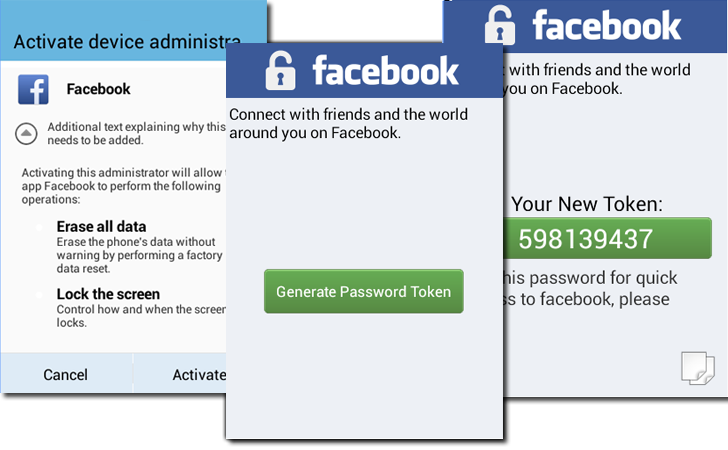
iBanking is nothing but a mobile banking Trojan app which impersonates itself as a so-called ' Security App ' for Android devices and distributed through HTML injection attacks on banking sites, in order to deceive its victims. Recently, its source code has been leaked online through an underground forum that gave the opportunities to a larger number of cyber criminals to launch attacks using this kind of ready-made mobile malware. The malicious iBanking app installed on victims’ phone has capabilities to spy on user’s communications. The bot allows an attacker to spoof SMS, redirect calls to any pre-defined phone number, capture audio using the device's microphone and steal other confidential data like call history log and the phone book contacts. According to new report from ESET security researchers, now this iBanking Trojan ( Android/Spy.Agent.AF ) is targeting Facebook users by tricking them to download a malware application. The malware uses ...
Schoolyard Bully Trojan Apps Stole Facebook Credentials from Over 300,000 Android Users

Schoolyard Bully Trojan Apps Stole Facebook Credentials from Over 300,000 Android Users

Dec 01, 2022 Mobile Threat Advisory
More than 300,000 users across 71 countries have been victimized by a new Android threat campaign called the  Schoolyard Bully Trojan . Mainly designed to steal Facebook credentials, the malware is camouflaged as legitimate education-themed applications to lure unsuspecting users into downloading them. The apps, which were available for download from the official Google Play Store, have now been taken down. That said, they still continue to be available on third-party app stores. "This trojan uses JavaScript injection to steal the Facebook credentials," Zimperium researchers Nipun Gupta and Aazim Bill SE Yaswant said in a report shared with The Hacker News. It achieves this by launching Facebook's login page in a WebView, which also embeds within it malicious JavasCript code to exfiltrate the user's phone number, email address, and password to a configured command-and-control (C2) server. The Schoolyard Bully Trojan further makes use of native libraries such ...
Security Experts Warn of Two Primary Client-Side Risks Associated with Data Exfiltration and Loss

Security Experts Warn of Two Primary Client-Side Risks Associated with Data Exfiltration and Loss

Jul 19, 2022
Two client-side risks dominate the problems with data loss and data exfiltration: improperly placed trackers on websites and web applications and malicious client-side code pulled from third-party repositories like NPM.  Client-side security researchers are finding that improperly placed trackers, while not intentionally malicious, are a growing problem and have clear and significant privacy implications when it comes to both compliance/regulatory concerns, like HIPAA or PCI DSS 4.0. To highlight the risks with misplaced trackers, a  recent study  by The Markup (a non-profit news organization) examined Newsweek’s top 100 hospitals in America. They found a Facebook tracker on one-third of the hospital websites which sent Facebook highly personal healthcare data whenever the user clicked the “schedule appointment” button. The data was not necessarily anonymized, because the data was connected to an IP address, and both the IP address and the appointment information get de...
cyber security

Incident Response Starter Pack

websiteWizIncident Response / Cloud Security
7 cloud incident response resources in one bundle. Get ready-to-use playbooks to contain, isolate, and defeat cloud threats.
cyber security

SANS 2026 State of ICS/OT Security Report

websiteSANS InstituteICS/OT Security
See what nearly 700 industrial professionals reveal about keeping operations safe during a cyber incident.
Beware! New Android Malware Hacks Thousands of Facebook Accounts

Beware! New Android Malware Hacks Thousands of Facebook Accounts

Aug 09, 2021
A new Android trojan has been found to compromise Facebook accounts of over 10,000 users in at least 144 countries since March 2021 via fraudulent apps distributed through Google Play Store and other third-party app marketplaces. Dubbed " FlyTrap ," the previously undocumented malware is believed to be part of a family of trojans that employ social engineering tricks to breach Facebook accounts as part of a session hijacking campaign orchestrated by malicious actors operating out of Vietnam, according to a  report  published by Zimperium's zLabs today and shared with The Hacker News. Although the offending nine applications have since been pulled from Google Play, they continue to be available in third-party app stores, "highlighting the risk of sideloaded applications to mobile endpoints and user data," Zimperium malware researcher Aazim Yaswant said. The list of apps is as follows - GG Voucher (com.luxcarad.cardid)  Vote European Football (com.gardengu...
Kaspersky Antivirus Flaw Exposed Users to Cross-Site Tracking Online

Kaspersky Antivirus Flaw Exposed Users to Cross-Site Tracking Online

Aug 15, 2019
In this digital era, the success of almost every marketing, advertising, and analytics company drives through tracking users across the Internet to identify them and learn their interests to provide targeted ads. Most of these solutions rely on 3rd-party cookies, a cookie set on a domain other than the one you are browsing, which allows companies including Google and Facebook to fingerprint you in order to track your every move across multiple sites. However, if you're using Kaspersky Antivirus, a vulnerability in the security software had exposed a unique identifier associated with you to every website you visited in the past 4 years, which might have allowed those sites and other third-party services to track you across the web even if you have blocked or erased third-party cookies timely. The vulnerability, identified as CVE-2019-8286 and discovered by independent security researcher Ronald Eikenberg, resides in the way a URL scanning module integrated into the antivir...
Chrome Ad Blocker with 10M+ Installs Found with Dormant Script Injection Capability

Chrome Ad Blocker with 10M+ Installs Found with Dormant Script Injection Capability

Jun 25, 2026 Browser Security / Malware
An analysis of a popular Google Chrome ad block extension for YouTube has uncovered the ability to execute arbitrary JavaScript code. According to Island, the extension, named Adblock for YouTube , has more than 10 million installs and carries a Featured badge on the Chrome Web Store. The extension (ID: cmedhionkhpnakcndndgjdbohmhepckk ) description states that it allows users to prevent web page elements like ads, including preroll ads, from being displayed on the video sharing platform, as well as on external sites that load YouTube. While the add-on offers the promised functionality, it also features capabilities to run arbitrary JavaScript code. "It also contains the architectural ingredients for arbitrary JavaScript execution on any website, activated by a single server-side configuration change, without an extension update, without a store review, and without any visible sign that something has changed," researchers Oleg Zaytsev and Shachar Gritzman said in a re...
SEO Poisoning Campaign Targets 8,500+ SMB Users with Malware Disguised as AI Tools

SEO Poisoning Campaign Targets 8,500+ SMB Users with Malware Disguised as AI Tools

Jul 07, 2025 Malware / Malvertising
Cybersecurity researchers have disclosed a malicious campaign that leverages search engine optimization ( SEO ) poisoning techniques to deliver a known malware loader called Oyster (aka Broomstick or CleanUpLoader). The malvertising activity, per Arctic Wolf, promotes fake websites hosting trojanized versions of legitimate tools like PuTTY and WinSCP, aiming to trick software professionals searching for these programs into installing them instead. "Upon execution, a backdoor known as Oyster/Broomstick is installed," the company said in a brief published last week. "Persistence is established by creating a scheduled task that runs every three minutes, executing a malicious DLL (twain_96.dll) via rundll32.exe using the DllRegisterServer export, indicating the use of DLL registration as part of the persistence mechanism." The names of some of the bogus websites are listed below - updaterputty[.]com zephyrhype[.]com putty[.]run putty[.]bet, and puttyy[.]org...
ClassicCars.com hacked by Indonesian hackers !

ClassicCars.com hacked by Indonesian hackers !

Feb 07, 2011
Late yesterday evening website classiccars.com had been defaced. While it's not shocking news that another site of the millions on the internet has been hacked, this one was unusual in that the defacement seemed to be nothing more than an advertisement for the hackers. Ten years ago hacking for bragging rights was a somewhat common practice, but today most attacks are more silent and are designed to steal information. I poked around to find out more about who was behind the attack and how they are compromising the security of the sites they are attacking. The image and stolen JavaScript code that made up the new home page were stored at a free web host. No surprises there, but I did discover that they had an active IRC network. The group had planted an IRC bot in a chat channel that they can command to remotely scan networks for vulnerabilities. This provides them with a list of hosts that are vulnerable to SQL injection and other techniques. It appears the bot uses search en...
Two Chrome Extensions Caught Secretly Stealing Credentials from Over 170 Sites

Two Chrome Extensions Caught Secretly Stealing Credentials from Over 170 Sites

Dec 23, 2025 Browser Security / Enterprise Security
Cybersecurity researchers have discovered two malicious Google Chrome extensions with the same name and published by the same developer that come with capabilities to intercept traffic and capture user credentials. The extensions are advertised as a "multi-location network speed test plug-in" for developers and foreign trade personnel. Both the browser add-ons are available for download as of writing. The details of the extensions are as follows - Phantom Shuttle (ID: fbfldogmkadejddihifklefknmikncaj) - 2,000 users (Published on November 26, 2017) Phantom Shuttle (ID: ocpcmfmiidofonkbodpdhgddhlcmcofd) - 180 users (Published on April 27, 2023) "Users pay subscriptions ranging from ¥9.9 to ¥95.9 CNY ($1.40 to $13.50 USD), believing they're purchasing a legitimate VPN service, but both variants perform identical malicious operations," Socket security researcher Kush Pandya said. "Behind the subscription facade, the extensions execute complete traffic ...
19 Chrome and Edge Extensions Found With Wallet-Stealing and Crypto-Draining Code

19 Chrome and Edge Extensions Found With Wallet-Stealing and Crypto-Draining Code

Aug 28, 2026 Web Security / Supply Chain
Cybersecurity researchers have discovered a cluster of 18 Google Chrome and one Microsoft Edge extensions that were published over the last six months and harbored wallet secret stealing and cryptocurrency draining capabilities. The extensions , per Socket security researcher Karlo Zanki, share similarities in code and tradecraft, with evidence indicating that the campaign may have been active since February 2024. Socket is tracking the activity under the name Superior. The modus operandi is relatively straightforward: the threat actor either acquires legitimate extensions with proper functionality or pushes a clean version that's devoid of any malware. Once the extensions begin to gather user downloads, a new version with the malicious behavior is published.
⚡ Weekly Recap: Proxy Botnets, Browser Ransomware, AI Agent Tricks, Fake PoC Malware and More

⚡ Weekly Recap: Proxy Botnets, Browser Ransomware, AI Agent Tricks, Fake PoC Malware and More

Jul 06, 2026 Cybersecurity / Hacking
A streaming box should not need a threat model. Neither should a username field, a demo repo, a reset flow, or a browser permission prompt. That is the irritating part this week: the risky pieces were ordinary. Home devices became a routing cover. Clean code pulled dirt from a dependency. Identity shortcuts aged badly. AI systems trusted the wrong instructions. Same soft spot throughout: trust placed one layer too early. Below is the full recap, since this is apparently what counted as a normal week. ⚡ Threat of the Week NetNut Residential Proxy Network Disrupted — Google, in collaboration with the U.S. Federal Bureau of Investigation (FBI), Lumen, and other partners, took action against the NetNut residential proxy network, also known as Popa, building upon its takedown of IPIDEA in January 2026. Google said it disabled Google accounts and associated Google services used by NetNut for malware command-and-control (C2) and updated Google Play Protect, in addition to disabling ...
⚡ Weekly Recap: iPhone Spyware, Microsoft 0-Day, TokenBreak Hack, AI Data Leaks and More

⚡ Weekly Recap: iPhone Spyware, Microsoft 0-Day, TokenBreak Hack, AI Data Leaks and More

Jun 16, 2025 Cybersecurity / Hacking News
Some of the biggest security problems start quietly. No alerts. No warnings. Just small actions that seem normal but aren't. Attackers now know how to stay hidden by blending in, and that makes it hard to tell when something’s wrong. This week’s stories aren’t just about what was attacked—but how easily it happened. If we’re only looking for the obvious signs, what are we missing right in front of us? Here’s a look at the tactics and mistakes that show how much can go unnoticed. ⚡ Threat of the Week Apple Zero-Click Flaw in Messages Exploited to Deliver Paragon Spyware — Apple disclosed that a security flaw in its Messages app was actively exploited in the wild to target civil society members in sophisticated cyber attacks. The vulnerability, CVE-2025-43200, was addressed by the company in February as part of iOS 18.3.1, iPadOS 18.3.1, iPadOS 17.7.5, macOS Sequoia 15.3.1, macOS Sonoma 14.7.4, macOS Ventura 13.7.4, watchOS 11.3.1, and visionOS 2.3.1. The Citizen Lab said it u...
⚡ Weekly Recap: Chrome 0-Days, Router Botnets, AWS Breach, Rogue AI Agents & More

⚡ Weekly Recap: Chrome 0-Days, Router Botnets, AWS Breach, Rogue AI Agents & More

Mar 16, 2026 Cybersecurity / Hacking
Some weeks in security feel normal. Then you read a few tabs and get that immediate “ah, great, we’re doing this now” feeling. This week has that energy. Fresh messes, old problems getting sharper, and research that stops feeling theoretical real fast. A few bits hit a little too close to real life, too. There’s a good mix here: weird abuse of trusted stuff, quiet infrastructure ugliness, sketchy chatter, and the usual reminder that attackers will use anything that works. Scroll on. You’ll see what I mean. ⚡ Threat of the Week Google Patches 2 Actively Exploited Chrome 0-Days — Google released security updates for its Chrome web browser to address two high-severity vulnerabilities that it said have been exploited in the wild. The vulnerabilities related to an out-of-bounds write vulnerability in the Skia 2D graphics library (CVE-2026-3909) and an inappropriate implementation vulnerability in the V8 JavaScript and WebAssembly engine (CVE-2026-3910) that could result in out-of-boun...
⚡ Weekly Recap: BadCam Attack, WinRAR 0-Day, EDR Killer, NVIDIA Flaws, Ransomware Attacks & More

⚡ Weekly Recap: BadCam Attack, WinRAR 0-Day, EDR Killer, NVIDIA Flaws, Ransomware Attacks & More

Aug 11, 2025
This week, cyber attackers are moving quickly, and businesses need to stay alert. They’re finding new weaknesses in popular software and coming up with clever ways to get around security. Even one unpatched flaw could let attackers in, leading to data theft or even taking control of your systems. The clock is ticking—if defenses aren’t updated regularly, it could lead to serious damage. The message is clear: don’t wait for an attack to happen. Take action now to protect your business. Here’s a look at some of the biggest stories in cybersecurity this week: from new flaws in WinRAR and NVIDIA Triton to advanced attack techniques you should know about. Let’s get into the details. ⚡ Threat of the Week Trend Micro Warns of Actively Exploited 0-Day — Trend Micro has released temporary mitigations to address critical security flaws in on-premise versions of Apex One Management Console that it said have been exploited in the wild. The vulnerabilities (CVE-2025-54948 and CVE-2025-54987),...
Google Chrome Bug Could Let Hackers Bypass CSP Protection; Update Web Browsers

Google Chrome Bug Could Let Hackers Bypass CSP Protection; Update Web Browsers

Aug 11, 2020
If you haven't recently updated your Chrome, Opera, or Edge web browser to the latest available version, it would be an excellent idea to do so as quickly as possible. Cybersecurity researchers on Monday disclosed details about a zero-day flaw in Chromium-based web browsers for Windows, Mac and Android that could have allowed attackers to entirely bypass Content Security Policy (CSP) rules since Chrome 73. Tracked as CVE-2020-6519 (rated 6.5 on the CVSS scale), the issue stems from a CSP bypass that results in arbitrary execution of malicious code on target websites. According to PerimeterX, some of the most popular websites, including Facebook, Wells Fargo, Zoom, Gmail, WhatsApp, Investopedia, ESPN, Roblox, Indeed, TikTok, Instagram, Blogger, and Quora, were susceptible to the CSP bypass. Interestingly, it appears that the same flaw was also highlighted by Tencent Security Xuanwu Lab more than a year ago, just a month after the release of Chrome 73 in March 2019, but...
⚡ Weekly Recap: Chrome 0-Day, 7.3 Tbps DDoS, MFA Bypass Tricks, Banking Trojan and More

⚡ Weekly Recap: Chrome 0-Day, 7.3 Tbps DDoS, MFA Bypass Tricks, Banking Trojan and More

Jun 23, 2025 Cyber Security / Hacking News
Not every risk looks like an attack. Some problems start as small glitches, strange logs, or quiet delays that don’t seem urgent—until they are. What if your environment is already being tested, just not in ways you expected? Some of the most dangerous moves are hidden in plain sight. It’s worth asking: what patterns are we missing, and what signals are we ignoring because they don’t match old playbooks? This week’s reports bring those quiet signals into focus—from attacks that bypassed MFA using trusted tools, to supply chain compromises hiding behind everyday interfaces. Here's what stood out across the cybersecurity landscape: ⚡ Threat of the Week Cloudflare Blocks Massive 7.3 Tbps DDoS Attack — Cloudflare said it autonomously blocked the largest distributed denial-of-service (DDoS) attack ever recorded, which hit a peak of 7.3 terabits per second (Tbps). The attack, the company said, targeted an unnamed hosting provider and delivered 37.4 terabytes in 45 seconds. It origi...
⚡ Weekly Recap: Double-Tap Skimmers, PromptSpy AI, 30Tbps DDoS, Docker Malware & More

⚡ Weekly Recap: Double-Tap Skimmers, PromptSpy AI, 30Tbps DDoS, Docker Malware & More

Feb 23, 2026 Cybersecurity / Hacking
Security news rarely moves in a straight line. This week, it feels more like a series of sharp turns, some happening quietly in the background, others playing out in public view. The details are different, but the pressure points are familiar. Across devices, cloud services, research labs, and even everyday apps, the line between normal behavior and hidden risk keeps getting thinner. Tools meant to protect, update, or improve systems are also becoming pathways when something goes wrong. This recap gathers the signals in one place. Quick reads, real impact, and developments that deserve a closer look before they become next week’s bigger problem. ⚡ Threat of the Week Dell RecoverPoint for VMs Zero-Day Exploited — A maximum severity security vulnerability in Dell RecoverPoint for Virtual Machines has been exploited as a zero-day by a suspected China-nexus threat cluster dubbed UNC6201 since mid-2024. The activity involves the exploitation of CVE-2026-22769 (CVSS score: 10.0), a ca...
⚡ Weekly Recap: APT Campaigns, Browser Hijacks, AI Malware, Cloud Breaches and Critical CVEs

⚡ Weekly Recap: APT Campaigns, Browser Hijacks, AI Malware, Cloud Breaches and Critical CVEs

May 26, 2025 Cybersecurity / Hacking News
Cyber threats don't show up one at a time anymore. They’re layered, planned, and often stay hidden until it’s too late. For cybersecurity teams, the key isn’t just reacting to alerts—it’s spotting early signs of trouble before they become real threats. This update is designed to deliver clear, accurate insights based on real patterns and changes we can verify. With today’s complex systems, we need focused analysis—not noise. What you’ll see here isn’t just a list of incidents, but a clear look at where control is being gained, lost, or quietly tested. ⚡ Threat of the Week Lumma Stealer, DanaBot Operations Disrupted — A coalition of private sector companies and law enforcement agencies have taken down the infrastructure associated with Lumma Stealer and DanaBot . Charges have also been unsealed against 16 individuals for their alleged involvement in the development and deployment of DanaBot. The malware is equipped to siphon data from victim computers, hijack banking session...
ThreatsDay Bulletin: CarPlay Exploit, BYOVD Tactics, SQL C2 Attacks, iCloud Backdoor Demand & More

ThreatsDay Bulletin: CarPlay Exploit, BYOVD Tactics, SQL C2 Attacks, iCloud Backdoor Demand & More

Oct 02, 2025 Threat Intelligence / Cyber Attacks
From unpatched cars to hijacked clouds, this week’s Threatsday headlines remind us of one thing — no corner of technology is safe. Attackers are scanning firewalls for critical flaws, bending vulnerable SQL servers into powerful command centers, and even finding ways to poison Chrome’s settings to sneak in malicious extensions. On the defense side, AI is stepping up to block ransomware in real time, but privacy fights over data access and surveillance are heating up just as fast. It’s a week that shows how wide the battlefield has become — from the apps on our phones to the cars we drive. Don’t keep this knowledge to yourself: share this bulletin to protect others, and add The Hacker News to your Google News list so you never miss the updates that could make the difference. Claude Now Finds Your Bugs Anthropic Touts Safety Protections Built Into Claude Sonnet 4.6 Anthropic said it has rolled out a number of safety and security improve...
ThreatsDay Bulletin: Claude Security Plugin, Azure Priv-Esc, Kali365 MFA Bypass, FIFA Scams +15 More

ThreatsDay Bulletin: Claude Security Plugin, Azure Priv-Esc, Kali365 MFA Bypass, FIFA Scams +15 More

May 28, 2026 Hacking News / Cybersecurity News
Every time you think the industry has finally stopped doing some reckless, low-effort crap, somebody spins up a fresh box full of sketchy loaders, fake installers, recycled social-engineering bait, and enough exposed infrastructure to make you wonder if prod is just a public beta now - meanwhile some researcher casually drops a technique that turns a "minor" foothold into total account compromise because apparently six digits and blind trust were all that stood between your vault and getting absolutely pwned. Cool. Great. Love that for us. Then there's the supply chain mess... signed binaries, poisoned updates, legit tooling getting hijacked like it's still 2017, plus a few reports this week that feel less like advanced tradecraft and more like watching skiddies discover low-hanging fruit with enterprise branding slapped on top. The weird part isn't that it works. The weird part is how damn easy it still is. Anyway. Grab caffeine. Let's get into it. ...
⚡ Top Stories This Week
Expert Insights Articles Videos
Cybersecurity Resources