#1 Trusted Cybersecurity News Platform
Followed by 5.20+ million
The Hacker News Logo
Subscribe – Get Latest News
Salesforce Security Handbook

Search results for fake scanner | Breaking Cybersecurity News | The Hacker News

Malicious Google Ads Pushing Fake IP Scanner Software with Hidden Backdoor

Malicious Google Ads Pushing Fake IP Scanner Software with Hidden Backdoor

Apr 18, 2024 Malvertising / Endpoint Security
A new Google malvertising campaign is leveraging a cluster of domains mimicking a legitimate IP scanner software to deliver a previously unknown backdoor dubbed  MadMxShell . "The threat actor registered multiple look-alike domains using a typosquatting technique and leveraged Google Ads to push these domains to the top of search engine results targeting specific search keywords, thereby luring victims to visit these sites," Zscaler ThreatLabz researchers Roy Tay and Sudeep Singh  said . As many as 45 domains are said to have been registered between November 2023 and March 2024, with the sites masquerading as port scanning and IT management software such as Advanced IP Scanner, Angry IP Scanner, IP scanner PRTG, and ManageEngine. While this is  not the first time  threat actors are  banking  on  malvertising techniques  to serve malware via lookalike sites, the development marks the first time the delivery vehicle is being used to propagate a ...
Android "Fake ID" Vulnerability Allows Malware to Impersonate Trusted Apps

Android "Fake ID" Vulnerability Allows Malware to Impersonate Trusted Apps

Jul 30, 2014
Due to the majority in the mobile platform, Google's Android operating system has been a prior target for cybercriminals and a recently exposed weakness in the way the operating system handles certificate validation, left millions of Android devices open to attack. Researchers at BlueBox security , who identified the vulnerability, dubbed the flaw as Fake ID , which affects all versions of Android operating system from 2.1 ( released in 2010 ) up to Android 4.4, also known as KitKat . ALL VERSIONS ARE VULNERABLE UPTO KITKAT Researchers marked the vulnerability as critical because it could allow a fake and malicious app to masquerade as a legitimate and trusted application, enabling an attacker to perform various actions such as inserting malicious code into a legitimate app, infiltrating your personal information or even take complete control of an affected device. Specifically, devices running the 3LM administration extension are at risk for a complete compromise, whic...
Samsung Plans to add Eye Scanner to its Upcoming Smartphones

Samsung Plans to add Eye Scanner to its Upcoming Smartphones

May 22, 2014
After introducing the Fingerprint scanner to its new release, Samsung next plans to add IRIS scanning technology to its future smartphones to better improve the security of smartphones and for being more innovative too. According to a report released by The Wall Street Journal, Samsung senior Vice President Rhee In-jong told analysts and investors at a forum in Hong Kong that the company is planning to incorporate biometric sensors such as eye scanners into more of its products as a part of its enterprise security software. " We're looking at various types of biometric mechanisms and one of things that everybody is looking at is iris detection, " Rhee said. The move is no doubt in order to bring an added layer of security to its devices. A Smartphone with an eye-scanning feature would most likely to be used in the front-facing camera to scan the unique patterns of the user's iris and once the pattern get matched with the already stored user's iris image in the phon...
cyber security

The Breach You Didn't Expect: Your AppSec Stack

websiteJFrogAppSec / DevSecOps
In a market undergoing mergers and acquisitions, vendor instability can put you in serious risk.
cyber security

How AI and Zero Trust Work Together to Catch Attacks With No Files or Indicators

websiteTHN WebinarZero Trust / Cloud Security
Modern cyberattacks hide in trusted tools and workflows, evading traditional defenses. Zero Trust and AI-powered cloud security give you the visibility and control to stop these invisible threats early.
Facebook Ads Lead to Fake Websites Stealing Credit Card Information

Facebook Ads Lead to Fake Websites Stealing Credit Card Information

Aug 01, 2024 Online Fraud / Malvertising
Facebook users are the target of a scam e-commerce network that uses hundreds of fake websites to steal personal and financial data using brand impersonation and malvertising tricks. Recorded Future's Payment Fraud Intelligence team, which detected the campaign on April 17, 2024, has given it the name ERIAKOS owing to the use of the same content delivery network (CDN) oss.eriakos[.]com. "These fraudulent sites were accessible only through mobile devices and ad lures, a tactic aimed at evading automated detection systems," the company said , noting the network comprised 608 fraudulent websites and that the activity spans several short-lived waves. A notable aspect of the sophisticated campaign is that it exclusively targeted mobile users who accessed the scam sites via ad lures on Facebook, some of which relied on limited-time discounts to entice users into clicking on them. Recorded Future said as many as 100 Meta Ads related to a single scam website were served in a ...
Scammers Are Using Fake Apple In-App Subscriptions to Make Lot of Money

Scammers Are Using Fake Apple In-App Subscriptions to Make Lot of Money

Jun 13, 2017
In this year's annual event, Apple announced that the company had paid out $70 Billion to developers in the App Store's lifetime and that $21 Billion of the amount was paid in the last year alone. But has all this money gone to the legitimate app developers? Probably not, as app developer Johnny Lin last week analyzed the Apple's App Store and discovered that most of the trending apps on the app store are completely fake and are earning their makers hundreds of thousands of dollars through in-app purchases and subscriptions. Scammers Use 'Search Ads' Platform to Boost App Ranking Shady developers are abusing Apple's relatively new and immature App Store Search Ads, which was launched at last year's Worldwide Developers Conference (WWDC), to promote their app in the store by using a few strategically chosen search ads and a bit of SEO. "They're taking advantage of the fact that there's no filtering or approval process for ads, and ...
Hackers Using Rogue Versions of KeePass and SolarWinds Software to Distribute RomCom RAT

Hackers Using Rogue Versions of KeePass and SolarWinds Software to Distribute RomCom RAT

Nov 03, 2022
The operators of RomCom RAT malware are continuing to evolve their campaigns by distributing rogue versions of software such as SolarWinds Network Performance Monitor, KeePass password manager, and PDF Reader Pro via fake copycat websites. Targets of the operation consist of victims in Ukraine and select English-speaking countries like the U.K. To be noted, the malicious software in question is not related to any product developed or released by SolarWinds, and is instead an unlicensed, "cracked" version of an old product. "Given the geography of the targets and the current geopolitical situation, it's unlikely that the RomCom RAT threat actor is cybercrime-motivated," the BlackBerry Threat Research and Intelligence Team  said  in a new analysis. The latest findings  come  a week after the Canadian cybersecurity company disclosed a spear-phishing campaign aimed at Ukrainian entities to deploy a remote access trojan called RomCom RAT. The unknown threat ac...
First Paid Fake Android Antivirus App Downloaded 10,000 times from Google Play Store

First Paid Fake Android Antivirus App Downloaded 10,000 times from Google Play Store

Apr 07, 2014
Well, we all are very conscious, when it comes to the security of our personal information, security of our financial data and security of everything related to us. In the world of Smart devices where our Smartphones knows more than we know ourselves. To keep our device protected from harmful viruses, malware or spyware, we totally depend on various security products such as antivirus, firewall and privacy guard apps, that we typically install from some trusted sources, Google Play Store. Most Antivirus apps are available to download for free, but some of them are paid with extra premium features like advance firewall protection, anti theft, App Locker or Cloud Backup etc. But do you believe that just because you're downloading an application from an official app store and also if its a premium paid version, you're safe from malicious software? Think twice. PAID, BUT FAKE ANTIVIRUS APP In Past, Mobile Security Researchers had spotted numerous fake mobile anti...
How to Defend Against Malware, Phishing, and Scams During COVID-19 Crisis

How to Defend Against Malware, Phishing, and Scams During COVID-19 Crisis

Dec 23, 2020
As if the exponential rise in phishing scams and malware attacks in the last five years wasn't enough, the COVID-19 crisis has worsened it further. The current scenario has given a viable opportunity to cybercriminals to find a way to target individuals, small and large enterprises, government corporations. According to Interpol's  COVID-19 Cybercrime Analysis Report , based on the feedback of 194 countries, phishing/scam/fraud, malware/ransomware, malicious domains, and fake news have emerged as the biggest digital threats across the world in the wake of the pandemic. Image source: interpol.int There are primarily two reasons for emerging cyber threats in 2020: Most of the population is working, learning, shopping, or running their business from home, where they're using personal devices from the home/public internet connection, which are usually unsafe and hence highly vulnerable to cybercrimes. The cybercriminals are using the COVID-19 theme to exploit people and...
⚡ THN Weekly Recap: GitHub Supply Chain Attack, AI Malware, BYOVD Tactics, and More

⚡ THN Weekly Recap: GitHub Supply Chain Attack, AI Malware, BYOVD Tactics, and More

Mar 24, 2025 Weekly Recap / Hacking
A quiet tweak in a popular open-source tool opened the door to a supply chain breach—what started as a targeted attack quickly spiraled, exposing secrets across countless projects. That wasn't the only stealth move. A new all-in-one malware is silently stealing passwords, crypto, and control—while hiding in plain sight. And over 300 Android apps joined the chaos, running ad fraud at scale behind innocent-looking icons. Meanwhile, ransomware gangs are getting smarter—using stolen drivers to shut down defenses—and threat groups are quietly shifting from activism to profit. Even browser extensions are changing hands, turning trusted tools into silent threats. AI is adding fuel to the fire—used by both attackers and defenders—while critical bugs, cloud loopholes, and privacy shakeups are keeping teams on edge. Let's dive into the threats making noise behind the scenes. ⚡ Threat of the Week Coinbase the Initial Target of GitHub Action Supply Chain Breach — The supply chain compromise...
ThreatsDay Bulletin: Stealth Loaders, AI Chatbot Flaws AI Exploits, Docker Hack, and 15 More Stories

ThreatsDay Bulletin: Stealth Loaders, AI Chatbot Flaws AI Exploits, Docker Hack, and 15 More Stories

Dec 25, 2025 Cybersecurity / Hacking News
It's getting harder to tell where normal tech ends and malicious intent begins. Attackers are no longer just breaking in — they're blending in, hijacking everyday tools, trusted apps, and even AI assistants. What used to feel like clear-cut "hacker stories" now looks more like a mirror of the systems we all use. This week's findings show a pattern: precision, patience, and persuasion. The newest campaigns don't shout for attention — they whisper through familiar interfaces, fake updates, and polished code. The danger isn't just in what's being exploited, but in how ordinary it all looks. ThreatsDay pulls these threads together — from corporate networks to consumer tech — revealing how quiet manipulation and automation are reshaping the threat landscape. It's a reminder that the future of cybersecurity won't hinge on bigger walls, but on sharper awareness.
MasterCard launches Credit Card with Built-In Fingerprint Scanner

MasterCard launches Credit Card with Built-In Fingerprint Scanner

Apr 21, 2017
MasterCard has unveiled its brand new payment card that has a built-in biometric fingerprint scanner, allowing customers to authorize payments with their fingerprint, without requiring a PIN code or a signature. The company is already testing the new biometric payment cards, combined with the on-board chips, in South Africa and says it hopes to roll out the new cards to the rest of the world by the end of 2017. Don't Worry, It Still Supports PIN-based Transactions as Fallback Wait — If you think that this feature would not allow you to share your card with your child and spouse, don't worry — Mastercard has a solution for this issue as well. The company has confirmed that even if the card is configured to expect the fingerprint for authenticating a purchase, but it does still have a PIN as a fallback, in case, for some reason EMV readers fail to read fingerprint or you have yourself handed it to your child for shopping. Stores & Retailers Don't Need New Hardw...
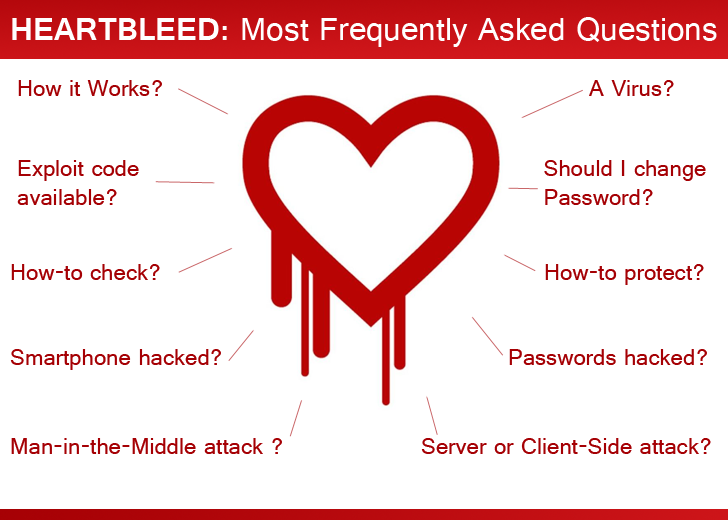
HeartBleed Bug Explained - 10 Most Frequently Asked Questions

HeartBleed Bug Explained - 10 Most Frequently Asked Questions

Apr 15, 2014
Heartbleed – I think now it's not a new name for you, as every informational website, Media and Security researchers are talking about probably the biggest Internet vulnerability in recent history. It is a critical bug in the OpenSSL's implementation of the TLS/DTLS heartbeat extension that allows attackers to read portions of the affected server's memory, potentially revealing users data, that the server did not intend to reveal. After the story broke online, websites around the world flooded with the heartbleed articles, explaining how it works, how to protect, and exactly what it is. Yet many didn't get it right. So based on the queries of Internet users, we answered some frequently asked questions about the bug. 1.) IS HEARTBLEED A VIRUS? Absolutely NO, It's not a virus. As described in our previous article , The Heartbleed bug is a vulnerability resided in TLS heartbeat mechanism built into certain versions of the popular open source encryption standard Open...
TeaBot Android Banking Malware Spreads Again Through Google Play Store Apps

TeaBot Android Banking Malware Spreads Again Through Google Play Store Apps

Mar 02, 2022
An Android banking trojan designed to steal credentials and SMS messages has been observed once again sneaking past Google Play Store protections to target users of more than 400 banking and financial apps, including those from Russia, China, and the U.S. "TeaBot RAT capabilities are achieved via the device screen's live streaming (requested on-demand) plus the abuse of Accessibility Services for remote interaction and key-logging," Cleafy researchers  said  in a report. "This enables Threat Actors (TAs) to perform ATO (Account Takeover) directly from the compromised phone, also known as 'On-device fraud.'" Also known by the names Anatsa and Toddler, TeaBot first  emerged  in May 2021, camouflaging its malicious functions by posing as seemingly innocuous PDF document and QR code scanner apps that are distributed via the official Google Play Store instead of third-party apps stores or via fraudulent websites. Further research published by Swiss cyber...
Massive AdSense Fraud Campaign Uncovered - 10,000+ WordPress Sites Infected

Massive AdSense Fraud Campaign Uncovered - 10,000+ WordPress Sites Infected

Feb 14, 2023 Ad Fraud / Online Security
The threat actors behind the black hat redirect malware campaign have scaled up their campaign to use more than 70 bogus domains mimicking URL shorteners and infect over 10,800 websites. "The main objective is still ad fraud by artificially increasing traffic to pages which contain the AdSense ID which contain Google ads for revenue generation," Sucuri researcher Ben Martin  said  in a report published last week. Details of the malicious activity were  first exposed  by the GoDaddy-owned company in November 2022. The campaign, which is said to have been active since September last year, is orchestrated to redirect visitors to compromised WordPress sites to fake Q&A portals. The goal, it appears, is to increase the authority of spammy sites in search engine results. "It's possible that these bad actors are simply trying to convince Google that real people from different IPs using different browsers are clicking on their search results," Sucuri noted at ...
Widespread FluBot and TeaBot Malware Campaigns Targeting Android Devices

Widespread FluBot and TeaBot Malware Campaigns Targeting Android Devices

Jan 27, 2022
Researchers from the Bitdefender Mobile Threats team said they have intercepted more than 100,000 malicious SMS messages attempting to distribute  Flubot  malware since the beginning of December. "Findings indicate attackers are modifying their subject lines and using older yet proven scams to entice users to click," the Romanian cybersecurity firm  detailed  in a report published Wednesday. "Additionally, attackers are rapidly changing the countries they are targeting in this campaign." The new wave of attacks is said to have been most active in Australia, Germany, Poland, Spain, Austria, and Italy, among others, with attacks spreading to newer countries like Romania, the Netherlands, and Thailand starting mid-January. FluBot (aka Cabassous) campaigns use smishing as the primary delivery method to target potential victims, wherein users receive an SMS message with the question "Is this you in this video?" and are tricked into clicking a link that inst...
Expert Insights Articles Videos
Cybersecurity Resources