#1 Trusted Cybersecurity News Platform
Followed by 5.20+ million
The Hacker News Logo
Subscribe – Get Latest News
Salesforce Security Handbook

Search results for Zscaler proxy | Breaking Cybersecurity News | The Hacker News

Why Your Detection-First Security Approach Isn't Working

Why Your Detection-First Security Approach Isn't Working

Apr 28, 2023 Endpoint Detection and Response
Stopping new and evasive threats is one of the greatest challenges in cybersecurity. This is among the biggest reasons why  attacks increased dramatically in the past year  yet again, despite the estimated $172 billion spent on global cybersecurity in 2022. Armed with cloud-based tools and backed by sophisticated affiliate networks, threat actors can develop new and evasive malware more quickly than organizations can update their protections.  Relying on malware signatures and blocklists against these rapidly changing attacks has become futile. As a result, the SOC toolkit now largely revolves around threat detection and investigation. If an attacker can bypass your initial blocks, you expect your tools to pick them up at some point in the attack chain. Every organization's digital architecture is now seeded with security controls that log anything potentially malicious. Security analysts pore through these logs and determine what to investigate further. Does this wor...
TA829 and UNK_GreenSec Share Tactics and Infrastructure in Ongoing Malware Campaigns

TA829 and UNK_GreenSec Share Tactics and Infrastructure in Ongoing Malware Campaigns

Jul 01, 2025 Cyber Espionage / Vulnerability
Cybersecurity researchers have flagged the tactical similarities between the threat actors behind the RomCom RAT and a cluster that has been observed delivering a loader dubbed TransferLoader . Enterprise security firm Proofpoint is tracking the activity associated with TransferLoader to a group dubbed UNK_GreenSec and the RomCom RAT actors under the moniker TA829 . The latter is also known by the names CIGAR, Nebulous Mantis, Storm-0978, Tropical Scorpius, UAC-0180, UAT-5647, UNC2596, and Void Rabisu. The company said it discovered UNK_GreenSec as part of its investigation into TA829, describing it as using an "unusual amount of similar infrastructure, delivery tactics, landing pages, and email lure themes." TA829 is something of an unusual hacking group in the threat landscape given its ability to conduct both espionage as well as financially motivated attacks. The Russia-aligned hybrid group has also been linked to the zero-day exploitation of security flaws in Mozil...
AI Tools Fuel Brazilian Phishing Scam While Efimer Trojan Steals Crypto from 5,000 Victims

AI Tools Fuel Brazilian Phishing Scam While Efimer Trojan Steals Crypto from 5,000 Victims

Aug 08, 2025 Cryptocurrency / SEO Poisoning
Cybersecurity researchers are drawing attention to a new campaign that's using legitimate generative artificial intelligence (AI)-powered website building tools like DeepSite AI and BlackBox AI to create replica phishing pages mimicking Brazilian government agencies as part of a financially motivated campaign. The activity involves the creation of lookalike sites imitating Brazil's State Department of Traffic and Ministry of Education, which then trick unsuspecting users into making unwarranted payments through the country's PIX payment system, Zscaler ThreatLabz said. These fraudulent sites are artificially boosted using search engine optimization (SEO) poisoning techniques to enhance their visibility, thereby increasing the likelihood of success of the attack. "Source code analysis reveals signatures of generative AI tools, such as overly explanatory comments meant to guide developers, non-functional elements that would typically work on an authentic website, and...
cyber security

The Breach You Didn't Expect: Your AppSec Stack

websiteJFrogAppSec / DevSecOps
In a market undergoing mergers and acquisitions, vendor instability can put you in serious risk.
cyber security

How AI and Zero Trust Work Together to Catch Attacks With No Files or Indicators

websiteTHN WebinarZero Trust / Cloud Security
Modern cyberattacks hide in trusted tools and workflows, evading traditional defenses. Zero Trust and AI-powered cloud security give you the visibility and control to stop these invisible threats early.
HiddenGh0st, Winos and kkRAT Exploit SEO, GitHub Pages in Chinese Malware Attacks

HiddenGh0st, Winos and kkRAT Exploit SEO, GitHub Pages in Chinese Malware Attacks

Sep 15, 2025 Malware / Cryptocurrency
Chinese-speaking users are the target of a search engine optimization (SEO) poisoning campaign that uses fake software sites to distribute malware. "The attackers manipulated search rankings with SEO plugins and registered lookalike domains that closely mimicked legitimate software sites," Fortinet FortiGuard Labs researcher Pei Han Liao said . "By using convincing language and small character substitutions, they tricked victims into visiting spoofed pages and downloading malware." The activity, which was discovered by the cybersecurity company in August 2025, leads to the deployment of malware families like HiddenGh0st and Winos (aka ValleyRAT), both of which are variants of a remote access trojan called Gh0st RAT. It's worth noting that the use of Winos has been attributed to a cybercrime group known as Silver Fox , which is also tracked as SwimSnake, The Great Thief of Valley (or Valley Thief), UTG-Q-1000, and Void Arachne. It's believed to be acti...
⚡ Weekly Recap: F5 Breached, Linux Rootkits, Pixnapping Attack, EtherHiding & More

⚡ Weekly Recap: F5 Breached, Linux Rootkits, Pixnapping Attack, EtherHiding & More

Oct 20, 2025 Cybersecurity / Hacking News
It's easy to think your defenses are solid — until you realize attackers have been inside them the whole time. The latest incidents show that long-term, silent breaches are becoming the norm. The best defense now isn't just patching fast, but watching smarter and staying alert for what you don't expect. Here's a quick look at this week's top threats, new tactics, and security stories shaping the landscape. ⚡ Threat of the Week F5 Exposed to Nation-State Breach — F5 disclosed that unidentified threat actors broke into its systems and stole files containing some of BIG-IP's source code and information related to undisclosed vulnerabilities in the product. The company said it learned of the incident on August 9, 2025, although it's believed that the attackers were in its network for at least 12 months. The attackers are said to have used a malware family called BRICKSTORM, which is attributed to a China-nexus espionage group dubbed UNC5221. GreyNoise said it observed elevat...
PyPI, npm, and AI Tools Exploited in Malware Surge Targeting DevOps and Cloud Environments

PyPI, npm, and AI Tools Exploited in Malware Surge Targeting DevOps and Cloud Environments

Jun 16, 2025 Malware / DevOps
Cybersecurity researchers from  SafeDep and Veracode detailed a number of malware-laced npm packages that are designed to execute remote code and download additional payloads. The packages in question are listed below - eslint-config-airbnb-compat (676 Downloads) ts-runtime-compat-check (1,588 Downloads) solders (983 Downloads) @mediawave/lib (386 Downloads) All the identified npm packages have since been taken down from npm, but not before they were downloaded hundreds of times from the package registry.  SafeDep's analysis of eslint-config-airbnb-compat found that the JavaScript library has ts-runtime-compat-check listed as a dependency, which, in turn, contacts an external server defined in the former package ("proxy.eslint-proxy[.]site") to retrieve and execute a Base64-encoded string. The exact nature of the payload is unknown. "It implements a multi-stage remote code execution attack using a transitive dependency to hide the malicious code,"...
Mustang Panda Targets Myanmar With StarProxy, EDR Bypass, and TONESHELL Updates

Mustang Panda Targets Myanmar With StarProxy, EDR Bypass, and TONESHELL Updates

Apr 17, 2025 Malware / Network Security
The China-linked threat actor known as Mustang Panda has been attributed to a cyber attack targeting an unspecified organization in Myanmar with previously unreported tooling, highlighting continued effort by the threat actors to increase the sophistication and effectiveness of their malware. This includes updated versions of a known backdoor called TONESHELL , as well as a new lateral movement tool dubbed StarProxy, two keyloggers codenamed PAKLOG, CorKLOG, and an Endpoint Detection and Response (EDR) evasion driver referred to as SplatCloak . "TONESHELL, a backdoor used by Mustang Panda, has been updated with changes to its FakeTLS command-and-control (C2) communication protocol as well as to the methods for creating and storing client identifiers," Zscaler ThreatLabz researcher Sudeep Singh said in a two-part analysis . Mustang Panda, also known as BASIN, Bronze President, Camaro Dragon, Earth Preta, HoneyMyte, and RedDelta, is a China-aligned state-sponsored threat ...
New Jupyter Infostealer Version Emerges with Sophisticated Stealth Tactics

New Jupyter Infostealer Version Emerges with Sophisticated Stealth Tactics

Nov 06, 2023 Data Security / Malvertising
An updated version of an information stealer malware known as  Jupyter  has resurfaced with "simple yet impactful changes" that aim to stealthily establish a persistent foothold on compromised systems. "The team has discovered new waves of Jupyter Infostealer attacks which leverage PowerShell command modifications and signatures of private keys in attempts to pass off the malware as a legitimately signed file," VMware Carbon Black researchers  said  in a report shared with The Hacker News. Jupyter Infostealer , also known as Polazert , SolarMarker, and Yellow Cockatoo, has a  track record  of leveraging manipulated search engine optimization (SEO) tactics and malvertising as an initial access vector to trick users searching for popular software into downloading it from dubious websites. It comes with capabilities to harvest credentials as well as establish encrypted command-and-control (C2) communication to exfiltrate data and execute arbitrary commands...
New Malware Campaign Uses PureCrypter Loader to Deliver DarkVision RAT

New Malware Campaign Uses PureCrypter Loader to Deliver DarkVision RAT

Oct 15, 2024 Malware / Cybercrime
Cybersecurity researchers have disclosed a new malware campaign that leverages a malware loader named PureCrypter to deliver a commodity remote access trojan (RAT) called DarkVision RAT. The activity, observed by Zscaler ThreatLabz in July 2024, involves a multi-stage process to deliver the RAT payload. "DarkVision RAT communicates with its command-and-control (C2) server using a custom network protocol via sockets," security researcher Muhammed Irfan V A said in an analysis. "DarkVision RAT supports a wide range of commands and plugins that enable additional capabilities such as keylogging, remote access, password theft, audio recording, and screen captures." PureCrypter, first publicly disclosed in 2022, is an off-the-shelf malware loader that's available for sale on a subscription basis, offering customers the ability to distribute information stealers, RATs, and ransomware. The exact initial access vector used to deliver PureCrypter and, by extensio...
New Payment Data Stealing Malware Hides in Nginx Process on Linux Servers

New Payment Data Stealing Malware Hides in Nginx Process on Linux Servers

Dec 03, 2021
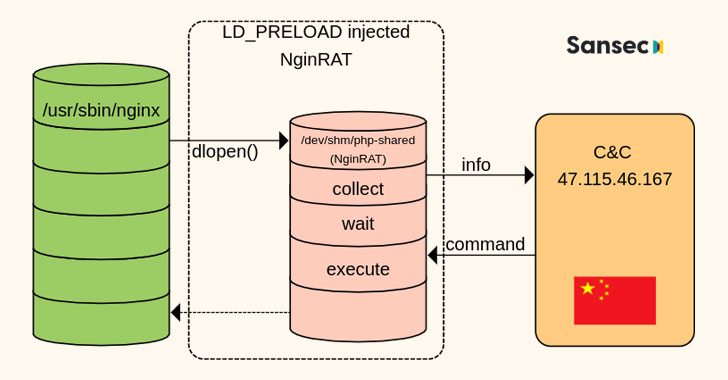
E-commerce platforms in the U.S., Germany, and France have come under attack from a new form of malware that targets Nginx servers in an attempt to masquerade its presence and slip past detection by security solutions. "This novel code injects itself into a host Nginx application and is nearly invisible," Sansec Threat Research team  said  in a new report. "The parasite is used to steal data from eCommerce servers, also known as 'server-side Magecart.'"  A free and open-source software, Nginx is a web server that can also be used as a reverse proxy, load balancer, mail proxy, and HTTP cache. NginRAT, as the advanced malware is called, works by hijacking a host Nginx application to embed itself into the webserver process. The remote access trojan itself is delivered via  CronRAT , another piece of malware the Dutch cybersecurity firm disclosed last week as hiding its malicious payloads in cron jobs scheduled to execute on February 31st, a non-existent ca...
Researchers Warns of Large-Scale AiTM Attacks Targeting Enterprise Users

Researchers Warns of Large-Scale AiTM Attacks Targeting Enterprise Users

Aug 03, 2022
A new, large-scale phishing campaign has been observed using adversary-in-the-middle (AitM) techniques to get around security protections and compromise enterprise email accounts. "It uses an adversary-in-the-middle (AitM) attack technique capable of bypassing multi-factor authentication," Zscaler researchers Sudeep Singh and Jagadeeswar Ramanukolanu  said  in a Tuesday report. "The campaign is specifically designed to reach end users in enterprises that use Microsoft's email services." Prominent targets include fintech, lending, insurance, energy, manufacturing, and federal credit union verticals located in the U.S., U.K., New Zealand, and Australia. This is not the first time such a phishing attack has come to light. Last month, Microsoft  disclosed  that over 10,000 organizations had been targeted since September 2021 by means of AitM techniques to breach accounts secured with multi-factor authentication (MFA). The ongoing campaign, effective June 2022,...
⚡ THN Weekly Recap: GitHub Supply Chain Attack, AI Malware, BYOVD Tactics, and More

⚡ THN Weekly Recap: GitHub Supply Chain Attack, AI Malware, BYOVD Tactics, and More

Mar 24, 2025 Weekly Recap / Hacking
A quiet tweak in a popular open-source tool opened the door to a supply chain breach—what started as a targeted attack quickly spiraled, exposing secrets across countless projects. That wasn't the only stealth move. A new all-in-one malware is silently stealing passwords, crypto, and control—while hiding in plain sight. And over 300 Android apps joined the chaos, running ad fraud at scale behind innocent-looking icons. Meanwhile, ransomware gangs are getting smarter—using stolen drivers to shut down defenses—and threat groups are quietly shifting from activism to profit. Even browser extensions are changing hands, turning trusted tools into silent threats. AI is adding fuel to the fire—used by both attackers and defenders—while critical bugs, cloud loopholes, and privacy shakeups are keeping teams on edge. Let's dive into the threats making noise behind the scenes. ⚡ Threat of the Week Coinbase the Initial Target of GitHub Action Supply Chain Breach — The supply chain compromise...
⚡ Weekly Recap: Drift Breach Chaos, Zero-Days Active, Patch Warnings, Smarter Threats & More

⚡ Weekly Recap: Drift Breach Chaos, Zero-Days Active, Patch Warnings, Smarter Threats & More

Sep 08, 2025 Cybersecurity / Hacking News
Cybersecurity never slows down. Every week brings new threats, new vulnerabilities, and new lessons for defenders. For security and IT teams, the challenge is not just keeping up with the news—it's knowing which risks matter most right now. That's what this digest is here for: a clear, simple briefing to help you focus where it counts. This week, one story stands out above the rest: the Salesloft–Drift breach, where attackers stole OAuth tokens and accessed Salesforce data from some of the biggest names in tech. It's a sharp reminder of how fragile integrations can become the weak link in enterprise defenses. Alongside this, we'll also walk through several high-risk CVEs under active exploitation, the latest moves by advanced threat actors, and fresh insights on making security workflows smarter, not noisier. Each section is designed to give you the essentials—enough to stay informed and prepared, without getting lost in the noise. ⚡ Threat of the Week Salesloft to Take Drift Of...
⚡ Weekly Recap: Apple 0-Days, WinRAR Exploit, LastPass Fines, .NET RCE, OAuth Scams & More

⚡ Weekly Recap: Apple 0-Days, WinRAR Exploit, LastPass Fines, .NET RCE, OAuth Scams & More

Dec 15, 2025 Hacking News / Cybersecurity
If you use a smartphone, browse the web, or unzip files on your computer, you are in the crosshairs this week. Hackers are currently exploiting critical flaws in the daily software we all rely on—and in some cases, they started attacking before a fix was even ready. Below, we list the urgent updates you need to install right now to stop these active threats. ⚡ Threat of the Week Apple and Google Release Fixes for Actively Exploited Flaws — Apple released security updates for iOS, iPadOS, macOS, tvOS, watchOS, visionOS, and Safari web browser to address two zero-days that the company said have been exploited in highly targeted attacks. CVE-2025-14174 has been described as a memory corruption issue, while the second, CVE-2025-43529, is a use-after-free bug. They can both be exploited using maliciously crafted web content to execute arbitrary code. CVE-2025-14174 was also addressed by Google in its Chrome browser since it resides in its open-source Almost Native Graphics Layer Engi...
More_eggs MaaS Expands Operations with RevC2 Backdoor and Venom Loader

More_eggs MaaS Expands Operations with RevC2 Backdoor and Venom Loader

Dec 06, 2024 Malware / Cybercrime
The threat actors behind the More_eggs malware have been linked to two new malware families, indicating an expansion of its malware-as-a-service (MaaS) operation. This includes a novel information-stealing backdoor called RevC2 and a loader codenamed Venom Loader, both of which are deployed using VenomLNK , a staple tool that serves as an initial access vector for the deployment of follow-on payloads. "RevC2 uses WebSockets to communicate with its command-and-control (C2) server. The malware is capable of stealing cookies and passwords, proxies network traffic, and enables remote code execution (RCE)," Zscaler ThreatLabz researcher Muhammed Irfan V A said . "Venom Loader is a new malware loader that is customized for each victim, using the victim's computer name to encode the payload." Both the malware families have been distributed as part of campaigns observed by the cybersecurity company between August and October 2024. The threat actor behind the e-cr...
Fake CAPTCHA PDFs Spread Lumma Stealer via Webflow, GoDaddy, and Other Domains

Fake CAPTCHA PDFs Spread Lumma Stealer via Webflow, GoDaddy, and Other Domains

Feb 28, 2025 Network Security / Malware
Cybersecurity researchers have uncovered a widespread phishing campaign that uses fake CAPTCHA images shared via PDF documents hosted on Webflow's content delivery network (CDN) to deliver the Lumma stealer malware. Netskope Threat Labs said it discovered 260 unique domains hosting 5,000 phishing PDF files that redirect victims to malicious websites. "The attacker uses SEO to trick victims into visiting the pages by clicking on malicious search engine results," security researcher Jan Michael Alcantara said in a report shared with The Hacker News. "While most phishing pages focus on stealing credit card information, some PDF files contain fake CAPTCHAs that trick victims into executing malicious PowerShell commands, ultimately leading to the Lumma Stealer malware." The phishing campaign is estimated to have affected more than 1,150 organizations and more than 7,000 users since the second half of 2024, with the attacks primarily singling out victims in Nort...
Expert Insights Articles Videos
Cybersecurity Resources