#1 Trusted Cybersecurity News Platform
Followed by 5.20+ million
The Hacker News Logo
Subscribe – Get Latest News

Search results for /extension/ | Breaking Cybersecurity News | The Hacker News

A Browser Extension Risk Guide After the ShadyPanda Campaign

A Browser Extension Risk Guide After the ShadyPanda Campaign

Dec 15, 2025 Browser Security / SaaS Security
In early December 2025, security researchers exposed a cybercrime campaign that had quietly hijacked popular Chrome and Edge browser extensions on a massive scale. A threat group dubbed ShadyPanda spent seven years playing the long game, publishing or acquiring harmless extensions, letting them run clean for years to build trust and gain millions of installs, then suddenly flipping them into malware via silent updates. In total, about 4.3 million users installed these once-legitimate add-ons, which suddenly went rogue with spyware and backdoor capabilities. This tactic was essentially a browser extension supply-chain attack. The ShadyPanda operators even earned featured and verified badges in the official Chrome Web Store and Microsoft Edge Add-ons site for some extensions, reinforcing user confidence. Because extension updates happen automatically in the background, the attackers were able to push out malicious code without users noticing a thing. Once activated in mid-2024, the...
Someone Hijacked MEGA Chrome Extension to Steal Users' Passwords

Someone Hijacked MEGA Chrome Extension to Steal Users' Passwords

Sep 05, 2018
Warning! If you are using Chrome browser extension from the MEGA file storage service, uninstall it right now. The official Chrome extension for the MEGA.nz cloud storage service had been compromised and replaced with a malicious version that can steal users' credentials for popular websites like Amazon, Microsoft, Github, and Google, as well as private keys for users' cryptocurrency wallets. On 4 September at 14:30 UTC, an unknown attacker managed to hack into MEGA's Google Chrome web store account and upload a malicious version 3.39.4 of an extension to the web store, according to a blog post published by the company. Malicious MEGA Chrome Extension Steals Passwords Upon installation or auto-update, the malicious extension asked for elevated permissions to access personal information, allowing it to steal credentials from sites like Amazon, Github, and Google, along with online wallets such as MyEtherWallet and MyMonero, and Idex.market cryptocurrency trading...
Beware of New Celebrity Sex Tape (Scam) Leaked on Facebook!

Beware of New Celebrity Sex Tape (Scam) Leaked on Facebook!

Dec 12, 2016
If you came across a celebrity sex video on Facebook featuring Jessica Alba or any other celebrity, just avoid clicking it. Another Facebook scam is circulating across the social networking website that attempts to trick Facebook users into clicking on a link for a celebrity sex tape that instead downloads malware onto their computers. Once installed, the malware would force web browsers to display aggressive advertising web pages which include sites with nudity and fake lotteries. The spam campaign was uncovered by researchers at Cyren, who noted that a malicious Google Chrome extension is spreading nude celebrity PDFs through private messages and posts on various Facebook groups. If opened, the PDF file takes victims to a web page with an image containing a play button, tricking users that the PDF may contain a video. Once clicked, the link redirects users of Internet Explorer, Firefox, or Safari to a web page with overly-aggressive popups and advertisements related to ...
cyber security

Secured Images 101

websiteWizDevOps / AppSec
Secure your container ecosystem with this easy-to-read digital poster that breaks down everything you need to know about container image security. Perfect for engineering, platform, DevOps, AppSec, and cloud security teams.
cyber security

When Zoom Phishes You: Unmasking a Novel TOAD Attack Hidden in Legitimate Infrastructure

websiteProphet SecurityArtificial Intelligence / SOC
Prophet AI uncovers a Telephone-Oriented Attack Delivery (TOAD) campaign weaponizing Zoom's own authentication infrastructure.
Dozens of Chrome Extensions Hacked, Exposing Millions of Users to Data Theft

Dozens of Chrome Extensions Hacked, Exposing Millions of Users to Data Theft

Dec 29, 2024 Endpoint Protection / Browser Security
A new attack campaign has targeted known Chrome browser extensions, leading to at least 35 extensions being compromised and exposing over 2.6 million users to data exposure and credential theft. The attack targeted publishers of browser extensions on the Chrome Web Store via a phishing campaign and used their access permissions to insert malicious code into legitimate extensions in order to steal cookies and user access tokens. The first company to shed light the campaign was cybersecurity firm Cyberhaven, one of whose employees was targeted by a phishing attack on December 24, allowing the threat actors to publish a malicious version of the extension. On December 27, Cyberhaven disclosed that a threat actor compromised its browser extension and injected malicious code to communicate with an external command-and-control (C&C) server located on the domain cyberhavenext[.]pro, download additional configuration files, and exfiltrate user data. The phishing email, which purported...
Someone Hijacks A Popular Chrome Extension to Push Malware

Someone Hijacks A Popular Chrome Extension to Push Malware

Jul 31, 2017
Phishers have recently hacked an extension for Google Chrome after compromising the Chrome Web Store account of German developer team a9t9 software and abused to distribute spam messages to unsuspecting users. Dubbed Copyfish, the extension allows users to extract text from images, PDF documents and video, and has more than 37,500 users. Unfortunately, the Chrome extension of Copyfish has been hijacked and compromised by some unknown attacker, who equipped the extension with advertisement injection capabilities. However, its Firefox counterpart was not affected by the attack. The attackers even moved the extension to their developer account, preventing its developers from removing the infected extension from the store, even after being spotted that the extension has been compromised. "So far, the update looks like standard adware hack, but, as we still have no control over Copyfish, the thieves might update the extension another time… until we get it back," the de...
Majority of Browser Extensions Can Access Sensitive Enterprise Data, New Report Finds

Majority of Browser Extensions Can Access Sensitive Enterprise Data, New Report Finds

Apr 15, 2025 Data Privacy / Enterprise Security
Everybody knows browser extensions are embedded into nearly every user's daily workflow, from spell checkers to GenAI tools. What most IT and security people don't know is that browser extensions' excessive permissions are a growing risk to organizations. LayerX today announced the release of the Enterprise Browser Extension Security Report 2025 , This report is the first and only report to merge public extension marketplace statistics with real-world enterprise usage telemetry. By doing so, it sheds light on one of the most underestimated threat surfaces in modern cybersecurity: browser extensions. The report reveals several findings that IT and security leaders will find interesting, as they build their plans for H2 2025. This includes information and analysis on how many extensions have risky permissions, which kinds of permissions are given, if extension developers are to be trusted, and more. Below, we bring key statistics from the report. Highlights from the Enterprise Browse...
Optimize Web Pages Using "Data Saver Chrome Extension" to Save Bandwidth

Optimize Web Pages Using "Data Saver Chrome Extension" to Save Bandwidth

Mar 27, 2015
Google want to save its users' bandwidth at home. The company has released a " Data Saver extension for Chrome , " bringing its data compression feature for its desktop users for the first time. While tethering to a mobile Hotspot for Internet connection for your laptop, this new Data Saver extension for Chrome helps you reduce bandwidth usage by compressing the pages you visit over the Internet. If you are unaware of it, the data compression proxy service by Google is designed to save users' bandwidth, load pages faster, and increase security (by checking for malicious web pages) on your smartphones and tablets. REDUCE AS MUCH AS 50% OF DATA USAGE  Until now, the data compression service has been meant to benefit only mobile users, but the latest Data Saver Chrome Extension aims at helping desktop users by reducing their data usage by as much as 50 percent. " Reduces data usage [bandwidth] by using Google servers to optimize pages you visit,...
Password Alert Chrome Extension to Protect your Google Account from Phishers

Password Alert Chrome Extension to Protect your Google Account from Phishers

Apr 30, 2015
As cybercriminals have started using sophisticated phishing techniques in an attempt to hijack online users' account, Google on Wednesday launched a new Chrome Extension to fight against Phishing . The search engine giant has launched a new Password Alert Chrome extension that will alert you whenever you accidentally enter your Google password on a carefully crafted phishing website that aimed at hijacking your account. So, GO and INSTALL the freely available, open-source Password Alert extension which is now available in the Chrome Web Store. Password Alert extension does two things: Prevents you from re-using your Google account password on other websites. Protects you if you've typed the same Google password on a non-Google website by generating a warning that you have just been phished and should immediately change your password. According to the company , nearly two percent of the e-mail messages to Google's Gmail are phishing emails from cyber ...
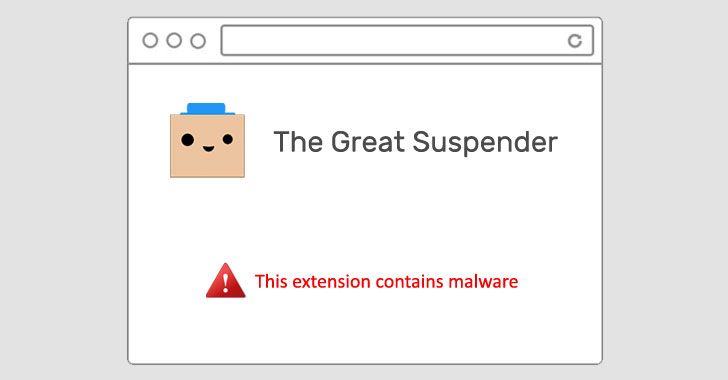
WARNING — Hugely Popular 'The Great Suspender' Chrome Extension Contains Malware

WARNING — Hugely Popular 'The Great Suspender' Chrome Extension Contains Malware

Feb 06, 2021
Google on Thursday removed The Great Suspender , a popular Chrome extension used by millions of users, from its Chrome Web Store for containing malware. It also took the unusual step of deactivating it from users' computers. "This extension contains malware,"  read  a terse notification from Google, but it has since emerged that the add-on stealthily added features that could be exploited to execute arbitrary code from a remote server, including tracking users online and committing advertising fraud. "The old maintainer appears to have sold the extension to parties unknown, who have malicious intent to exploit the users of this extension in advertising fraud, tracking, and more," Calum McConnell  said  in a GitHub post. The extension, which had more than two million installs before it was disabled, would suspend tabs that aren't in use, replacing them with a blank gray screen until they were reloaded upon returning to the tabs in question. Signs of the...
Malicious Chrome Extension Steals MEXC API Keys by Masquerading as Trading Tool

Malicious Chrome Extension Steals MEXC API Keys by Masquerading as Trading Tool

Jan 13, 2026 Web Security / Online Fraud
Cybersecurity researchers have disclosed details of a malicious Google Chrome extension that's capable of stealing API keys associated with MEXC, a centralized cryptocurrency exchange (CEX) available in over 170 countries , while masquerading as a tool to automate trading on the platform. The extension, named MEXC API Automator (ID: pppdfgkfdemgfknfnhpkibbkabhghhfh), has 29 downloads and is still available on the Chrome Web Store as of writing. It was first published on September 1, 2025, by a developer named "jorjortan142." "The extension programmatically creates new MEXC API keys, enables withdrawal permissions, hides that permission in the user interface (UI), and exfiltrates the resulting API key and secret to a hardcoded Telegram bot controlled by the threat actor," Socket security researcher Kirill Boychenko said in an analysis. According to the Chrome Web Store listing, the web browser add-on is described as an extension that "simplifies connecti...
Malware Can Bypass Chrome Extension Security Feature Easily

Malware Can Bypass Chrome Extension Security Feature Easily

Sep 06, 2014
Researchers have uncovered a new social engineering trick that leads users to a malicious extension from Google Chrome impersonating to deliver Adobe's Flash Player in order to lure victims in a click fraud campaign. Security experts at TrendMicro believe that the malware is triggered by opening Facebook or Twitter via shortened links provided in any social networking websites. Once clicked, the links may lead victims to a site that automatically downloads the malicious browser extension . MALWARE INVOLVES DOWNLOADING MULTIPLE MALICIOUS FILES The process is quite complicated as the malware drops a downloader file which downloads multiple malicious files on the victim's computer. Moreover, the malicious program also has ability to bypass Google's recent security protection added to Chrome against installation of browser extensions that are not in Chrome Web Store. Researchers came across a baiting tweet that advertises " Facebook Secrets ", claiming to show videos...
New Report: Unveiling the Threat of Malicious Browser Extensions

New Report: Unveiling the Threat of Malicious Browser Extensions

Dec 06, 2023 Browser Security / Privacy
Compromising the browser is a high-return target for adversaries. Browser extensions, which are small software modules that are added to the browser and can enhance browsing experiences, have become a popular browser attack vector. This is because they are widely adopted among users and can easily turn malicious through developer actions or attacks on legitimate extensions. Recent incidents like  DataSpii  and the  Nigelthorn  malware attack have exposed the extent of damage that malicious extensions can inflict. In both cases, users innocently installed extensions that compromised their privacy and security. The underlying issue lies in the permissions granted to extensions. These permissions, often excessive and lacking granularity, allow attackers to exploit them. What can organizations do to protect themselves from the risks of browser extensions without barring them from use altogether (an act that would be nearly impossible to enforce)?  A new report b...
Microsoft Edge Bug Could Have Allowed Attackers to Silently Install Malicious Extensions

Microsoft Edge Bug Could Have Allowed Attackers to Silently Install Malicious Extensions

Mar 27, 2024 Vulnerability / API Security
A now-patched security flaw in the Microsoft Edge web browser could have been abused to install arbitrary extensions on users' systems and carry out malicious actions.  "This flaw could have allowed an attacker to exploit a private API, initially intended for marketing purposes, to covertly install additional browser extensions with broad permissions without the user's knowledge," Guardio Labs security researcher Oleg Zaytsev  said  in a new report shared with The Hacker News. Tracked as  CVE-2024-21388  (CVSS score: 6.5), it was addressed by Microsoft in Edge stable version 121.0.2277.83 released on January 25, 2024, following responsible disclosure in November 2023. The Windows maker credited both Zaytsev and Jun Kokatsu for reporting the issue. "An attacker who successfully exploited this vulnerability could gain the privileges needed to install an extension," Microsoft said in an advisory for the flaw, adding it "could lead to a browser sandbo...
Malicious Chrome Extension Hijacks CryptoCurrencies and Wallets

Malicious Chrome Extension Hijacks CryptoCurrencies and Wallets

Apr 25, 2014
Although the number of malicious browser extensions has significantly increased in the past years, but recently a new extension of the Google Chrome is allegedly targeting Cryptocurrency users that is capable of stealing Bitcoins and other crypto coins silently. The malicious Chrome browser extension dubbed as ' Cryptsy Dogecoin (DOGE) Live Ticker ' which is available on Chrome Web store for free downloads and developed by " TheTrollBox " account. Reddit user noticed that the updated version of the extension has a malicious code, which is designed to hijack the crypto currency transactions. HOW CHROME EXTENSION STEALS CRYPTOCURRENCY It is very obvious that the kind of crypto related software extensions is downloaded only by the users who deal with the digital currency. So, once the user installed the malicious extension, the software within the extension starts monitoring users' web activity and looks for those users who go to Cryptocurrency exchange sites s...
Google Announces 5 Major Security Updates for Chrome Extensions

Google Announces 5 Major Security Updates for Chrome Extensions

Oct 02, 2018
Google has made several new announcements for its Chrome Web Store that aims at making Chrome extensions more secure and transparent to its users. Over a couple of years, we have seen a significant rise in malicious extensions that appear to offer useful functionalities, while running hidden malicious scripts in the background without the user's knowledge. However, the best part is that Google is aware of the issues and has proactively been working to change the way its Chrome web browser handles extensions. Earlier this year, Google banned extensions using cryptocurrency mining scripts and then in June, the company also disabled inline installation of Chrome extensions completely. The company has also been using machine learning technologies to detect and block malicious extensions. To take a step further, Google announced Monday five major changes that give users more control over certain permissions, enforces security measures, as well as makes the ecosystem more t...
Experts Uncover 350 Browser Extension Variants Used in ABCsoup Adware Campaign

Experts Uncover 350 Browser Extension Variants Used in ABCsoup Adware Campaign

Jul 08, 2022
A malicious browser extension with 350 variants is masquerading as a Google Translate add-on as part of an adware campaign targeting Russian users of Google Chrome, Opera, and Mozilla Firefox browsers. Mobile security firm Zimperium dubbed the malware family  ABCsoup , stating the "extensions are installed onto a victim's machine via a Windows-based executable, bypassing most endpoint security solutions, along with the security controls found in the official extension stores." The rogue browser add-ons come with the same extension ID as that of Google Translate — " aapbdbdomjkkjkaonfhkkikfgjllcleb " — in an attempt to trick users into believing that they have installed a legitimate extension. The extensions are not available on the official browser web stores themselves. Rather they are delivered through different Windows executables that install the add-on on the victim's web browser. In the event the targeted user already has the Google Translate ext...
Expert Insights Articles Videos
Cybersecurity Resources