-->
#1 Trusted Cybersecurity News Platform
Followed by 5.70+ million
The Hacker News Logo
Get the Latest News
cybersecurity

The Hacker News | #1 Trusted Source for Cybersecurity News — Index Page

Kaspersky Labs uncover 'Gauss' Espionage Malware hits Middle East banks

Kaspersky Labs uncover 'Gauss' Espionage Malware hits Middle East banks

Aug 10, 2012
A new cyber surveillance virus has been found in the Middle East that can spy on banking transactions and steal login and passwords, according Kaspersky Lab , a leading computer security firm. After Stuxnet, Duqu, and Flame, this one seems to mainly spy on computer users in Lebanon. It’s been dubbed Gauss (although Germanic-linguistic purists will no doubt be complaining that it should be written Gauß). Gauss is a complex cyber-espionage toolkit, highly modular and supports new functions which can be deployed remotely by the operators in the form of plugins. The currently known plugins perform the following functions: Intercept browser cookies and passwords. Harvest and send system configuration data to attackers. Infect USB sticks with a data stealing module. List the content of the system drives and folders Steal credentials for various banking systems in the Middle East. Hijack account information for social network, email and IM accounts. The researchers at Russia-based Ka...
Zeus malware targeting BlackBerry and Android devices

Zeus malware targeting BlackBerry and Android devices

Aug 09, 2012
Security researchers at Kaspersky Lab have discovered five new samples of the ZeuS-in-the-Mobile (ZitMo) malware package, targeting Android and BlackBerry devices. Zitmo (Zeus in the mobile) is the name given to the mobile versions of Zeus, and it's been around for a couple of years already, mostly infecting Android phones. The Zitmo variant has reportedly been operating for at least two years targeting Android phones by masquerading as banking security application or security add-on. ZitMo gets hold of banking information by intercepting all text messages and passing them on to attackers’ own devices. It gets onto devices inside malicious applications, which users are duped into downloading. In this case, the malicious app was posing as security software called ‘Zertifikat’. Once installed, the packages forward all incoming SMS messages to one of two command and control numbers located in Sweden, with the aim of snaring secure codes and other data. Kaspersky found mobile users ...
Mariposa botnet creator goes on trial

Mariposa botnet creator goes on trial

Aug 09, 2012
26-year-old Slovenian hacker known as Iserdo stands thought to have been behind the Mariposa botnet is on trial in Slovenia, charged with having masterminded an international cybercrime gang. At its height, the Mariposa botnet infected up to 12.7 million PCs, with more than half of the Fortune 1,000 companies believed to have been compromised, including 40 major banks. Once a computer had been compromised and brought into the botnet, operators could steal information from innocent users - including credit card details and banking passwords. Computer crime-fighting authorities had succeeded in bringing down the Mariposa botnet at the end of 2009, FBI officials worked with Spanish and Slovenian authorities to track down Mariposa's mastermind, Iserdo. He was said to charge between $500 for basic versions of the botnet code and up to $1,300 for more advanced ones, which included customised features, such as capabilities which allowed its operators to to steal credit cards and onlin...
cyber security

The Systems That Power America Are Under Threat. Is Your ICS/OT Program Ready?

websiteSANS InstituteCritical infrastructure / Webinar
Discover where federal ICS programs are most exposed and what closing the skills gap requires in practice.
cyber security

Inside Device Code Phishing: Live Demos, Real Kits, and What's Next

websitePush SecurityPhishing Attack / Webinar
Device code attacks are up 37x this year, with 18+ kits in the wild. Now available on-demand.
Researcher demonstrate hardware based backdoor called Rakshasa

Researcher demonstrate hardware based backdoor called Rakshasa

Aug 07, 2012
Security researcher Jonathan Brossard created a proof-of-concept hardware backdoor called Rakshasa that replaces a computer's BIOS (Basic Input Output System) and can compromise the operating system at boot time without leaving traces on the hard drive. In short, firmware is software that is stored in non-volatile memory on a computer chip, and is used to initialise a piece of hardware’s functionality. In a PC, the BIOS is the most common example of firmware but in the case of wireless routers, a whole Linux operating system is stored in firmware. Hardware backdoors are lethal for three reasons: They can’t be removed by conventional means (antivirus, formatting). They can circumvent other types of security (passwords, encrypted file systems). They can be injected during manufacturing. Rakshasa, named after a demon from the Hindu mythology, is not the first malware to target the BIOS the low-level motherboard firmware that initializes other hardware components. Rakshasa replac...
Malicious Olympic 2012 Android Apps & Domains

Malicious Olympic 2012 Android Apps & Domains

Aug 07, 2012
Whenever an important event takes place, new opportunities for cyber criminals, especially for those who develop attacks based on social engineering, arise. Currently, the whole world has its eyes glued to TV screens watching the London 2012 Olympic Games. Anti-malware and anti-virus solutions provider Webroot has issued a warning that an app app called " London Olympics Widget ," which is described as an app that displays aggregated Olympic news coverage. In fact, it's really just harvesting the user's contact list and device ID while reading up on SMS messages too. The package name is ‘com.games.London.Olympics.widget’. This app has a digital certificate claiming it was developed in New Delhi, India. For this scam, cybercriminals create websites that are very appealing; some even look very professional that they make it seem that you are close to having access to live programming. Researchers explain that the crooks rely on black hat SEO techniques to make sure t...
Pakistani hackers deface Indian Southern Railways website

Pakistani hackers deface Indian Southern Railways website

Aug 07, 2012
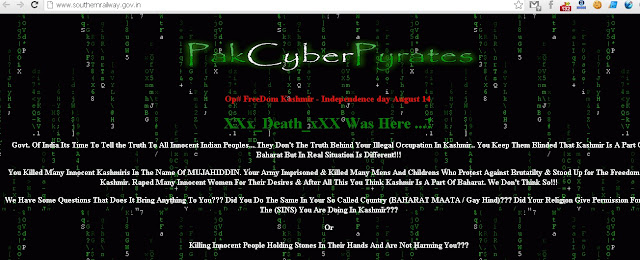
Website of the Southern Railways www.southernrailway.gov.in has been defaced apparently by Pakistani hackers. The hacker group that calls itself ' Pak Cyber Pyrates ' replaced the home page of the website with a page with content that denounces India's role in Kashmir. Indian and Pakistani hacking groups are engaged in a cyber war of sorts with websites in both the countries being regularly attacked and defaced.
⚡ Top Stories This Week
Expert Insights Articles Videos
Cybersecurity Resources