-->
#1 Trusted Cybersecurity News Platform
Followed by 5.40+ million
The Hacker News Logo
Subscribe – Get Latest News

Search results for javascript:alert(1)/ | Breaking Cybersecurity News | The Hacker News

Hacker Finds a Simple Way to Bypass Google Password Alert

Hacker Finds a Simple Way to Bypass Google Password Alert

May 02, 2015
Less than 24 hours after Google launched the new Phishing alert extension Password Alert , a security researcher was able to bypass the feature using deadly simple exploits. On Wednesday, the search engine giant launched a new Password Alert Chrome extension to alert its users whenever they accidentally enter their Google password on a carefully crafted phishing website that aimed at hijacking users’ account. However, security expert Paul Moore easily circumvented the technology using just seven lines of simple JavaScript code that kills phishing alerts as soon as they started to appear, defeating Google’s new Password Alert extension. Google shortly fixed the issue and released a new update to Password Alert extension that blocked the Moore’s exploit. However, Moore discovered another way to block the new version of Password Alert, as well. The first proof of concept exploit by Moore relied on a JavaScript that looks for instances of warning screen every five mil...
WordPress Vulnerability Puts Millions of Websites At Risk

WordPress Vulnerability Puts Millions of Websites At Risk

May 07, 2015
Millions of WordPress websites are at risks of being completely hijacked by the hackers due to a critical cross-site scripting (XSS) vulnerability present in the default installation of the widely used content management system. The cross-site scripting (XSS) vulnerability, uncovered by the security researcher reported by Robert Abela of Security firm  Netsparker . Wordpress vulnerability resides in Genericons webfont package that is part of default WordPress Twenty Fifteen Theme. Here comes the threat: The XSS vulnerability has been identified as a " DOM-based ," which means the flaw resides in the document object model (DOM) that is responsible for text, images, headers, and links representation in a web browser. The easy-to-exploit DOM-based Cross-Site Scripting (XSS) vulnerability occurred due to an insecure file included with Genericons that allowed the Document Object Model Environment in the victim’s browser to be modified. What’s DOM-Bas...
Worst Day for eBAY, Multiple Flaws leave Millions of Users vulnerable to Hackers

Worst Day for eBAY, Multiple Flaws leave Millions of Users vulnerable to Hackers

May 23, 2014
It's not been more than 36 hours since eBay revealed it was hacked and we just come to know about three more critical vulnerabilities in eBay website that could allow an attacker to compromise users' account once again, even if you have already reset your account password after the last announcement. Yesterday eBay admitted to the massive data breach that affected 145 million registered users worldwide after its database was compromised. eBay urged its 145 million users to change their passwords after the cyber attack, but are passwords enough? eBay Data breach happened mainly because of their vulnerable infrastructure, not weak passwords. I think eBay's morning just going to be bad to worse as today, three Security researchers came forward with three more different types of critical flaws in eBay website that leave its 145 million users vulnerable to hackers. HACKER UPLOADED SHELL ON eBAY SERVER (UNPATCHED) A critical security flaw in the eBay website for i...
cyber security

2026 Annual Threat Report: A Defender's Playbook From the Front Lines

websiteSentinelOneEnterprise Security / Cybersecurity
Learn how modern attackers bypass MFA, exploit gaps, weaponize automation, run 8-phase intrusions, and more.
cyber security

Anthropic Won't Release Mythos. But Claude Is Already in Your Salesforce

websiteRecoSaaS Security /AI Security
The real enterprise AI risk isn't the model they locked away. It's the one already inside.
A Data Exfiltration Attack Scenario: The Porsche Experience

A Data Exfiltration Attack Scenario: The Porsche Experience

Jul 28, 2023 Cyber Attack / Vulnerability
As part of  Checkmarx's mission  to help organizations develop and deploy secure software, the Security Research team started looking at the security posture of major car manufacturers. Porsche has a well-established Vulnerability Reporting Policy (Disclosure Policy) [1] , it was considered in scope for our research, so we decided to start there, and see what we could find. What we found is an attack scenario that results from chaining security issues found on different Porsche's assets, a website and a GraphQL API, that could lead to data exfiltration. Data exfiltration is an attack technique that can impact businesses and organizations, regardless of size. When malicious users breach a company's or organization's systems and exfiltrate data, it can be a jarring and business-critical moment. Porsche has a diverse online presence - deploying several microsites, websites, and web applications. The Porsche Experience [2] is one website that allows registered users to ...
Critical RSC Bugs in React and Next.js Allow Unauthenticated Remote Code Execution

Critical RSC Bugs in React and Next.js Allow Unauthenticated Remote Code Execution

Dec 03, 2025 Vulnerability / Cloud Security
A maximum-severity security flaw has been disclosed in React Server Components (RSC) that, if successfully exploited, could result in remote code execution. The vulnerability, tracked as CVE-2025-55182, carries a CVSS score of 10.0. The vulnerability has been codenamed React2shell . It allows "unauthenticated remote code execution by exploiting a flaw in how React decodes payloads sent to React Server Function endpoints," the React Team said in an alert issued today. "Even if your app does not implement any React Server Function endpoints, it may still be vulnerable if your app supports React Server Components." According to cloud security firm Wiz , the issue is a case of logical deserialization that stems from processing RSC payloads in an unsafe manner. As a result, an unauthenticated attacker could craft a malicious HTTP request to any Server Function endpoint that, when deserialized by React, achieves execution of arbitrary JavaScript code on the server. ...
Cross Site Scripting (XSS) Vulnerability in Google

Cross Site Scripting (XSS) Vulnerability in Google

Jan 26, 2012
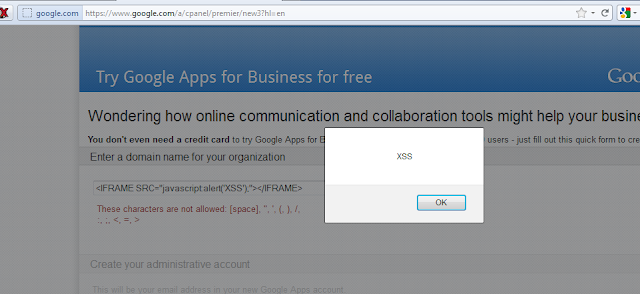
Cross Site Scripting (XSS) Vulnerability in Google Ucha Gobejishvili Hacker with codename " longrifle0x " discovered another Cross Site Scripting (XSS) Vulnerability in Google's Website. He already reported about the Vulnerability to Google Security Experts. Proof of Concept: Open https://www.google.com/a/cpanel/premier/new3?hl=en  and Click Find Domain . Put xss code: <IFRAME SRC="javascript:alert('XSS');"></IFRAME> Another XSS Vulnerabilities Discovered by longrifle0x  http://xssed.com/archive/author=longrifle0x/special=1/
When Browsers Become the Attack Surface: Rethinking Security for Scattered Spider

When Browsers Become the Attack Surface: Rethinking Security for Scattered Spider

Sep 01, 2025 Browser Security / Threat Intelligence
As enterprises continue to shift their operations to the browser, security teams face a growing set of cyber challenges. In fact, over 80% of security incidents now originate from web applications accessed via Chrome, Edge, Firefox, and other browsers. One particularly fast-evolving adversary, Scattered Spider, has made it their mission to wreak havoc on enterprises by specifically targeting sensitive data on these browsers. Scattered Spider, also referred to as UNC3944, Octo Tempest, or Muddled Libra, has matured over the past two years through precision targeting of human identity and browser environments. This shift differentiates them from other notorious cybergangs like Lazarus Group, Fancy Bear, and REvil. If sensitive information such as your calendar, credentials, or security tokens is alive and well in browser tabs, Scattered Spider is able to acquire them.  In this article, you’ll learn details about Scattered Spider’s attack methods and how you can stop them in their ...
A New Way To Manage Your Web Exposure: The Reflectiz Product Explained

A New Way To Manage Your Web Exposure: The Reflectiz Product Explained

Mar 06, 2024 Website Security / Compliance
An in-depth look into a proactive website security solution that continuously detects, prioritizes, and validates web threats, helping to mitigate security, privacy, and compliance risks.  Reflectiz  shields websites from client-side attacks, supply chain risks, data breaches, privacy violations, and compliance issues. You Can’t Protect What You Can’t See Today’s websites are connected to dozens of third-party web apps, trackers, and open-source tools like pixels, tag managers, and JavaScript frameworks. Some of these elements are stored on public CDNs, while others are loaded from third-party web servers that may be unfamiliar. These external web components and data items are not always visible to standard security controls, and they often expose you to security threats such as supply chain risks, client-side attacks, and vulnerabilities in your online software. This means that these serious challenges will frequently go unnoticed. Moreover, security and privacy regulatio...
Popular NPM Package Hijacked to Publish Crypto-mining Malware

Popular NPM Package Hijacked to Publish Crypto-mining Malware

Oct 23, 2021
The U.S. Cybersecurity and Infrastructure Security Agency on Friday  warned  of crypto-mining and password-stealing malware embedded in " UAParser.js ," a popular JavaScript NPM library with over 6 million weekly downloads, days after the NPM repository moved to get rid of three rogue packages that were found to mimic the same library. The supply-chain attack targeting the open-source library saw three different versions — 0.7.29, 0.8.0, 1.0.0 — that were published with malicious code on Thursday following a successful takeover of the maintainer's NPM account. "I believe someone was hijacking my NPM account and published some compromised packages (0.7.29, 0.8.0, 1.0.0) which will probably install malware," UAParser.js's developer Faisal Salman  said . The issue has been patched in versions 0.7.30, 0.8.1, and 1.0.1. The development comes days after DevSecOps firm Sonatype disclosed details of three packages —  okhsa, klow, and klown  — that masqueraded ...
WordPress Security Alert: New Linux Malware Exploiting Over Two Dozen CMS Flaws

WordPress Security Alert: New Linux Malware Exploiting Over Two Dozen CMS Flaws

Jan 02, 2023 Web Security / Linux
WordPress sites are being targeted by a previously unknown strain of Linux malware that exploits flaws in over two dozen plugins and themes to compromise vulnerable systems. "If sites use outdated versions of such add-ons, lacking crucial fixes, the targeted web pages are injected with malicious JavaScripts," Russian security vendor Doctor Web  said  in a report published last week. "As a result, when users click on any area of an attacked page, they are redirected to other sites." The attacks involve weaponizing a list of known security vulnerabilities in 19 different plugins and themes that are likely installed on a WordPress site, using it to deploy an implant that can target a specific website to further expand the network. It's also capable of injecting JavaScript code retrieved from a remote server in order to redirect the site visitors to an arbitrary website of the attacker's choice. Doctor Web said it identified a second version of the backdoor...
Cross Site Scripting Vulnerability in Speed Bit Search Engine

Cross Site Scripting Vulnerability in Speed Bit Search Engine

Nov 09, 2011
Cross Site Scripting Vulnerability in Speed Bit Search Engine Debasish Mandal, A hacker from India , Found that there is a XSS through JavaScript Injection vulnerability in the Home page of Speed Bit Search Engine.The XSS filter is filtering normal html /script /iframe tags but XSS can be achieved by injecting JavaScript event "onmouseover()".Technical Description is below. Debasish have reported the vulnerability to the Speed Bit Team but haven't yet got any response from their side. Proof Of Concept: 1) Visit this URL http://search.speedbit.com/?aff=grbr" onmousemove="alert(document.cookie) 2) Bring mouse cursor over the hyperlink shown in the image and you should see a POP up box showing the browser cookies. Submitted By :  Debasish Mandal, India.
Zero-Day Alert: Google Issues Patch for New Chrome Vulnerability - Update Now!

Zero-Day Alert: Google Issues Patch for New Chrome Vulnerability - Update Now!

Jun 06, 2023 Browser Security / Vulnerability
Google on Monday released security updates to patch a high-severity flaw in its Chrome web browser that it said is being actively exploited in the wild. Tracked as  CVE-2023-3079 , the vulnerability has been described as a type confusion bug in the V8 JavaScript engine. Clement Lecigne of Google's Threat Analysis Group (TAG) has been credited with reporting the issue on June 1, 2023. "Type confusion in V8 in Google Chrome prior to 114.0.5735.110 allowed a remote attacker to potentially exploit heap corruption via a crafted HTML page,"  according  to the NIST's National Vulnerability Database (NVD). The tech giant, as is typically the case, did not disclose details of the nature of the attacks, but  noted  it's "aware that an exploit for CVE-2023-3079 exists in the wild." With the latest development, Google has addressed a total of three actively exploited zero-days in Chrome since the start of the year - CVE-2023-2033  (CVSS score: 8.8) - Type Co...
Multiple WordPress Plugins Compromised: Hackers Create Rogue Admin Accounts

Multiple WordPress Plugins Compromised: Hackers Create Rogue Admin Accounts

Jun 25, 2024 WordPress / Web Security
Multiple WordPress plugins have been backdoored to inject malicious code that makes it possible to create rogue administrator accounts with the aim of performing arbitrary actions. "The injected malware attempts to create a new administrative user account and then sends those details back to the attacker-controlled server," Wordfence security researcher Chloe Chamberland said in a Monday alert. "In addition, it appears the threat actor also injected malicious JavaScript into the footer of websites that appears to add SEO spam throughout the website." The admin accounts have the usernames "Options" and "PluginAuth," with the account information exfiltrated to the IP address 94.156.79[.]8. It's currently not known how the unknown attackers behind the campaign managed to compromise the plugins, but the earliest signs of the software supply chain attack date back to June 21, 2024. The plugins in question are no longer available for downlo...
Expert Insights Articles Videos
Cybersecurity Resources