#1 Trusted Cybersecurity News Platform
Followed by 5.20+ million
The Hacker News Logo
Subscribe – Get Latest News
Salesforce Security Handbook

The Hacker News | #1 Trusted Source for Cybersecurity News — Index Page

Kaspersky finds Malware that resides in your RAM

Kaspersky finds Malware that resides in your RAM

Mar 20, 2012
Kaspersky finds Malware that resides in your RAM Kaspersky Lab researchers have discovered a drive-by download attack that evades hard-drive checkers by installing malware that lives in the computer's memory. The 'fileless' bot is more difficult for antivirus software to detect, and resides in memory until the machine is rebooted. This Malware doesn't create any files on the affected systems was dropped on to the computers of visitors to popular news sites in Russia in a drive-by download attack.Drive-by download attacks are one of the primary methods of distributing malware over the web. They usually exploit vulnerabilities in outdated software products to infect computers without requiring user interaction. The attack code loaded an exploit for a known Java vulnerability (CVE-2011-3544), but it wasn't hosted on the affected websites themselves. Once the malware infected a Microsoft machine, the bot disabled User Account Control, contacted a command and control...
The Pirate Bay plans Low Orbit Server Drones to beat #Censorship

The Pirate Bay plans Low Orbit Server Drones to beat #Censorship

Mar 20, 2012
The Pirate Bay plans Low Orbit Server Drones to beat Censorship One of the world's largest BitTorrent sites " The Pirate Bay " is going to put servers on GPS-controlled aircraft drones in order to evade authorities who are looking to shut the site down. In a Sunday blog post, The Pirate Bay announced new " Low Orbit Server Stations " that will house the site's servers and files on unmanned, GPS-controlled, aircraft drones. TPB said: With the development of GPS controlled drones, far-reaching cheap radio equipment and tiny new computers like the Raspberry Pi, we're going to experiment with sending out some small drones that will float some kilometers up in the air. This way our machines will have to be shut down with aeroplanes in order to shut down the system. A real act of war. We're just starting so we haven't figured everything out yet. But we can't limit ourselves to hosting things just on land anymore. These Low Orbit Server Stations (LOSS) are jus...
Fake LinkedIn Emails Link to Blackhole Exploit Malware

Fake LinkedIn Emails Link to Blackhole Exploit Malware

Mar 19, 2012
Fake LinkedIn Emails Link to Blackhole Exploit Malware Cyber Criminals have been busy pumping out spam emails that pose as legitimate LinkedIn notices, enticing you to click on a link in order to read what message some random stranger has left for you. The incident was identified by researchers at security provider GFI Labs . If your Click the links, It will send you directly to a site housing a blackhole exploit kit that will attempt to take advantage of any system vulnerabilities in order to infect your PC with malware, Exactly which attempts to drop Cridex onto the PC. Cridex malware variant from the wild caught on camera that shows CAPTCHA tests used by some online services are still weak and can be broken by malware. The spammers did a good job crafting the bogus LinkedIn notices LinkedIn logo at the top left, familiar blue coloring, no obvious spelling mistakes, disguised links and even a spoofed sender's address it's pretty easy to spot the fake emails when you...
cyber security

10 Must-Have Features Your BAS Should Deliver

websitePicus SecurityBreach and Attack Simulation
Evaluating Breach and Attack Simulation? Use this guide to distinguish marketing claims from real proof.
cyber security

Pentesting With Proof. Zero-Day, Zero-Pay and the #1 AI Hacker Behind It

websiteXBOWPenetration Testing
Real exploits, no fluff. The AI that topped HackerOne powers every on-demand pentest.
Security holes in Android with apps Advertisements

Security holes in Android with apps Advertisements

Mar 19, 2012
Security holes in Android with apps Advertisements Researchers at North Carolina State University have found privacy and security holes in Android apps because of in-application advertisements. They study the popular Android platform and collect 100,000 apps from the official Android Market in March-May, 2011 and Then they identify the possible 52.1% apps using Advertisements and further developa system called AdRisk to systematically identify potentialrisks. They explain that most of the ad libraries collect private information, some ofthem may be used for legitimate targeting purposes (i.e., the user'slocation) while others are hard to justify by invasively collectingthe information such as the user's call logs, phone number, browserbookmarks, or even the list of installed apps on the phone. The researchers wrote in a paper to be presented at the 5th ACM Conference on Security and Privacy in Wireless and Mobile Networks in Tucson on April 17th, [ Read Here ] As one...
Mystery of Duqu Programming Language Solved

Mystery of Duqu Programming Language Solved

Mar 19, 2012
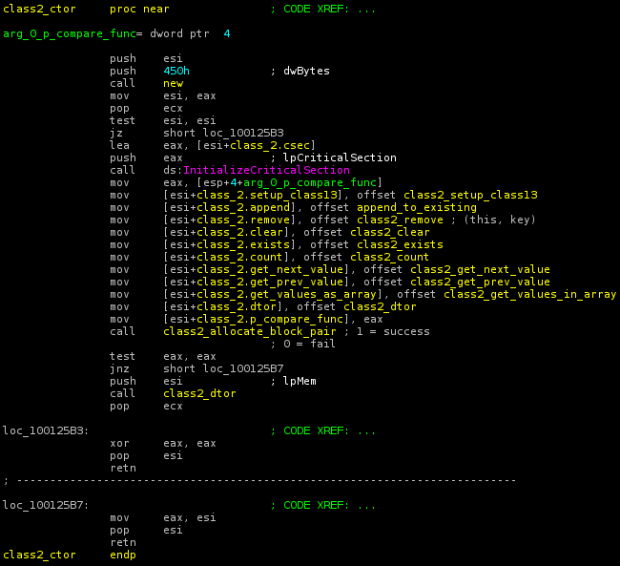
Mystery of Duqu Programming Language Solved An appeal for help from the programming community has allowed antivirus analysts to classify the unknown language used to develop key components of the Duqu Trojan. The sections responsible for downloading and executing additional modules in the Duqu Trojan, referred to by some as Stuxnet 2.0, were written in standard C++. Kaspersky Lab experts now say with a high degree of certainty that the Duqu framework was written using a custom object-oriented extension to C, generally called "OO C" and compiled with Microsoft Visual Studio Compiler 2008 (MSVC 2008) with special options for optimizing code size and inline expansion. Kaspersky's Igor Soumenkov wrote, " No matter which of these two variants is true, the implications are impressive. The Payload DLL contains 95 Kbytes of event-driven code written with OO C, a language that has no automatic memory management or safe pointers ,". Kaspersky's analysis now concludes: The Duqu Fra...
Yet Another Google Chrome Sandbox Critical Exploit by Turkish security experts

Yet Another Google Chrome Sandbox Critical Exploit by Turkish security experts

Mar 18, 2012
Yet Another Google Chrome Sandbox Critical Exploit by Turkish security experts Turkish security experts from Arf Iskenderun Technologies, finds the new vulnerability open in Google Chrome 17.0.963.78 , same risk working on new update 17.0.963.79 and bypass Chrome SandBox. Last week,  Vupen Security reports that it has officially "pwned" Google Chrome's sandbox. Vupen hacked Chrome 17.0.963.66 update. But, Turkish security experts claim that they hacked Chrome Sandbox after Vupen and This vulnerability is critical for Chrome.  A sandbox is security mechanism used to run an application in a restricted environment. If an attacker is able to exploit the browser in a way that lets him run arbitrary code on the machine, the sandbox would help prevent this code from causing damage to the system. The sandbox would also help prevent this exploit from modifying and even reading your files or any information on the system. Maiden says th...
Expert Insights Articles Videos
Cybersecurity Resources