-->
#1 Trusted Cybersecurity News Platform
Followed by 5.70+ million
The Hacker News Logo
Get the Latest News
cybersecurity

The Hacker News | #1 Trusted Source for Cybersecurity News — Index Page

IBM developing Self-Destructing Microchips for US Defense

IBM developing Self-Destructing Microchips for US Defense

Feb 07, 2014
Science Fiction Movies always show the possible direction of the development of technology and gives us the opportunity to think about it. The U.S. Government is also trying to develop such technology that was introduced in movies like Star Trek and TERMINATOR i.e. Self destructing Network of computers, Sensors and other devices. The agency of the United States Department of Defense which is responsible for funding the development of many technologies, Defense Advanced Research Projects Agency (DARPA) has handed over a contract to IBM for creating a microchip that will self-destruct remotely. The project announced a year back, known as Vanishing Programmable Resources ( VAPR ) , which is dedicated to developing a CMOS microchip that self-destructs when it receives a certain frequency of radio signal from military command, in order to fully destroy it and preventing it from being used by the enemy. The U.S. Military uses all kinds of embedded systems and there are obvio...
98% of SSL enabled websites still using SHA-1 based weak Digital Certificates

98% of SSL enabled websites still using SHA-1 based weak Digital Certificates

Feb 06, 2014
The National Institute of Standards and Technology (NIST) had published a document on Jan 2011 that the SHA-1 algorithm will be risky and should be disallowed after year 2013, but it was recently noticed by Netcraft experts that NIST.gov website itself were using 2014 dated SSL certificate with SHA-1 hashes. " From January 1, 2011 through December 31, 2013, the use of SHA-1 is deprecated for digital signature generation. The user must accept risk when SHA-1 is used, particularly when approaching the December 31, 2013 upper limit. SHA-1 shall not be used for digital signature generation after December 31, 2013. " NIST in the document. Digital signatures facilitate the safe exchange of electronic documents by providing a way to test both the authenticity and the integrity of information exchanged digitally. Authenticity means when you sign data with a digital signature, someone else can verify the signature, and can confirm that the data originated from you and was not...
British Intelligence Agency DDoSed Anonymous Chatrooms to disrupt communication

British Intelligence Agency DDoSed Anonymous Chatrooms to disrupt communication

Feb 06, 2014
Since 2011, the collective hacking group, Anonymous and LulzSec were targeting both Government and law-enforcement websites of U.S and UK, by their own DDoS attack tactics which they used to communicate and plan on Chat rooms known as IRCs, but British intelligence agency GCHQ used their own weapon against them. According to the recent Edward Snowden document, a division of Government Communications Headquarters (GCHQ), which is also very well known as the British counterpart of the NSA, had shut down communications among Anonymous hacktivists by launching a “ denial of service ” (DDOS) attacks, making the British government the first western government known to have conducted such an attack, NBC news reports . The same DDoS technique the hackers use to take down government, political and industry websites, including the Central Intelligence Agency (CIA), Federal bureau of Investigation (FBI), the Serious Organized Crime Agency (SOCA), Sony News International and Westbor...
cyber security

11 years of data. New AI Risk Guidance

websiteSANS InstituteSecurity Awareness / Cybersecurity
See where the field is heading.
cyber security

New Webinar: How AI Broke the Pyramid of Pain for Threat Detection

websitePush SecurityThreat Hunting / Phishing
Attacker tools and infrastructure are now changing at machine speed. Learn what’s changed and how to adapt.
Google adds its Chrome apps and extensions to Bug Bounty Program

Google adds its Chrome apps and extensions to Bug Bounty Program

Feb 06, 2014
Google's Vulnerability Reward Program which started in November 2010, offers a hefty reward to the one who find a good vulnerability in its products.  Now Google is getting a little more serious about the security of its Chrome Browser and has expanded its Bug Bounty Program to include all Chrome apps, extensions developed and branded as " by Google ". The Internet is a platform which has become a necessary medium for performing our daily tasks like reading news, paying bills, playing games, scheduling meetings and everything we perform on this platform is possible only because of the various applications maintained by the service providers. " We think developing Chrome extensions securely is relatively easy, but given that extensions like Hangouts and GMail are widely used, we want to make sure efforts to keep them secure are rewarded accordingly. " Google said in a blog post . Not only this, to improve the security of open-source proje...
Facebook domain hacked by Syrian Electronic Army

Facebook domain hacked by Syrian Electronic Army

Feb 06, 2014
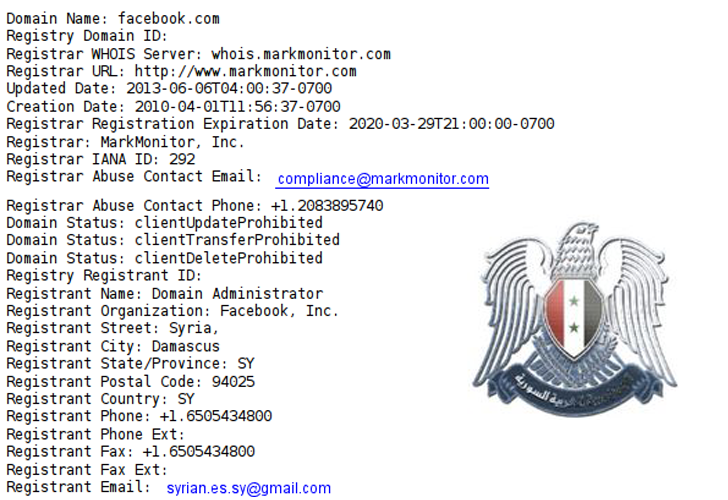
On the 10th Anniversary of Social networking website Facebook, the hacker group ' Syrian Electronic Army ' claimed that they managed to hack into the administrator account of the Facebook's Domain Registrar - MarkMonitor. The hacking group changed the Facebook Domain's contact information to a Syrian email address on the company’s WHOIS domain information page, as shown. " Happy Birthday Mark! http://Facebook.com owned by #SEA " the group tweeted . Hackers also claimed that it had updated the nameserver information to hijack domain, but the process had to be abandoned because it was " taking too much time... " whereas, Facebook spokesperson did confirm that the website's domain record email contact information had been changed. Why SEA Targeted Facebook? Syrian activists and Hackers claimed that Facebook has been deleting pages created by dissidents and removing content as it was violating the social network’s standards, acc...
⚡ Top Stories This Week
Expert Insights Articles Videos
Cybersecurity Resources