-->
#1 Trusted Cybersecurity News Platform
Followed by 5.20+ million
The Hacker News Logo
Subscribe – Get Latest News
Security Service Edge

The Hacker News | #1 Trusted Source for Cybersecurity News — Index Page

Flickr vulnerable to SQL Injection and Remote Code Execution Flaws

Flickr vulnerable to SQL Injection and Remote Code Execution Flaws

Apr 14, 2014
Yahoo-owned Flickr , one of the biggest online photo management and sharing website in the world was recently impacted by critical web application vulnerabilities, which left website's database and server vulnerable hackers. Ibrahim Raafat , a security researcher from Egypt has found SQL injection vulnerabilities on  Flickr Photo Books , new feature for printing custom photo books through Flickr that was launched 5 months ago. He claimed to have found two parameters ( page_id , items ) vulnerable to Blind SQL injection and one  (i.e. order_id ) Direct SQL Injection that allowed him to query the Flickr database for its content by the injection of a SQL SELECT statements. A Successful SQL exploitation could allow an attacker to steal the Database and MYSQL administrator password. Furthermore, Flickr's SQL injection flaws also facilitate the attacker to exploit remote code execution on the server and using  load_file(“/etc/passwd“)   function he wa...
Billions of Smartphone Users affected by Heartbleed Vulnerability

Billions of Smartphone Users affected by Heartbleed Vulnerability

Apr 13, 2014
Heartbleed has left a worst impression worldwide affecting millions of websites and is also supposed to put millions of Smartphones and tablets users at a great risk. Heartbleed is a critical bug ( CVE-2014-0160 ) in the popular OpenSSL cryptographic software library, that actually resides in the OpenSSL's implementation of the TLS/DTLS heartbeat extension, which allows attackers to read portions of the affected server’s memory, potentially revealing users data such as usernames, passwords, and credit card numbers, that the server did not intend to reveal. OpenSSL is a widely-used cryptographic library which implements the SSL and TLS protocol and protects communications on the Internet, and mostly every websites use either SSL or TLS, even the Apache web server that powers almost half of the websites over internet utilizes OpenSSL. But to assume that the users using desktop browsers to visit websites are vulnerable to the Heartbleed bug, will be wrong. Despite 40...
Researchers Get $10,000 for Hacking Google Server with Malicious XML

Researchers Get $10,000 for Hacking Google Server with Malicious XML

Apr 12, 2014
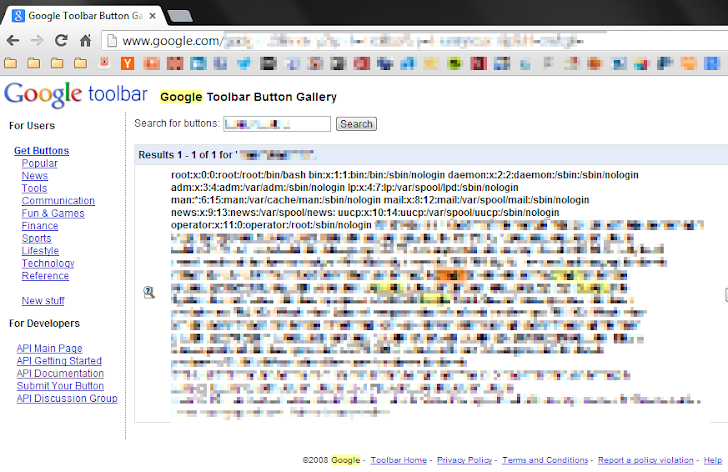
A critical vulnerability has been uncovered in Google that could allow an attacker to access the internal files of Google’s production servers. Sounds ridiculous but has been proven by the security researchers from Detectify. The vulnerability resides in the Toolbar Button Gallery ( as shown ). The team of researchers found a loophole after they noticed that Google Toolbar Button Gallery allows users to customize their toolbars with new buttons. So, for the developers, it is easy to create their own buttons by uploading XML files containing metadata for styling and other such properties. This feature of Google search engine is vulnerable to  XML External Entity (XXE) . It is an XML injection that allows an attacker to force a badly configured XML parser to " include " or " load " unwanted functionality that can compromise the security of a web application. “ The root cause of XXE vulnerabilities is naive XML parsers that blindly interpret the DTD of t...
cyber security

Practical Tools for Modern CISOs + Security Leaders

websiteWizCISO / Product Security
Get 5 of the most widely used CISO resources in one place. Each asset is designed to solve real, recurring security leadership challenges.
cyber security

OpenClaw: RCE, Leaked Tokens, and 21K Exposed Instances in 2 Weeks

websiteRecoSaaS Security / AI Security
The viral AI agent connects to Slack, Gmail, and Drive—and most security teams have zero visibility into it.
NSA denies Report that Agency knew and exploited Heartbleed Vulnerability

NSA denies Report that Agency knew and exploited Heartbleed Vulnerability

Apr 12, 2014
The Bloomberg claimed that the U.S. National Security Agency (NSA) knew about the most critical Heartbleed flaw and has been using it on a regular basis to gather “ critical intelligence ” and sensitive information for at least past two years and decided to keep the bug secret, citing two sources ‘ familiar with the matter ’. In response to the above report, NSA has issued a ' 94 character' statement today denying the claims that it has known about the Heartbleed bug since two years and that it has been using it silently for the purpose of surveillance. " NSA was not aware of the recently identified Heartbleed vulnerability until it was made public ," the U.S. intelligence agency said on its Twitter feed . Heartbleed is one of the biggest Internet vulnerabilities in recent history that left large number of cryptographic keys and private data such as usernames, passwords, and credit card numbers, from the most important sites and services on the Int...
German Developer responsible for HeartBleed Bug in OpenSSL

German Developer responsible for HeartBleed Bug in OpenSSL

Apr 12, 2014
We have already read so many articles on Heartbleed, one of the biggest iNternet threat that recently came across by a team of security engineers at Codenomicon , while improving the SafeGuard feature in Codenomicon's Defensics security testing tools.  The story has taken every media attention across the World, as the bug opened doors for the cyber criminals to extract sensitive data from the server's memory and almost every major site have been affected by it. UNINTENTIONAL  BIRTH OF HEARTBLEED More than two years ago, German programmer Robin Seggelmann introduced a new feature called " Heartbeat " in the most secured open source encryption protocol, OpenSSL , which is used by several social networks, search engines, banks and other websites to enable secure connections while transmitting data. But introducing heartbeat feature cost him dearly, as here the most critical bug resides. Dr. Seggelmann allegedly was just trying to improve OpenSSL and wo...
Mobile Charger That Can Power-Up Your Smartphone in 30 Seconds

Mobile Charger That Can Power-Up Your Smartphone in 30 Seconds

Apr 12, 2014
Going for a meeting or for a party and your Phone's battery discharged? Oops!  Yes, I know this happens with most of us once in a day or I can rather say all of us. Smartphones are smart enough but not that smarter as expected keeping in mind today’s lifestyle. Phones are the basic necessity now-a-days, but this comes up with another tension-tension of charging at regular intervals, which took most of our precious time. GET-SET CHARGE IN 30 SECONDS Now, if I say that your Smartphone will charge in just 30 seconds, then you definitely won’t believe it. But saying this won't be wrong, Israeli start-up claims to have created a battery that uses nanotechnology to charge your Smartphone in 30 seconds. StoreDot unveiled the device Monday at Microsoft's Think Next Conference in Tel Aviv . The prototype charger is capable to charge your Smartphone 100% within few blinks of your eyes, all in about 30 seconds. It depends on bio-organic quantum dots that are na...
APT Groups Return - Chinese Hackers Resume Cyber Espionage Operations

APT Groups Return - Chinese Hackers Resume Cyber Espionage Operations

Apr 11, 2014
Year back, one of the largest “ Advanced Persistent Threat ” ( APT ) hacking groups received widespread attention from the media and from the U.S. government. APT Groups are China’s cyber espionage units and they won’t stop their espionage operation, despite being exposed last year. Yes, APT hacking groups, APT1 and APT12 , are again making headlines. Without bothering that the world knows about its cyber hacking activities, the two of its major hacking groups have became once again active and have resumed their espionage operation, reports the security firm Mandiant . A timeline of APT1 economic espionage conducted since 2006 and has systematically stolen confidential data from at least 141 organizations across multiple industries. Mandiant, the FireEye owned company, announced in its M-Trend report that over the past year the firm has a close eye on the APT1 group , which it first exposed in February 2013. It’s also been monitoring the second Chinese hackers group, APT12 that...
Google Chrome vulnerability allows Websites to Eavesdrop on You

Google Chrome vulnerability allows Websites to Eavesdrop on You

Apr 11, 2014
Just imagine, you are sitting in front of your laptop and your laptop is listening to your nearby conversations. What if the recorded audio from the system’s microphone is being instantly uploaded to a malicious website? Google has created a speech-recognition Application Programming Interface (API) that allows websites to interact with Google Chrome and the computer’s microphone allows you to speak instead of typing into any text box, to make hands-free web searches, quick conversions, and audio translator also work with them. In January, a flaw was discovered in Google Chrome that enabled malicious websites with speech recognition software to eavesdrop on users’ conversations from background without their knowledge using an outdated Google speech API. CHROME IS LISTENING YOU A new similar vulnerability in Google Chrome has been discovered by Israeli security researcher, Guy Aharonovsky, claimed that the Chrome’s speech-recognition API has a vulnerability that ...
Expert Insights Articles Videos
Cybersecurity Resources