-->
#1 Trusted Cybersecurity News Platform
Followed by 5.70+ million
The Hacker News Logo
Get the Latest News
cybersecurity

The Hacker News | #1 Trusted Source for Cybersecurity News — Index Page

Malware Attackers Using MacroPack to Deliver Havoc, Brute Ratel, and PhantomCore

Malware Attackers Using MacroPack to Deliver Havoc, Brute Ratel, and PhantomCore

Sep 05, 2024 Cyber Threat / Malware
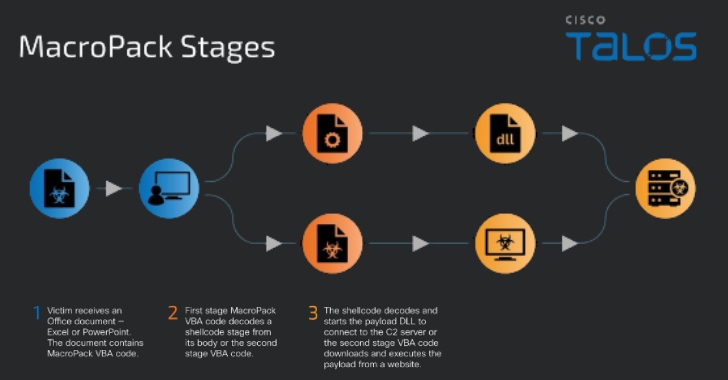
Threat actors are likely employing a tool designated for red teaming exercises to serve malware, according to new findings from Cisco Talos. The program in question is a payload generation framework called MacroPack , which is used to generate Office documents, Visual Basic scripts, Windows shortcuts, and other formats for penetration testing and social engineering assessments. It was developed by French developer Emeric Nasi. The cybersecurity company said it found artifacts uploaded to VirusTotal from China, Pakistan, Russia, and the U.S. that were all generated by MacroPack and used to deliver various payloads such as Havoc, Brute Ratel , and a new variant of PhantomCore , a remote access trojan (RAT) attributed to a hacktivist group named Head Mare. "A common feature in all the malicious documents we dissected that caught our attention is the existence of four non-malicious VBA subroutines," Talos researcher Vanja Svajcer said . "These subroutines appeared...
New Cross-Platform Malware KTLVdoor Discovered in Attack on Chinese Trading Firm

New Cross-Platform Malware KTLVdoor Discovered in Attack on Chinese Trading Firm

Sep 05, 2024 Cyber Attack / Malware
The Chinese-speaking threat actor known as Earth Lusca has been observed using a new backdoor dubbed KTLVdoor as part of a cyber attack targeting an unnamed trading company based in China. The previously unreported malware is written in Golang, and thus is a cross-platform weapon capable of targeting both Microsoft Windows and Linux systems. "KTLVdoor is a highly obfuscated malware that masquerades as different system utilities, allowing attackers to carry out a variety of tasks including file manipulation, command execution, and remote port scanning," Trend Micro researchers Cedric Pernet and Jaromir Horejsi said in an analysis published Wednesday. Some of the tools KTLVdoor impersonates include sshd, Java, SQLite, bash, and edr-agent, among others, with the malware distributed in the form of dynamic-link library (.dll) or a shared object (.so). Perhaps the most unusual aspect of the activity cluster is the discovery of more than 50 command-and-control (C&C) s...
Cisco Fixes Two Critical Flaws in Smart Licensing Utility to Prevent Remote Attacks

Cisco Fixes Two Critical Flaws in Smart Licensing Utility to Prevent Remote Attacks

Sep 05, 2024
Cisco has released security updates for two critical security flaws impacting its Smart Licensing Utility that could allow unauthenticated, remote attackers to elevate their privileges or access sensitive information. A brief description of the two vulnerabilities is below - CVE-2024-20439 (CVSS score: 9.8) - The presence of an undocumented static user credential for an administrative account that an attacker could exploit to log in to an affected system CVE-2024-20440 (CVSS score: 9.8) - A vulnerability arising due to an excessively verbose debug log file that an attacker could exploit to access such files by means of a crafted HTTP request and obtain credentials that can be used to access the API While these shortcomings are not dependent on each other for them to be successful, Cisco notes in its advisory that they "are not exploitable unless Cisco Smart Licensing Utility was started by a user and is actively running." The flaws, which were discovered during i...
cyber security

AI Adoption Is Outpacing Governance, New SANS Survey Data Shows

websiteSANSCybersecurity / AI Security
See where 536 security pros say AI programs fall short: detection, trust, workforce readiness.
cyber security

11 Real Stories: How Identity Exposure Unlocks Active Attack Paths

websiteXM CyberCloud Security / Identity Security
Map cross-domain privilege escalation to sever breach routes at key choke points.
North Korean Hackers Targets Job Seekers with Fake FreeConference App

North Korean Hackers Targets Job Seekers with Fake FreeConference App

Sep 04, 2024 Cryptocurrency / Malware
North Korean threat actors have leveraged a fake Windows video conferencing application impersonating FreeConference.com to backdoor developer systems as part of an ongoing financially-driven campaign dubbed Contagious Interview. The new attack wave, spotted by Singaporean company Group-IB in mid-August 2024, is yet another indication that the activity is also leveraging native installers for Windows and Apple macOS to deliver malware. Contagious Interview, also tracked as DEV#POPPER, is a malicious campaign orchestrated by a North Korean threat actor tracked by CrowdStrike under the moniker Famous Chollima. The attack chains begin with a fictitious job interview, tricking job seekers into downloading and running a Node.js project that contains the BeaverTail downloader malware, which in turn delivers InvisibleFerret, a cross-platform Python backdoor that's equipped with remote control, keylogging, and browser stealing capabilities. Some iterations of BeaverTail, which also...
Android Users Urged to Install Latest Security Updates to Fix Actively Exploited Flaw

Android Users Urged to Install Latest Security Updates to Fix Actively Exploited Flaw

Sep 04, 2024 Vulnerability / Mobile Security
Google has released its monthly security updates for the Android operating system to address a known security flaw that it said has come under active exploitation in the wild. The high-severity vulnerability, tracked as CVE-2024-32896 (CVSS score: 7.8), relates to a case of privilege escalation in the Android Framework component. According to the description of the bug in the NIST National Vulnerability Database (NVD), it concerns a logic error that could lead to local escalation of privileges without requiring any additional execution privileges. "There are indications that CVE-2024-32896 may be under limited, targeted exploitation," Google said in its Android Security Bulletin for September 2024. It's worth noting that CVE-2024-32896 was first disclosed in June 2024 as impacting only the Google-owned Pixel lineup. There are currently no details on how the vulnerability is being exploited in the wild, although GrapheneOS maintainers revealed that CVE-2024-32896...
⚡ Top Stories This Week
Expert Insights Articles Videos
Cybersecurity Resources