-->
#1 Trusted Cybersecurity News Platform
Followed by 5.70+ million
The Hacker News Logo
Get the Latest News
cybersecurity

The Hacker News | #1 Trusted Source for Cybersecurity News — Index Page

New Rugmi Malware Loader Surges with Hundreds of Daily Detections

New Rugmi Malware Loader Surges with Hundreds of Daily Detections

Dec 28, 2023 Malware / Cyber Threat
A new malware loader is being used by threat actors to deliver a wide range of  information stealers  such as Lumma Stealer (aka LummaC2), Vidar, RecordBreaker (aka Raccoon Stealer V2), and  Rescoms . Cybersecurity firm ESET is tracking the trojan under the name  Win/TrojanDownloader.Rugmi . "This malware is a loader with three types of components: a downloader that downloads an encrypted payload, a loader that runs the payload from internal resources, and another loader that runs the payload from an external file on the disk," the company  said  in its Threat Report H2 2023. Telemetry data gathered by the company shows that detections for the Rugmi loader spiked in October and November 2023, surging from single digit daily numbers to hundreds per day. Stealer malware is typically sold under a malware-as-a-service (MaaS) model to other threat actors on a subscription basis. Lumma Stealer, for instance, is advertised in underground forums for $250 a mo...
Critical Zero-Day in Apache OfBiz ERP System Exposes Businesses to Attack

Critical Zero-Day in Apache OfBiz ERP System Exposes Businesses to Attack

Dec 27, 2023 Zero-Day / Vulnerability
A new zero-day security flaw has been discovered in Apache OfBiz, an open-source Enterprise Resource Planning (ERP) system that could be exploited to bypass authentication protections. The vulnerability, tracked as  CVE-2023-51467 , resides in the login functionality and is the result of an incomplete patch for another critical vulnerability ( CVE-2023-49070 , CVSS score: 9.8) that was released earlier this month. "The  security measures  taken to patch CVE-2023-49070 left the root issue intact and therefore the authentication bypass was still present," the SonicWall Capture Labs threat research team, which discovered the bug,  said  in a statement shared with The Hacker News. CVE-2023-49070 refers to a pre-authenticated remote code execution flaw impacting versions prior to 18.12.10 that, when successfully exploited, could allow threat actors to gain full control over the server and siphon sensitive data. It is caused due to a deprecated XML-RPC component ...
Chinese Hackers Exploited New Zero-Day in Barracuda's ESG Appliances

Chinese Hackers Exploited New Zero-Day in Barracuda's ESG Appliances

Dec 27, 2023 Zero-Day / Email Security
Barracuda has revealed that Chinese threat actors exploited a new zero-day in its Email Security Gateway (ESG) appliances to deploy backdoors on a "limited number" of devices. Tracked as  CVE-2023-7102 , the issue relates to a case of  arbitrary code execution  that resides within a third-party and open-source library named Spreadsheet::ParseExcel that's used by the Amavis scanner within the gateway to screen Microsoft Excel email attachments for malware. The company attributed the activity to a threat actor tracked by Google-owned Mandiant as  UNC4841 , which was previously linked to the  active exploitation  of another zero-day in Barracuda devices (CVE-2023-2868, CVSS score: 9.8) earlier this year. Successful exploitation of the new flaw is accomplished by means of a specially crafted Microsoft Excel email attachment. This is followed by the deployment of new variants of known implants called  SEASPY and SALTWATER  that are equipped to off...
cyber security

AI Threat Readiness 101

websiteWizCloud Security / AI Security
Learn the four pillars of AI threat readiness and how security teams can reduce risk faster with detection, validation, and remediation built for today's threat landscape.
cyber security

The State of Shadow AI in 2026 (And How Attackers Are Taking Advantage)

websitePush SecurityShadow AI / Browser Security
AI adoption has exploded, but every new app, integration and extension introduces new threats and risks.
New Sneaky Xamalicious Android Malware Hits Over 327,000 Devices

New Sneaky Xamalicious Android Malware Hits Over 327,000 Devices

Dec 27, 2023 Privacy / App Security
A new Android backdoor has been discovered with potent capabilities to carry out a range of malicious actions on infected devices. Dubbed  Xamalicious  by the McAfee Mobile Research Team, the malware is so named for the fact that it's developed using an open-source mobile app framework called Xamarin and abuses the operating system's accessibility permissions to fulfill its objectives. It's also capable of gathering metadata about the compromised device and contacting a command-and-control (C2) server to fetch a second-stage payload, but only after determining if it fits the bill. The second stage is "dynamically injected as an assembly DLL at runtime level to take full control of the device and potentially perform fraudulent actions such as clicking on ads, installing apps, among other actions financially motivated without user consent," security researcher Fernando Ruiz  said . The cybersecurity firm said it identified 25 apps that come with this active thr...
Warning: Poorly Secured Linux SSH Servers Under Attack for Cryptocurrency Mining

Warning: Poorly Secured Linux SSH Servers Under Attack for Cryptocurrency Mining

Dec 27, 2023 Malware / Server Security
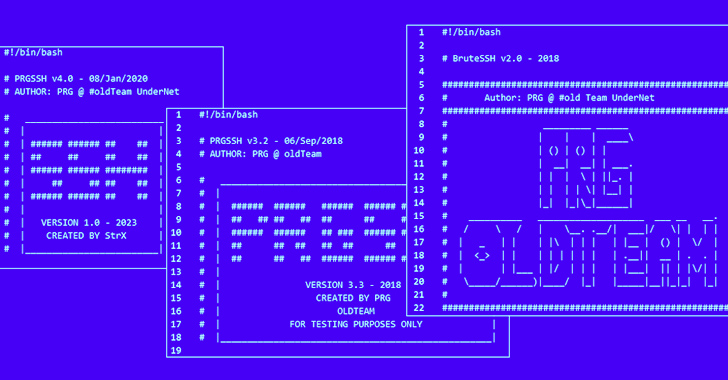
Poorly secured Linux SSH servers are being targeted by bad actors to install port scanners and dictionary attack tools with the goal of targeting other vulnerable servers and co-opting them into a network to carry out cryptocurrency mining and distributed denial-of-service (DDoS) attacks. "Threat actors can also choose to install only scanners and sell the breached IP and account credentials on the dark web," the AhnLab Security Emergency Response Center (ASEC)  said  in a report on Tuesday. In these attacks, adversaries try to guess a server's SSH credentials by running through a list of commonly used combinations of usernames and passwords, a technique called dictionary attack. Should the brute-force attempt be successful, it's followed by the threat actor deploying other malware, including scanners, to scan for other susceptible systems on the internet. Specifically, the scanner is designed to look for systems where port 22 -- which is associated with the SSH ...
⚡ Top Stories This Week
Expert Insights Articles Videos
Cybersecurity Resources