-->
#1 Trusted Cybersecurity News Platform
Followed by 5.20+ million
The Hacker News Logo
Subscribe – Get Latest News
Security Service Edge

The Hacker News | #1 Trusted Source for Cybersecurity News — Index Page

Critical Pre-Auth RCE Flaw Found in F5 Big-IP Platform — Patch ASAP!

Critical Pre-Auth RCE Flaw Found in F5 Big-IP Platform — Patch ASAP!

Mar 11, 2021
Application security company F5 Networks on Wednesday published an  advisory  warning of four critical vulnerabilities impacting multiple products that could result in a denial of service (DoS) attack and even unauthenticated remote code execution on target networks. The patches concern a total of seven related flaws (from CVE-2021-22986 through CVE-2021-22992),  two  of  which  were discovered and reported by Felix Wilhelm of Google Project Zero in December 2020. The four critical flaws affect BIG-IP versions 11.6 or 12.x and newer, with a critical pre-auth remote code execution (CVE-2021-22986) also affecting BIG-IQ versions 6.x and 7.x. F5 said it's not aware of any public exploitation of these issues. Successful exploitation of these vulnerabilities could lead to a full compromise of vulnerable systems, including the possibility of remote code execution as well as trigger a buffer overflow, leading to a DoS attack. Urging customers to update their...
Researchers Unveil New Linux Malware Linked to Chinese Hackers

Researchers Unveil New Linux Malware Linked to Chinese Hackers

Mar 10, 2021
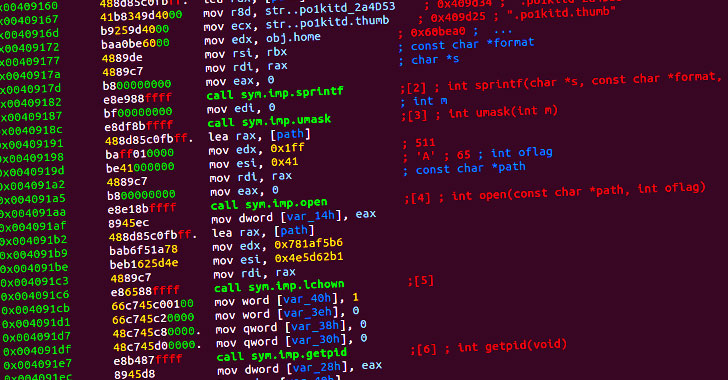
Cybersecurity researchers on Wednesday shed light on a new sophisticated backdoor targeting Linux endpoints and servers that's believed to be the work of Chinese nation-state actors. Dubbed " RedXOR " by Intezer, the backdoor masquerades as a polkit daemon, with similarities found between the malware and those previously associated with the  Winnti Umbrella  (or Axiom) threat group such as ​PWNLNX, ​XOR.DDOS​ and Groundhog. RedXOR's name comes from the fact that it encodes its network data with a scheme based on XOR, and that it's compiled with a legacy  GCC compiler  on an old release of Red Hat Enterprise Linux, suggesting that the malware is deployed in targeted attacks against legacy Linux systems. Intezer said  two   samples  of the malware were uploaded from Indonesia and Taiwan around Feb. 23-24, both countries that are known to be singled out by China-based threat groups. Aside from the overlaps in terms of the overall flow and functional...
FIN8 Hackers Return With More Powerful Version of BADHATCH PoS Malware

FIN8 Hackers Return With More Powerful Version of BADHATCH PoS Malware

Mar 10, 2021
Threat actors known for keeping a low profile do so by ceasing operations for prolonged periods in between to evade attracting any attention as well as constantly refining their toolsets to fly below the radar of many detection technologies. One such group is  FIN8 , a financially motivated threat actor that's back in action after a year-and-a-half hiatus with a powerful version of a backdoor with upgraded capabilities including screen capturing, proxy tunneling, credential theft, and  fileless execution . First documented in 2016 by FireEye, FIN8 is known for its attacks against the retail, hospitality, and entertainment industries while making use of a wide array of techniques such as spear-phishing and malicious tools like  PUNCHTRACK  and  BADHATCH  to steal payment card data from point-of-sale (POS) systems. "The FIN8 group is known for taking long breaks to improve  TTPs  and increase their rate of success," Bitdefender researchers...
cyber security

5 Cloud Security Risks You Can’t Afford to Ignore

websiteSentinelOneEnterprise Security / Cloud Security
Get expert analysis, attacker insights, and case studies in our 2025 risk report.
cyber security

Red Report 2026: Analysis of 1.1M Malicious Files and 15.5M Actions

websitePicus SecurityAttack Surface / Cloud Security
New research shows 80% of top ATT&CK techniques now target evasion to remain undetected. Get your copy now.
Microsoft Issues Security Patches for 89 Flaws — IE 0-Day Under Active Attacks

Microsoft Issues Security Patches for 89 Flaws — IE 0-Day Under Active Attacks

Mar 10, 2021
Microsoft plugged as many as  89 security flaws  as part of its monthly Patch Tuesday updates released today, including fixes for an actively exploited zero-day in Internet Explorer that could permit an attacker to run arbitrary code on target machines. Of these flaws, 14 are listed as Critical, and 75 are listed as Important in severity, out of which two of the bugs are described as publicly known, while five others have been reported as under active attack at the time of release. Among those five security issues are a clutch of vulnerabilities known as  ProxyLogon  (CVE-2021-26855, CVE-2021-26857, CVE-2021-26858, and CVE-2021-27065) that allows adversaries to break into Microsoft Exchange Servers in target environments and subsequently allow the installation of unauthorized web-based backdoors to facilitate long-term access. But in the wake of Exchange servers coming under  indiscriminate assault  toward the end of February by multiple threat groups ...
9 Android Apps On Google Play Caught Distributing AlienBot Banker and MRAT Malware

9 Android Apps On Google Play Caught Distributing AlienBot Banker and MRAT Malware

Mar 09, 2021
Cybersecurity researchers have discovered a new malware dropper contained in as many as 9 Android apps distributed via Google Play Store that deploys a second stage malware capable of gaining intrusive access to the financial accounts of victims as well as full control of their devices. "This dropper, dubbed Clast82, utilizes a series of techniques to avoid detection by Google Play Protect detection, completes the evaluation period successfully, and changes the payload dropped from a non-malicious payload to the AlienBot Banker and MRAT," Check Point researchers Aviran Hazum, Bohdan Melnykov, and Israel Wernik said in a write-up published today. The apps that were used for the campaign include Cake VPN, Pacific VPN, eVPN, BeatPlayer, QR/Barcode Scanner MAX, Music Player, tooltipnatorlibrary, and QRecorder. After the findings were reported to Google on January 28, the rogue apps were removed from the Play Store on February 9.  Malware authors have resorted to a variety o...
Expert Insights Articles Videos
Cybersecurity Resources