#1 Trusted Cybersecurity News Platform
Followed by 5.20+ million
The Hacker News Logo
Subscribe – Get Latest News

The Hacker News | #1 Trusted Source for Cybersecurity News — Index Page

MegaChat — Kim Dotcom launches end-to-end encrypted Video Calling Service

MegaChat — Kim Dotcom launches end-to-end encrypted Video Calling Service

Jan 22, 2015
Are you worried about your privacy? Its Obvious because of a Hacker or the government could be snooping in your emails, voice or video calls. The Famous Internet entrepreneur Kim Dotcom , who introduced legendary Megaupload and Mega file sharing services to the World, has now released its latest encrypted communication software for video calling, messaging and chat. Kim Doctom's file-sharing site Mega has launched the public beta of its end-to-end encrypted video and audio chat service called " MegaChat ", which the company says gives better protection than alternatives such as Skype and Google Hangouts. MegaChat is currently free to use and right now just provides browser-based audio and video calls, but Mr. Dotcom said on Twitter "Text chat and video conferencing will follow soon," HOW TO USE MEGACHAT Create a Mega account. Simply log in via the web browser and click on the Conversations icon provided on the left-hand side  Contacts will need their o...
WhatsApp Web — New WhatsApp Feature Allows You to Chat From Your Browser

WhatsApp Web — New WhatsApp Feature Allows You to Chat From Your Browser

Jan 21, 2015
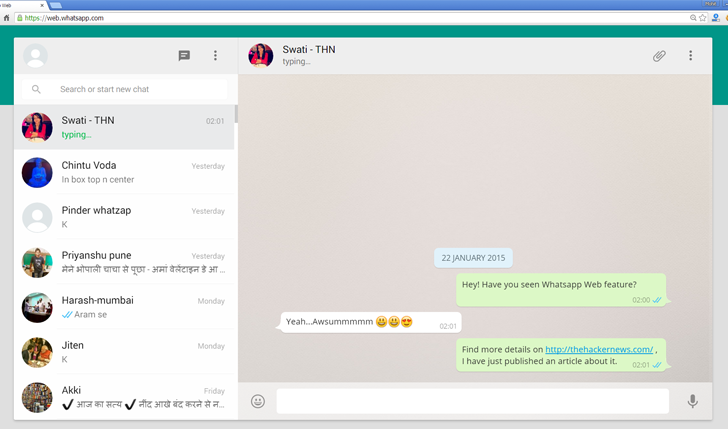
The most popular smartphone messaging service WhatsApp is now able to communicate with friends from their PC. No Rumours at all !! Enjoy WhatsApp from your desktop from now on. Last month, it was leaked that Whatsapp was working on a web client and finally from today they are introducing it to the public. The feature is called " WhatsApp Web ," which gives its users the ability to read and send messages directly from their web browsers. HOW TO USE WHATSAPP ON PC/DESKTOP Interested WhatsApp users simply need to open Chrome and navigate to https://web.whatsapp.com A QR code will appear on the web page, which must be scanned using WhatsApp mobile application to activate the service. By scanning the  QR code  that appears, users will automatically have paired their mobile WhatsApp with the WhatsApp web client, as shown.  WhatsApp Web requires that you install and run the latest Whatsapp version of the Android app on your phone. The feature currently work...
Oracle releases 169 Updates, Including 19 Patches for JAVA Vulnerabilities

Oracle releases 169 Updates, Including 19 Patches for JAVA Vulnerabilities

Jan 21, 2015
Get Ready to update your Java program as Oracle has released its massive patch package for multiple security vulnerabilities in its software. The United States software maker Oracle releases its security updates every three months on Tuesday, which it referred to as " Critical Patch Updates " (CPU). Yesterday, Oracle released its first quarterly CPU-date of this year, issuing a total of 169 security fixes for hundreds of its products including Java, Fusion Middleware, Enterprise Manager and MySQL. The security update for Oracle's popular browser plug-in Java addresses vulnerabilities in the software, 14 of which could be remotely exploitable without authentication, that means an attacker wouldn't need a username and password to exploit them over a network. Four Java flaws were marked most severe and received a score of 10.0 on the Common Vulnerability Scoring System (CVSS) , the most critical ranking. Nine other Java flaws given a CVSS Base Score of 6.0 ...
cyber security

Secured Images 101

websiteWizDevOps / AppSec
Secure your container ecosystem with this easy-to-read digital poster that breaks down everything you need to know about container image security. Perfect for engineering, platform, DevOps, AppSec, and cloud security teams.
cyber security

When Zoom Phishes You: Unmasking a Novel TOAD Attack Hidden in Legitimate Infrastructure

websiteProphet SecurityArtificial Intelligence / SOC
Prophet AI uncovers a Telephone-Oriented Attack Delivery (TOAD) campaign weaponizing Zoom's own authentication infrastructure.
Two Million Cars Using Wireless Insurance Dongle Vulnerable to Hacking

Two Million Cars Using Wireless Insurance Dongle Vulnerable to Hacking

Jan 21, 2015
2015 will be a year more smarter than 2014 with smarter mobile devices, smarter home appliances, and yes Smarter Automobiles. Nowadays, there are a number of automobiles companies offering vehicles that run on a mostly drive-by-wire system, meaning that a majority of the controls are electronically controlled, from instrument cluster to steering, brakes, and accelerator as well. No doubt these systems makes your driving experience better, but at the same time they also increase the risk of getting hacked. According to a recent research, an electronic dongle used to plugged into the on-board diagnostic port of more than two million cars and trucks contains few security weaknesses that makes them vulnerable to wireless attacks, resulting in taking control of the entire vehicle. Since 2008, US-based Progressive Insurance has used the SnapShot device in more than two million vehicles . The little device monitors and tracks users' driving behavior by collecting vehicle location a...
GoDaddy Vulnerability Allows Domain Hijacking

GoDaddy Vulnerability Allows Domain Hijacking

Jan 21, 2015
An Internet domain registrar and web hosting company GoDaddy has patched a Cross-Site Request Forgery ( CSRF or XSRF) vulnerability that allowed hackers and malicious actors to hijack websites registered with the domain registration company. The vulnerability was reported to GoDaddy on Saturday by Dylan Saccomanni, a web application security researcher and penetration testing consultant in New York. Without any time delay, the company patched the bug in less than 24 hours after the blog was published. While managing an old domain registered on GoDaddy, Saccomanni stumbled across the bug and noticed that there was absolutely no protection against CSRF vulnerability at all on many GoDaddy DNS management actions. Cross-Site Request Forgery (CSRF) is a method of attacking a website in which an attacker need to convince the victim to click on a specially crafted HTML exploit page that will make a request to the vulnerable website on their behalf. This common but rathe...
Expert Insights Articles Videos
Cybersecurity Resources