-->
#1 Trusted Cybersecurity News Platform
Followed by 5.70+ million
The Hacker News Logo
Get the Latest News
cybersecurity

The Hacker News | #1 Trusted Source for Cybersecurity News — Index Page

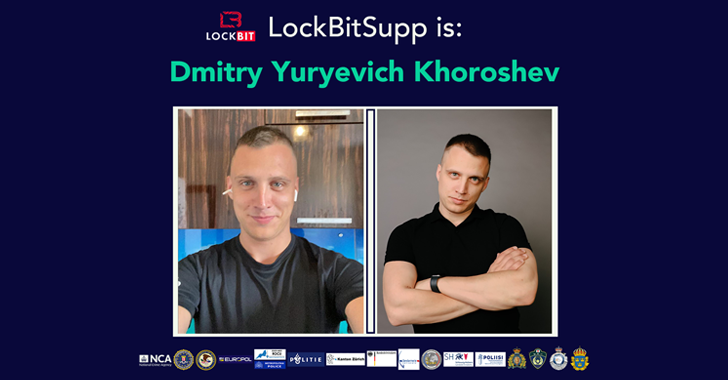
Russian Hacker Dmitry Khoroshev Unmasked as LockBit Ransomware Administrator

Russian Hacker Dmitry Khoroshev Unmasked as LockBit Ransomware Administrator

May 07, 2024 Ransomware / Cybercrime
The U.K. National Crime Agency (NCA) has unmasked the administrator and developer of the LockBit ransomware operation, revealing it to be a 31-year-old Russian national named  Dmitry Yuryevich Khoroshev . In addition, Khoroshev has been sanctioned  by the U.K. Foreign, Commonwealth and Development Office (FCD), the U.S. Department of the Treasury’s Office of Foreign Assets Control (OFAC), and the Australian Department of Foreign Affairs. Europol, in a  press statement , said authorities are in possession of over 2,500 decryption keys and are continuing to contact LockBit victims to offer support. Khoroshev, who went by the monikers LockBitSupp and putinkrab, has also become the subject of asset freezes and travel bans, with the U.S. Department of State offering a reward of up to $10 million for information leading to his arrest and/or conviction. Previously, the agency had  announced  reward offers of up to $15 milli...
APT42 Hackers Pose as Journalists to Harvest Credentials and Access Cloud Data

APT42 Hackers Pose as Journalists to Harvest Credentials and Access Cloud Data

May 07, 2024 Cyber Espionage / Malware
The Iranian state-backed hacking outfit called  APT42  is making use of enhanced social engineering schemes to infiltrate target networks and cloud environments. Targets of the attack include Western and Middle Eastern NGOs, media organizations, academia, legal services and activists, Google Cloud subsidiary Mandiant said in a report published last week. "APT42 was observed  posing as journalists  and event organizers to build trust with their victims through ongoing correspondence, and to deliver invitations to conferences or legitimate documents," the company  said . "These social engineering schemes enabled APT42 to harvest credentials and use them to gain initial access to cloud environments. Subsequently, the threat actor covertly exfiltrated data of strategic interest to Iran, while relying on built-in features and open-source tools to avoid detection." APT42 (aka Damselfly and UNC788),  first documented  by the company...
China-Linked Hackers Used ROOTROT Webshell in MITRE Network Intrusion

China-Linked Hackers Used ROOTROT Webshell in MITRE Network Intrusion

May 07, 2024 Vulnerability / Network Security
The MITRE Corporation has offered more details into the recently disclosed cyber attack, stating that the first evidence of the intrusion now dates back to December 31, 2023. The attack, which  came to light last month , singled out MITRE's Networked Experimentation, Research, and Virtualization Environment (NERVE) through the exploitation of two Ivanti Connect Secure zero-day vulnerabilities tracked as CVE-2023–46805 and CVE-2024–21887, respectively. "The adversary maneuvered within the research network via VMware infrastructure using a compromised administrator account, then employed a combination of backdoors and web shells to maintain persistence and harvest credentials," MITRE  said . While the organization had previously disclosed that the attackers performed reconnaissance of its networks starting in January 2024, the latest technical deep dive puts the earliest signs of compromise in late December 2023, with the adversary dropping a Perl-based web shell ...
cyber security

AI Is Flooding Security with Bugs Nobody Proved

websiteSANSVulnerability / Artificial intelligence
Stephen Sims on why unproven AI findings pile up as a triage burden. Read the full SANS blog.
cyber security

Exploit Time Just Dropped From 30 Days to 30 Minutes

websiteRecoAI Security / SaaS Security
Download the 11-step checklist CISOs use to close exposure windows first.
New Case Study: The Malicious Comment

New Case Study: The Malicious Comment

May 07, 2024 Regulatory Compliance / Cyber Threat
How safe is your comments section? Discover how a seemingly innocent 'thank you' comment on a product page concealed a malicious vulnerability, underscoring the necessity of robust security measures. Read the full real-life case study  here .  When is a ‘Thank you’ not a ‘Thank you’? When it’s a sneaky bit of code that’s been hidden inside a ‘Thank You’ image that somebody posted in the comments section of a product page! The guilty secret hidden inside this particular piece of code was designed to let hackers bypass security controls and steal the personal identifying information of online shoppers, which could have meant big trouble for them and the company. The page in question belongs to a global retailer. User communities are often a great source of unbiased advice from fellow enthusiasts, which was why a Nikon camera owner was posting there. They were looking for the ideal 50mm lens and asked for a recommendation....
Google Simplifies 2-Factor Authentication Setup (It's More Important Than Ever)

Google Simplifies 2-Factor Authentication Setup (It's More Important Than Ever)

May 07, 2024 Online Security / Data Breach
Google on Monday announced that it's simplifying the process of enabling two-factor authentication (2FA) for users with personal and Workspace accounts. Also called 2-Step Verification ( 2SV ), it aims to add an extra layer of security to users' accounts to prevent takeover attacks in case the passwords are stolen. The new change entails adding a second step method, such as an authenticator app or a hardware security key, before turning on 2FA, thus eliminating the need for using the less secure SMS-based authentication. "This is particularly helpful for organizations using Google Authenticator (or other equivalent time-based one-time password (TOTP) apps)," the company  said . "Previously, users had to enable 2SV with a phone number before being able to add Authenticator." Users with hardware security keys have two options to add them to their accounts, including by registering a FIDO1 credential on the hardware key or by assigning a passkey...
⚡ Top Stories This Week
Expert Insights Articles Videos
Cybersecurity Resources