-->
#1 Trusted Cybersecurity News Platform
Followed by 5.20+ million
The Hacker News Logo
Subscribe – Get Latest News
Security Service Edge

The Hacker News | #1 Trusted Source for Cybersecurity News — Index Page

Microsoft Seizes 42 Malicious Web Domains Used By Chinese Hackers

Microsoft Seizes 42 Malicious Web Domains Used By Chinese Hackers

Dec 07, 2021
Microsoft on Monday announced the seizure of 42 domains used by a China-based cyber espionage group that set its sights on organizations in the U.S. and 28 other countries pursuant to a legal warrant issued by a federal court in the U.S. state of Virginia. The Redmond company attributed the malicious activities to a group it pursues as Nickel , and by the wider cybersecurity industry under the monikers APT15, Bronze Palace, Ke3Chang, Mirage, Playful Dragon, and Vixen Panda. The advanced persistent threat (APT) actor is believed to have been active since at least 2012. "Nickel has targeted organizations in both the private and public sectors, including diplomatic organizations and ministries of foreign affairs in North America, Central America, South America, the Caribbean, Europe and Africa," Microsoft's Corporate Vice President for Customer Security and Trust, Tom Burt, said . "There is often a correlation between Nickel's targets and China’s geopolitical int...
Latest Firefox 95 Includes RLBox Sandboxing to Protect Browser from Malicious Code

Latest Firefox 95 Includes RLBox Sandboxing to Protect Browser from Malicious Code

Dec 07, 2021
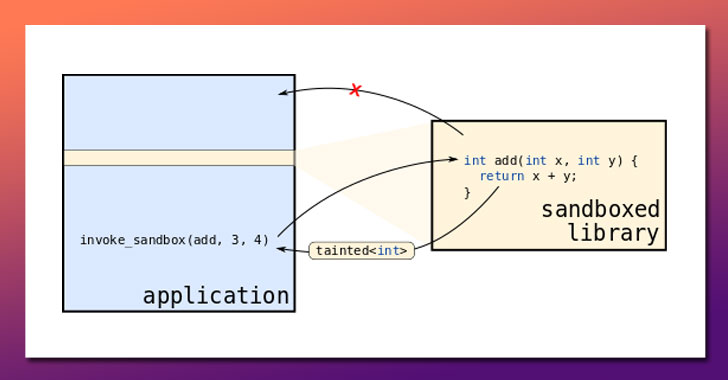
Mozilla is beginning to roll out Firefox 95 with a new sandboxing technology called RLBox that prevents untrusted code and other security vulnerabilities from causing "accidental defects as well as supply-chain attacks." Dubbed " RLBox " and implemented in collaboration with researchers at the University of California San Diego and the University of Texas, the improved protection mechanism is designed to harden the web browser against potential weaknesses in off-the-shelf libraries used to render audio, video, fonts, images, and other content. To that end, Mozilla is incorporating "fine-grained sandboxing" into five modules, including its  Graphite  font rendering engine,  Hunspell  spell checker,  Ogg  multimedia container format,  Expat  XML parser, and  Woff2  web font compression format. The framework uses  WebAssembly , an open standard that defines a portable binary-code format for executable programs that can be run on m...
Malicious KMSPico Windows Activator Stealing Users' Cryptocurrency Wallets

Malicious KMSPico Windows Activator Stealing Users' Cryptocurrency Wallets

Dec 06, 2021
Users looking to activate Windows without using a digital license or a product key are being targeted by tainted installers to deploy malware designed to plunder credentials and other information in cryptocurrency wallets. The malware, dubbed " CryptBot ," is an information stealer capable of obtaining credentials for browsers, cryptocurrency wallets, browser cookies, credit cards, and capturing screenshots from the infected systems. Deployed via cracked software, the latest attack involves the malware masquerading as KMSPico. KMSPico is an unofficial tool that's used to illicitly  activate  the full features of pirated copies of software such as Microsoft Windows and Office suite without actually owning a license key. "The user becomes infected by clicking one of the malicious links and downloading either KMSPico, Cryptbot, or another malware without KMSPico," Red Canary researcher Tony Lambert  said  in a report published last week. "The adversaries...
cyber security

GitLab Security Best Practices

websiteWizDevSecOps / Compliance
Learn how to reduce real-world GitLab risk by implementing essential hardening steps across the full software delivery lifecycle.
cyber security

Can AI Be Secure? Find Out at SANS 2026

websiteSANSCybersecurity Training
SANS Fellow, Mark Baggett explores threats, defense, & where AI security is heading.
Vulnerability Scanning Frequency Best Practices

Vulnerability Scanning Frequency Best Practices

Dec 06, 2021
So you've decided to set up a vulnerability scanning programme, great. That's one of the best ways to avoid data breaches. How often you should run your scans, though, isn't such a simple question. The answers aren't the same for every type of organization or every type of system you're scanning. This guide will help you understand the questions you should be asking and help you come up with the answers that are right for you. How often should vulnerability scans be run A lot of the advice below depends on what exactly you're scanning. If you're not sure about that yet - check out this comprehensive  vulnerability scanning guide . Once you've decided which systems should be in scope, and what type of scanner you need, you're ready to start scanning. So how often should you ideally be running vulnerability scans? Here are five strategies to consider, and we'll discuss in which scenarios they work best: Change-based Hygiene-based Complian...
Hackers Steal $200 Million Worth of Cryptocurrency Tokens from BitMart Exchange

Hackers Steal $200 Million Worth of Cryptocurrency Tokens from BitMart Exchange

Dec 06, 2021
Cryptocurrency trading platform BitMart has disclosed a "large-scale security breach" that it blamed on a stolen private key, resulting in the theft of more than $150 million in various cryptocurrencies. The breach is said to have impacted two of its hot wallets on the Ethereum (ETH) blockchain and the Binance smart chain (BSC). The company  noted  that the wallets carried only a "small percentage" of the assets." Hot wallets, as opposed to their cold counterparts, are connected to the internet and allow cryptocurrency owners to receive and send tokens. Blockchain security and data analytics company PeckShield  estimated  the total loss to be around $200 million, calling the whole chain of events as "Pretty straightforward: transfer-out, swap, and wash." "This security breach was mainly caused by a stolen private key that had two of our hot wallets compromised," BitMart's chief executive Sheldon Xia  said  in a series of tweets sent...
Expert Insights Articles Videos
Cybersecurity Resources